
Behind the Build: Custom Fabricating a Hi-Rail Scissor Lift Truck for New Jersey Transit (Project Case Study)

The email came in on a Tuesday morning last September. New Jersey Transit needed something that didn’t exist—a truck that could operate on both highway and rail, equipped with a scissor lift for overhead work, configured to meet both DOT highway specifications and Federal Railroad Administration requirements, and delivered in time for a critical infrastructure project starting in four months. Most custom fabrication experts would have politely declined. The complexity, the dual regulatory requirements, the timeline—any one of those factors makes a project challenging. All three together make it nearly impossible. We said yes. Not because we’re reckless or overconfident, but because this is exactly the type of problem our custom fabrication capabilities were developed to solve. Standard off-the-shelf equipment works for standard problems. When clients face unique challenges requiring tailored solutions, custom fabrication delivers real value. This is the story of that build—what made it complex, how we solved problems nobody had solved before, and what the finished product looks like in operation. The Initial Challenge Definition New Jersey Transit’s infrastructure team had identified a specific operational problem. They needed to perform routine inspection and maintenance on overhead catenary systems along commuter rail lines. The work involved checking wire tension, inspecting insulators, and performing minor repairs on electrical components suspended 18 to 22 feet above the tracks. Their current approach uses separate equipment for different aspects of the job. A hi-rail truck to access the rail line. A separate scissor lift positioned on a road crossing to reach overhead components. Coordination between crews. Equipment movements. Setup time. The inefficiency was obvious. So was the safety concern. Working around active rail lines requires extensive safety protocols. Every additional piece of equipment, every crew member, every movement increases risk and complexity. What they wanted was a single vehicle that could drive to the location on public roads, transition to rail operation, position itself on the tracks, and provide elevated work capability for technicians to access overhead systems—all with minimal crew size and setup time. That vehicle didn’t exist in any manufacturer’s catalog. Why This Build Was Technically Complex Creating a hi-rail scissor lift truck isn’t just a matter of bolting a scissor lift onto a hi-rail chassis. Every aspect of the design creates technical challenges that require careful engineering. Dual Operating Environment Requirements The truck needs to meet Federal Motor Vehicle Safety Standards (FMVSS) for highway operation. It must be licensed, insured, and operated legally on public roads. That means proper lighting, braking systems, weight distribution, and crash safety features. It also needs to meet Federal Railroad Administration requirements for on-track equipment. That means hi-rail wheels that properly engage rail, braking systems that work in rail mode, railroad lighting and warning signals, and dead-man switches to prevent runaway equipment. These two regulatory frameworks weren’t designed to work together. They evolved separately in different environments. Making a vehicle that satisfies both sets of requirements simultaneously requires deep knowledge of beach and creative problem-solving when they conflict. Weight and Balance Considerations A scissor lift extending 20 feet into the air, with a worker and tools on the platform, creates an enormous overturning moment. The truck’s center of gravity shifts dramatically when the lift is deployed and extended. This requires careful calculation of weight distribution, strategic placement of ballast, and the engineering of stabilization systems that are specifically designed for the rail environment. Power System Requirements A scissor lift requires substantial hydraulic power. Raising and lowering the platform, extending outriggers, and maintaining position all demand consistent hydraulic pressure. The truck’s engine provides power, but it can’t run continuously during hours-long maintenance operations. That would waste fuel, create excessive noise, and produce emissions in enclosed or semi-enclosed rail environments. The Design Phase We started with extensive consultation with New Jersey Transit’s engineering team. Our goal was to understand not just what they wanted, but why they wanted it and how it would be used in actual operations. Operational Requirements The truck needed to operate on roads for up to 50 miles between rail access points. That meant a comfortable cab configuration, highway-appropriate speed capability, and fuel efficiency for extended driving. Once at a rail access point, it needed to transition from highway to rail mode in under five minutes with a single operator. The previous hi-rail equipment that New Jersey Transit operated required 15 to 20 minutes to transition, with multiple crew members. On the rail line, the truck would travel at slower speeds (typically 5 to 15 MPH) over distances of up to 3 miles between work locations. At each work location, the scissor lift needed to deploy, extend to working height, and provide a stable platform for technicians in under ten minutes. Previous procedures using separate equipment required 30 to 40 minutes of setup. The lift platform needed a 500-pound capacity to accommodate two technicians plus tools and materials. The platform needed sufficient size for workers to move and position themselves for various tasks. Environmental Considerations The truck would operate year-round in New Jersey weather conditions. That means summer heat exceeding 95°F, winter cold below 20°F, rain, snow, and high winds. All hydraulic systems, electrical systems, and mechanical components needed to function reliably across this temperature range. Operators couldn’t be expected to perform complex maintenance in the field when systems failed due to weather. The cab needed heating and air conditioning for operator comfort during potentially hours-long positioning and monitoring activities. Maintenance and Service Requirements New Jersey Transit operates a fleet of specialized vehicles. They have maintenance facilities and trained technicians, but they’re not equipped to support highly customized one-off equipment that requires unique parts or specialized knowledge. The design needed to use standard components wherever possible. Hydraulic cylinders, pumps, valves, and fittings should be readily available from standard suppliers. Custom components should be limited to areas where standard parts genuinely wouldn’t work. Budget Parameters New Jersey Transit provided a budget range for the project. They weren’t looking for the cheapest possible solution, but they also couldn’t justify spending unlimited funds on
Cone Truck vs. Manual Placement: The Real Cost Analysis DOT Supervisors Need to See

A Pennsylvania DOT crew spent 47 minutes setting up a lane closure on I-80 last summer. Two workers carried cones from a flatbed truck, placed them in position, and returned to their vehicle. Standard procedure. They’ve done it a thousand times. Here’s the cost analysis of those 47 minutes: two workers at full pay plus benefits for nearly an hour, a work truck positioned in a potentially hazardous location for the entire setup period. Traffic is exposed to workers carrying cones across travel lanes. Forty-seven minutes of roadway capacity were reduced because the lane was closed during setup, even though no actual construction work was happening yet. The crew didn’t count any of this as cost because it’s just how cone placement gets done. It’s the way it’s always been done. The real cost was invisible. A cone truck does the same lane closure in eight minutes with one operator who never leaves the vehicle. The difference is 39 minutes per deployment, which may seem minor until you multiply it by hundreds of deployments per season. This is the analysis most DOT supervisors have never seen because manual cone placement isn’t measured as a cost center. It’s just background operational overhead. But when you actually calculate the costs of manual versus automated placement, the numbers are striking. The True Cost of Manual Cone Placement Let’s start with the baseline: what does manual cone placement actually cost per deployment? Direct Labor Manual cone placement requires at least two workers. One worker placing cones while another remains with the truck creates an unacceptable safety risk. OSHA and most state DOT safety protocols require two workers performing the task together. Average loaded labor cost (wages plus benefits, workers’ compensation, unemployment insurance, payroll taxes) for DOT highway workers ranges from $38 to $52 per hour,r depending on the state and worker classification. We’ll use $45 as a reasonable middle estimate. Vehicle Costs Manual deployment requires a truck to be positioned in or adjacent to the work zone for the entire placement process. This is typically a flatbed or dump truck carrying the cones. The truck is actively involved in cone deployment for 42 minutes, plus the 42-minute retrieval, totaling 84 minutes (1.4 hours). That’s $42 in vehicle costs per work zone setup. Equipment Costs The cones themselves wear out and need to be replaced. A quality channelizing cone costs $18 to $25. The lifespan varies dramatically based on usage, but it figures to be 18 to 24 months of active use before they need replacement. A cone used 150 times per year over two years sees 300 deployments. At $20 per cone and 300 uses, that’s about seven cents per deployment per cone. For a 40-cone deployment, that’s $2.80 in cone depreciation per work zone setup. This seems minor until you multiply it across all your annual deployments. Safety Equipment and PPE Workers deploying cones need high-visibility clothing, safety boots, hard hats, gloves, and other PPE. The cost per worker is about $400 annually for a complete PPE kit with regular replacement of worn items. A worker who spends 20% of their time on cone deployment activities is using $80 worth of PPE annually for cone-related work. Spread across roughly 400 work zone setups per year, that’s 20 cents per setup per worker, or 40 cents for two workers. Traffic Control and Safety TMA truck operating cost, including operator, runs about $85 per hour all-in. If the TMA truck is positioned for the entire 84-minute cone deployment and retrieval cycle, that’s $119 in TMA truck cost per work zone setup. Some manual operations don’t use a TMA truck for every cone deployment, instead relying on less expensive upstream warning configurations. But best safety practice increasingly requires TMA protection during manual cone placement, and that’s the standard we should strive for. The Hidden Costs Nobody Calculates Injury Risk and Workers Compensation The incident rate for highway workers involved in traffic control activities is roughly 4.2 incidents per 100 full-time equivalent employees per year, according to Bureau of Labor Statistics data. That’s significantly higher than the 2.8 incident rate for all construction workers. A single serious injury can cost $50,000 to $200,000 in direct workers’ compensation costs, plus indirect costs of investigation, replacement worker training, lost productivity, and increased insurance premiums. Even minor injuries—a worker struck by a slow-moving vehicle, a slip and fall while deploying cones—cost thousands in medical expenses and lost time. Spread across five years and 2,000 total deployments, that’s $37.50 per deployment in expected injury cost. That might seem like statistical abstraction until you’re the one dealing with an injured worker and filling out incident reports. Supervisor Time and Coordination Manual cone deployment requires coordination. Someone needs to verify that cones are positioned correctly, that spacing meets specifications and that the work zone configuration matches the approved traffic control plan. This typically involves supervisor oversight. A crew supervisor making $58 per hour, with loading taking 10 minutes per work zone to check cone placement, represents $9.67 in supervisor time per deployment. Multiply that across hundreds of deployments, and you’ve got significant supervisor time devoted to verifying manual work. Deployment Speed and Traffic Impact Manual cone placement takes longer, leaving the roadway partially configured for a longer period. Either you’re closing a lane before all cones are in place (creating confusion for motorists), or you’re placing cones with workers exposed to traffic before the lane is officially closed. Fatigue and Repetitive Stress Workers placing 40 cones per deployment, multiple deployments per day, day after day, accumulate significant physical stress. Each cone weighs 7 to 10 pounds. Carrying it from the truck, placing it, returning for the next one, repeat forty times, then do it again in reverse at the end of the shift. That’s 600 to 800 pounds of cones moved per work zone setup. Do that four times a day, and workers are handling over 3,000 pounds of cones. It’s physically demanding work that contributes to fatigue and long-term repetitive stress
New MUTCD Updates 2026: How Recent Highway Safety Regulations Affect Your Attenuator Truck Fleet

The Manual on Uniform Traffic Control Devices isn’t exactly bedtime reading. Most contractors know the MUTCD exists, know it matters, and know they’re supposed to comply with it. Beyond that, the details get fuzzy. That approach worked fine when updates came out every few years with minor tweaks. But the MUTCD 2026 updates aren’t minor tweaks. Substantial changes are affecting how TMA trucks must be equipped, configured and deployed in work zones. If you’re operating crash trucks under the old assumptions, you’re potentially running non-compliant equipment. That’s not just a paperwork problem. That’s a liability exposure that could cost you contracts, expose you to citations, and—in the worst case—undermine your legal position if there’s an incident in your work zone. What Actually Changed in the 2026 MUTCD Update The Federal Highway Administration released the 2026 MUTCD revisions in December 2025, with most provisions taking effect in early 2026. State DOTs have some flexibility in adoption timing, but the trend is toward faster implementation than previous updates. The changes affecting TMA trucks fall into several categories. Some are about equipment specifications, others are related to operational procedures and documentation. All of them matter if you’re operating attenuator trucks on federally funded projects or state highways. Enhanced Visibility Requirements for Shadow Vehicles Previous MUTCD standards specified minimum requirements for warning lights and reflective markings on TMA trucks. The language was prescriptive but left room for interpretation. The 2026 update tightens these requirements significantly. The specific requirement is for warning lights with minimum candela ratings at specified angles. Most older light bars don’t meet the new photometric standards. The lights physically illuminate, but they don’t produce enough light intensity at the required angles to meet the standard. You can’t just look at lights and tell whether they’re compliant. You need photometric test data from the manufacturer showing the lights meet the current MUTCD specifications. Reflective sheeting requirements have also increased. The previous standard required certain amounts of reflective material but didn’t specify reflectivity values with precision. The 2026 standard specifies ASTM D4956 Type XI reflective sheeting for specific applications on TMA trucks. Type XI is a higher-performance material than what most trucks currently have installed. It provides better reflectivity at the wider entrance angles common in work zone approaches. Attenuator Performance Standards and Testing Requirements The MUTCD has always referenced crash testing standards for attenuators, but the 2026 update changes how those standards are applied and verified. First, there’s now a service life maximum for attenuator cartridges. Even if a cartridge has never been impacted, it must be retired after ten years from the date of manufacture. This recognizes that materials degrade over time regardless of use. A 12-year-old attenuator that’s been sitting unused hasn’t been crash-tested at that age. The certification testing was done on new equipment. For contractors running older trucks, this is a significant issue. A truck with a 2014-manufactured attenuator must have that attenuator replaced by 2024, which means it should already have been replaced. If you’re rolling into the 2026 construction season with attenuators manufactured before 2016, you’re running out-of-compliance equipment. The verification requirements have also changed. Previously, contractors could maintain records showing when attenuators were installed and provide manufacturer certification. The new standard requires serial-number tracking and verification that specific attenuators on specific trucks meet current crash-test standards. This prevents situations where someone swaps an old attenuator from a retired truck onto a newer truck without proper documentation. Work Zone Intrusion Alert System Requirements This is entirely new territory. The 2026 MUTCD doesn’t just recommend work zone intrusion alert systems—it requires them for specific types of operations. Any work zone on a limited-access highway with posted speeds of 55 mph or higher must have an active intrusion alert system. This typically refers to systems that detect vehicles entering the work zone and alert workers with visual or audible signals. For TMA trucks, this requirement applies when the truck is positioned as the primary protective measure. The truck itself must have intrusion detection capability that alerts the operator when a vehicle approaches at an unsafe speed or trajectory. The technology has existed for years, but it was optional. Now it’s mandatory for certain applications. The systems range from relatively simple radar-based detection to sophisticated camera-based systems with AI processing. Costs start at around $3,500 for basic systems and can reach $12,000 or more for advanced installations. Documentation and Inspection Requirements The 2026 MUTCD significantly expands documentation requirements for TMA trucks operating in compliant work zones. This isn’t about the equipment itself—it’s about proving your equipment meets the standards. Every TMA truck must now have an equipment compliance folder maintained either physically in the truck or electronically accessible by the operator. This folder must include: Current certification documents for the attenuator system, including manufacturer specs and crash test reports. The serial number on the certification must match the serial number of the actual attenuator installed on the truck. Operator training records showing that anyone operating the truck has completed MUTCD-compliant work zone safety training within the past two years. This training must be documented with specific curriculum topics covered and trainer certification information. Photometric test results for all lighting systems, demonstrating compliance with the candela requirements at specified angles. This is new and catches many contractors off guard. Most people don’t have photometric test data for their lights because it was never required before. For many contractors, assembling this documentation means going back to manufacturers and suppliers to obtain specification sheets and test reports that should have been provided initially but weren’t. It means implementing maintenance documentation systems if you haven’t been keeping detailed records. It means scheduling and documenting training even if your operators have years of experience. The Compliance Cost Analysis Let’s break down what it actually costs to bring a typical 2020-standard TMA truck into full compliance with the 2026 MUTCD. Attenuator replacement: If your attenuator is approaching or past its 10-year service life, replacement costs $18,000 to $ 28,000, depending on the specific model
Why Renting Highway Safety Equipment is Bankrupting Mid-Size Contractors (And When Buying Actually Makes Sense)

Last month, I sat down with a contractor who’d been in business for twelve years doing highway work across three states. Good reputation, steady work, experienced crews. He showed me his equipment rental invoices from the previous year and nearly fell out of his chair when we added them up. $147,000 just for TMA trucks and related safety equipment rentals. Not total project costs – just rentals. We did the math on buying vs. renting, showing what it would have cost him to own that equipment instead. Even after accounting for the purchase price, insurance, maintenance, storage, and everything else, he would have saved roughly $65,000 that year. One year. He’d been doing this for over a decade, which meant he’d probably flushed somewhere north of half a million dollars down the rental drain when he could have owned the equipment outright after year two. Here’s the thing, though – I’ve also seen contractors rush out and buy equipment when they absolutely should have kept renting. They tie up capital in trucks that sit idle half the year, discover maintenance costs they weren’t prepared for, and end up in worse financial shape than if they’d just paid rental fees. The rental-versus-purchase decision for highway safety equipment isn’t straightforward. There’s no universal answer that works for every contractor. But there are clear patterns in who benefits from owning versus renting, and most mid-size contractors fall squarely into the category where ownership makes overwhelming financial sense – yet they keep renting anyway because nobody’s done the actual math, or they’re afraid of the upfront investment. I’m going to walk you through the real costs of both approaches, show you exactly when buying pays off, explain the hidden expenses that sabotage the economics of renting, and give you a framework for making this decision based on your actual situation rather than on gut feeling or industry assumptions. The Rental Trap: How Those “Reasonable” Daily Rates Add Up Rental rates for highway safety equipment look reasonable when quoted per day. A TMA attenuator truck might be rented for $450- $650 per day, depending on the market and equipment specifications. That doesn’t sound wild when you’re bidding on a project. You factor it into your costs, mark it up appropriately, pass it through to the client, and move on. The problem shows up when you start tracking annual utilization. Most mid-size highway contractors doing steady traffic control work have equipment on rent for 150-250 days per year across their various projects. Let’s use 180 days as a reasonable middle estimate for a contractor running consistent highway work. At an average rental rate of $500 per day, that’s $90,000 per year for one TMA truck. If you need two trucks to handle simultaneous projects or larger jobs, you’re at $180,000 annually. Add in cone trucks, arrow boards, message signs, and other safety equipment rentals, and you can easily hit $200,000-$300,000 in annual rental expenses for a mid-size operation. Now here’s where it gets painful. Those rental costs are pure expenses. You’re paying for the privilege of using someone else’s equipment. At the end of the year, you have nothing to show for that $90,000 except completed projects. The equipment goes back to the rental company. You start the next year from zero, needing to rent equipment all over again at rates that typically increase 3-5% annually. Compare buying vs renting. A quality used TMA truck in good condition runs $60,000-$85,000. A new one costs $100,000-$150,000, depending on specifications and features. Even at the high end, you’re looking at less than two years of rental costs. After that initial investment, your per-day cost of ownership drops dramatically to just maintenance, insurance, and depreciation. The Hidden Rental Costs Nobody Talks About The daily rental rate is just the beginning. Rental agreements come with a bunch of additional costs that don’t show up in the advertised price but absolutely show up on your invoice. Delivery and pickup fees are standard. Depending on the distance, you might pay $200- $500 each way to transport equipment to and from your project site. That’s $400-$1,000 per rental period that doesn’t show up in the “daily rate” marketing. For a contractor running multiple projects, these transportation fees add up to thousands of dollars annually. Damage waivers and insurance are usually optional but recommended. If you decline coverage and something happens to the equipment, you’re liable for repair costs or replacement value. If you take the coverage, add 10-15% to your daily rate. Most contractors take the coverage because the risk of a $50,000+ loss from a damaged attenuator system isn’t worth gambling on. Minimum rental periods mean you often pay for more days than you actually need. A project that really needs equipment for 8 days gets billed for a full week plus the partial second week, which might get rounded up to two weeks, depending on the rental agreement terms. You end up paying for equipment that sits idle while you wait for your project schedule. When Renting Actually Makes Sense Understanding when to rent versus buy requires an honest assessment of your business situation. Low-utilization operations should be rented. If you do highway work occasionally – maybe 30-50 days per year – the economics of ownership don’t work. You’re not using the equipment enough to justify the fixed costs of ownership. Your rental costs might be $15,000-$25,000 annually, which is less than the annual ownership costs after accounting for depreciation. The breakeven point on utilization is typically around 80-100 days per year. Below that threshold, renting makes sense. Businesses in growth or transition phases often benefit from rental flexibility. If you’re not sure what your work volume will look like next year, committing to equipment purchases is risky. Rental lets you scale up or down based on actual project demand without being stuck with underutilized assets. Specialized equipment for occasional use should be rented. Maybe you need a hi-rail truck for one project per year, or specialized lift equipment for a
Electric vs. Diesel TMA Trucks: The Real ROI Nobody’s Talking About for Highway Contractors in 2026

Every equipment dealer and manufacturer wants to sell you on electric TMA trucks right now. They’ll show you glossy brochures with impressive torque numbers, zero-emissions claims, and fuel-savings calculators that make it look like you’re throwing money away by sticking with diesel. But here’s what they’re not telling you: the ROI calculation for an electric TMA truck is way more complicated than “electricity costs less than diesel, therefore you save money.” I’ve been watching contractors get burned by oversimplified electric vehicle pitches for the past three years. They buy into the hype, drop serious cash on electric equipment, and then six months later, they’re dealing with problems nobody warned them about. Range anxiety on projects far from charging infrastructure. Batteries that don’t hold a charge in cold weather. Charge times that leave equipment sitting idle when you need it working. Higher insurance premiums because repair shops don’t know how to work on electric drivetrains yet. Don’t get me wrong – electric TMA trucks absolutely make sense for some contractors in some situations. The technology has come a long way, and for certain use cases, the numbers really do work out better than diesel. But the decision isn’t as simple as “electric good, diesel bad” like the sales guys want you to believe. You need to run the actual numbers for your specific operation, projects, and market conditions. So let’s cut through the marketing nonsense and talk real numbers. What does an electric vs diesel attenuator truck comparison actually look like when you factor in everything – not just the stuff that makes electric look good, but all the hidden costs and operational realities that impact your bottom line? The Upfront Cost Reality Check Let’s start with the number that hits you first: purchase price. An electric TMA truck will cost you more upfront than a comparable diesel unit. How much more? That depends on the specific models, but you’re generally looking at a 30-50% premium for electric. A quality diesel TMA attenuator truck might run you $180,000-$220,000, depending on specs and configuration. The electric equivalent? You’re looking at $235,000-$310,000. That $55,000-$90,000 difference is real money that has to come from somewhere – either your capital budget, a larger loan, or higher equipment rental rates passed to clients. Here’s what actually determines if that upfront cost premium pays off: Annual utilization hours matter way more than anything else. If you’re running that TMA truck 2,000 hours per year on active highway projects, the fuel savings add up fast enough to justify the premium potentially. If you’re only using it 400 hours per year because highway work is a small part of your business, you’ll never make that money back. The equipment will be obsolete before the savings catch up to the extra upfront cost. Financing costs eat into electric’s advantage. That larger loan amount means higher monthly payments and more interest paid over the loan term. If you’re financing at 6% over five years, that extra $70,000 costs you an additional $11,000+ in interest alone. That’s $11,000 that has to come out of your fuel savings before you’re actually ahead. Depreciation curves haven’t been determined yet for electric highway equipment. We’ve got decades of data on how diesel TMA trucks hold their value. Electric? It’s anyone’s guess. The technology is changing fast enough that today’s electric trucks might be viewed as obsolete junk in five years when better battery tech comes out. Or they might hold value better because operating costs are lower. Nobody actually knows, which makes calculating the true total cost of ownership basically impossible. Fuel Costs: Where Electric Actually Wins Electricity is cheaper than diesel per mile or per hour of operation. That’s just math. But the actual savings depend on how you’re charging and what you’re paying for electricity. Best-case scenario: You’re charging at your own shop at commercial electricity rates of around $0.12- $0.15 per kWh. Your electric TMA truck uses roughly 2-3 kWh per mile at highway speeds (these trucks are heavy and not aerodynamic). That works out to about $0.24-$0.45 per mile in electricity costs. A diesel TMA truck getting 6-8 MPG at $4.00 per gallon of diesel costs you $0.50-$0.67 per mile in fuel. The electric saves you $0.15-$0.35 per mile. If you’re putting 12,000 miles per year on that truck, you’re saving $1,800-$4,200 annually on fuel. Over five years, that’s $9,000-$21,000 in savings. Decent, but not enough on its own to justify a $70,000 premium. Worst-case scenario: Your project sites are in areas without convenient charging infrastructure. You’re either running a generator to charge the electric truck (insanity, but I’ve seen it), paying premium prices at whatever charging you can find, or dealing with range limitations that require multiple charges per day. Now, electric is costing you more than diesel when you factor in time wasted, inconvenience costs, and premium charging rates. The fuel savings are real, but only if your operational reality aligns with the ideal charging scenario. If you’re doing urban or suburban highway work where you can charge at your shop overnight and projects are within a reasonable range, great. Maintenance: The Numbers Are Messier Than You Think This is where electric vehicle advocates really oversell things. The pitch is that electric drivetrains have fewer moving parts, no oil changes, no transmission maintenance, and therefore cost way less to maintain. In theory, that’s true. In practice with highway safety trucks? It’s complicated. What you actually save on with electricity: No oil changes, obviously. That’s $15-$300 per service, depending on the oil type and capacity. On a diesel TMA truck getting changed every 3,000-5,000 miles, you might do 3-4 oil changes per year. Call it $600- $1,200 in annual savings. No transmission maintenance. Diesel trucks have complex automatic transmissions that require fluid changes, filter replacements, and, eventually, expensive rebuilds. Over five years, you might spend $2,000-$4,000 on diesel transmission maintenance. Electric drivetrains don’t have traditional transmissions. Simpler cooling system. Fewer fluids to change, fewer pumps to fail, less complexity
The Hidden Cost of Highway Work Zone Fatalities: OSHA’s 2026 Compliance Crackdown

If you’re running highway construction projects in 2026, you’ve probably noticed OSHA isn’t playing around anymore. The fines are getting steeper, the inspections are getting more frequent, and the tolerance for outdated safety equipment is basically zero. But here’s what most contractors don’t realize until it’s too late – the real cost of highway work zone fatalities goes way beyond the initial OSHA penalty. We’re talking about project shutdowns, skyrocketing insurance premiums, wrongful-death lawsuits that can bankrupt a mid-size company, and a reputational hit that makes bidding on future contracts nearly impossible. OSHA work zone safety compliance is essential to ensure worker safety and to carry out actions with confidence. Let me paint you a picture. Last year, a contractor in Pennsylvania was slapped with a $436,000 OSHA fine after a work zone incident that could’ve been prevented with the proper placement of a TMA attenuator truck. The fine was just the beginning. Their insurance premiums tripled, they lost their pre-qualification status with the state DOT for 18 months, and three major clients terminated their contracts early. The total financial damage? North of $2.8 million. All because they were running old equipment that didn’t meet current OSHA work zone safety compliance standards. Why OSHA Is Coming Down Hard on Work Zone Safety in 2026 Highway work zone deaths keep going up, and the feds aren’t messing around anymore. The Bureau of Labor Statistics numbers tell a brutal story: 857 workers killed in roadway work zone incidents over the last two years. Every single one of those deaths left behind a devastated family. Everyone shut down a job site. The economic damage runs into hundreds of millions of dollars. OSHA saw those numbers and decided the kid gloves were coming off. They’ve completely overhauled how they inspect highway construction sites. Work zone traffic control and equipment standards are getting hammered now. Inspectors aren’t just walking through with clipboards anymore. They’re showing up with engineers. They’re out there with tape measures, checking stopping distances. They’re going through the traffic control plans line by line. Stuff that would’ve gotten you a warning in 2022? Now it’s a citation and a hefty fine. Regional OSHA offices got marching orders from the top: make highway work zones a priority. And they actually got the budget to do it. So what lit the fire under them? Politics played a big role. Federal infrastructure money is pouring into highway projects all over the country—billions of dollars. More projects mean more workers out there in traffic. More exposure to danger. More deaths. Congress wasn’t subtle about it either – show us you’re fixing the work zone safety problem, or we’ll cut your funding. OSHA got the message loud and clear. Here’s the part most people miss, though. Insurance companies are getting absolutely destroyed by wrongful death lawsuits. When a worker dies in a work zone, their family lawyers up and goes after everyone involved. The settlements are massive – often several million dollars per case. Insurance carriers started doing the math and realized they’re bleeding money on these claims. So they went to OSHA and basically said, “You need to enforce the rules harder because we can’t keep paying out like this.” When insurance money and federal oversight start working together, contractors are the ones who get caught in the middle. The Real Costs Nobody Warns You About Let’s break down what actually happens when OSHA catches you operating in a work zone where OSHA work zone safety compliance has not been met. The initial citation and fine are just the tip of the iceberg. Direct OSHA Penalties: Current willful violation fines max out at $156,259 per violation. Serious violations run $15,625 each. But here’s the kicker – they stack. If your TMA attenuator truck doesn’t meet MASH certification requirements, that’s one violation. Project Shutdown Costs: OSHA can issue stop-work orders for serious hazards. Your entire project stops immediately. Crews sit idle but still get paid. Equipment rental charges keep piling up. Your client starts assessing liquidated damages for every day you’re behind schedule. A three-day shutdown on a $5 million highway project can cost you $150,000-$300,000 in direct losses, and that’s before you factor in the domino effect on your other scheduled projects. Lost Bonding Capacity: Surety companies hate OSHA violations. Your bonding capacity – the total dollar amount of projects you can bond simultaneously – gets slashed. If you had $15 million in bonding capacity, you might drop to $8 million after a serious citation. That means you literally cannot bid on larger projects because you can’t get bonded. You’re stuck taking smaller jobs with thinner margins while your competitors eat your lunch on the profitable work. Pre-Qualification Nightmares: State DOTs and major private clients have gotten brutal about safety records. Most now require disclosure of OSHA citations within the past three years as part of pre-qualification. Some automatically disqualify contractors with willful violations. Others assign point systems that make your bids less competitive. New Jersey DOT, for example, can disqualify you from bidding on state contracts for up to three years after serious safety violations. In a state where 40% of highway work is state-funded, that’s a death sentence for many contractors. What OSHA Actually Checks When They Show Up Understanding what inspectors look for helps you know where your vulnerabilities are. OSHA doesn’t inspect randomly – they follow specific protocols, and highway work zones get the white-glove treatment. Equipment Certification and Maintenance: Your crash attenuator trucks better have current MASH certification documentation. Inspectors will ask to see it. They’ll also want maintenance records proving your equipment is in proper working condition. That TMA truck with the hydraulic leak you’ve been meaning to fix? That’s a citation. The attenuator that hasn’t been crash-tested or recertified after its last impact? That’s another citation. Keep detailed maintenance logs for every piece of highway safety equipment you own or rent. Traffic Control Plan Compliance: OSHA requires that your actual setup exactly match your approved traffic control plan.
TMA Truck Winter Operations: Cold Weather Challenges & Solutions 2026

Winter transforms highway work zones into some of the most challenging environments for maintaining worker safety. When temperatures plummet, snow blankets roadways, and ice creates treacherous conditions, the TMA trucks that protect utility crews, highway maintenance workers, and emergency responders face their toughest operational tests. Understanding how cold weather affects these critical safety vehicles—and knowing proven solutions to overcome winter challenges—means the difference between reliable protection and dangerous equipment failures when workers need it most. TMA truck winter operations are quite different from those in the summer. For organizations operating across the northern United States, winter isn’t just another season—it’s the most demanding period for traffic management attenuator systems. Power companies respond to storm-related outages affecting thousands of customers. Water utilities handle frozen pipe emergencies. Highway departments work around the clock, clearing snow and treating icy roads. Emergency services see accident rates spike on slippery highways. All this critical work takes place under conditions that push equipment and operators to their limits. The reality is that TMA truck winter operations’ cold-weather performance directly impacts worker safety, operational efficiency, and your organization’s ability to respond when communities need you most. This comprehensive guide draws on decades of real-world experience helping organizations maintain reliable attenuator truck operations under the harshest winter conditions. How Cold Weather Attacks TMA Truck Systems Understanding exactly how winter conditions affect different truck systems helps you anticipate problems and take preventive action before equipment fails in the field. Cold weather is remarkably effective at revealing and exploiting weaknesses in vehicle systems. Hydraulic Systems Face Viscosity Challenges The hydraulic systems controlling TMA deployment encounter immediate problems when temperatures drop. Hydraulic fluid thickens dramatically in cold weather, transforming from free-flowing liquid into something closer to molasses. This viscosity change creates multiple operational problems that compound as temperatures fall further. Pumps strain to move thickened fluid through lines and valves, sometimes overheating from the excessive workload. Deployment and retraction cycles that take seconds in warm weather may require minutes when the fluid is cold. Control valves respond sluggishly or not at all when fluid won’t flow freely through small passages. Seals designed for normal-viscosity fluid may leak when forced to handle thick, cold oil under high pressure. The solution starts with proper fluid selection. Winter-grade hydraulic oils maintain workable viscosity across temperature ranges from well above freezing down to 30 or even 40 degrees below zero Fahrenheit. These specialized fluids use different base stocks and additive packages than standard hydraulic oils, engineered specifically for cold-weather performance. Organizations serious about winter readiness convert their entire TMA fleet to cold-weather hydraulic fluid before winter arrives rather than waiting for problems to develop. Battery Systems Struggle with Cold Temperatures Battery chemistry works against you in cold weather—the electrochemical reactions generating electrical current slow dramatically as the temperature drops. A battery that provides robust cranking power at 70 degrees Fahrenheit might deliver only half that capacity at 0 degrees. Meanwhile, engine oil thickens, requiring more cranking power to turn the engine over. Cold weather creates the perfect storm—batteries produce less power precisely when engines need more. This problem intensifies for TMA trucks because of their operational profile. These vehicles often idle for hours during work zone deployments, slowly draining batteries without the benefit of highway driving that would fully recharge them. Cold weather accelerates this drain while simultaneously reducing the battery’s ability to accept charge from the alternator. After a long cold-weather deployment, operators sometimes discover their truck won’t restart—a serious problem when you need to relocate equipment or respond to another emergency quickly. Proper battery maintenance becomes absolutely critical for winter operations. Load testing before winter identifies weak batteries that might survive summer but will fail under cold-weather stress. Replacement is far less expensive than field failures during emergency response. Battery terminals must be spotlessly clean and properly tightened—resistance at the connections increases when available power is already reduced by cold. Some organizations invest in battery blankets or heating systems that maintain battery temperature during cold weather. These systems draw power from shore power when trucks are parked or from the vehicle’s electrical system during operation, keeping batteries warm enough to deliver full capacity even in extreme cold. While adding complexity and cost, they virtually eliminate cold-weather starting failures. Impact Attenuators Respond Differently in Cold The energy-absorbing materials inside TMA units—typically aluminum honeycomb structures, foam cartridges, or composite materials—have been engineered and tested to perform across wide temperature ranges. However, material properties do change with temperature. Some materials become slightly more brittle in extreme cold, potentially affecting their crushability and impact energy absorption. Traction and Handling Become Critical Concerns TMA trucks often operate in locations with marginal traction, even in good weather—on narrow shoulders, steep grades, or in tight work zones. Add snow, ice, and the weight distribution changes that come with deploying a rear-mounted attenuator, and you have a recipe for positioning difficulties or even getting stuck. All-season tires adequate for three-quarters of the year may prove insufficient for serious winter operations. Dedicated winter tires with aggressive tread patterns and rubber compounds formulated for cold temperatures deliver dramatically better traction on snow and ice. The investment in seasonal tire changes pays dividends in reduced incidents, fewer stuck trucks requiring recovery, and improved operator confidence when positioning in challenging locations. Tire chains provide another level of traction insurance for truly extreme conditions. While not practical for routine use, chains enable operation in snow depths or ice conditions that would otherwise make work impossible. TMA trucks should carry properly sized chains along with operators who know how to install them quickly when conditions warrant. Tire pressure monitoring becomes more important in winter because pressure drops significantly as temperatures fall. A tire properly inflated at 70 degrees might be 15% under-inflated at 10 degrees, reducing traction, increasing fuel consumption, and causing uneven wear. Daily pressure checks and adjustments should be standard practice throughout winter. Comprehensive Pre-Winter Preparation Protocols A systematic approach to pre-winter preparation addresses known vulnerabilities and positions your TMA fleet for reliable performance
Smart TMA Truck Technology 2026: AI, Telematics & Safety Innovations for Utility Work Applications

The landscape of highway work zone safety is experiencing a dramatic transformation in 2026, driven by artificial intelligence, advanced telematics systems, and innovative safety technologies integrated into modern TMA trucks. In 2026, the smart TMA truck technology is making sure things go smoothly on the highway. For utility companies, emergency responders, and highway maintenance crews, these technological advances aren’t just improving safety—they’re fundamentally changing how organizations approach roadside work protection and operational efficiency. The Evolution of TMA Truck Technology Truck-mounted attenuators have come a long way from their origins as simple impact-absorbing barriers. Today’s smart TMA trucks represent the convergence of crash-protection engineering, real-time data analytics, artificial intelligence, and connected-vehicle technology. These systems work together to create work zones that are safer, more efficient, and significantly more cost-effective than ever before. The traditional approach to work zone protection relied heavily on manual setup, human judgment, and reactive safety measures. Workers would arrive at a site, deploy traffic control devices, position the attenuator truck, and hope that approaching drivers would notice the warnings and slow down appropriately. This system worked reasonably well but had significant limitations—human error, inconsistent positioning, delayed response to changing conditions, and limited visibility into actual traffic patterns and risks. Artificial Intelligence Transforming Work Zone Safety Artificial intelligence has emerged as perhaps the most significant advancement in TMA trucks’ utility work applications. Modern AI systems integrated into attenuator trucks perform functions that were impossible just a few years ago, fundamentally changing how work zones operate and how safe they can be. Intelligent Traffic Pattern Recognition AI-powered camera systems mounted on TMA trucks continuously analyze approaching traffic, identifying patterns that indicate potential danger. These systems can detect vehicles traveling at unsafe speeds, erratic driving behavior suggesting distracted or impaired drivers, vehicles drifting toward the work zone, and changes in traffic density that might require adjusted positioning. When the AI identifies a high-risk situation, it immediately alerts the operator through visual and audible warnings, providing critical seconds of advance notice that can prevent incidents. The sophistication of these systems is remarkable. They don’t just detect vehicles—they analyze driving behavior with nuance that rivals human perception. The AI can distinguish between a vehicle that’s simply changing lanes and one that’s veering dangerously toward the work zone due to driver inattention. It recognizes the difference between normal traffic flow slowdown and the sudden deceleration pattern that suggests an impending rear-end collision upstream from the work zone. Predictive Risk Assessment Beyond real-time monitoring, AI systems analyze historical data to predict when and where high-risk situations are most likely to occur. By examining factors like time of day, weather conditions, traffic volume, road geometry, and past incident patterns, these systems help fleet managers and safety coordinators make informed decisions about resource deployment and work scheduling. Automated Impact Response When impacts do occur, AI systems instantly analyze the collision severity, automatically notify emergency services if needed, document the incident with video and sensor data, and provide immediate guidance to operators on appropriate response actions. This automated response reduces confusion during high-stress situations and ensures that critical steps aren’t overlooked in the aftermath of an incident. The documentation capabilities alone represent enormous value for fleet managers. Instead of relying on operator recollection and limited information to understand what happened during an incident, organizations now have comprehensive data that show exactly what occurred, how the TMA performed, and whether any procedural improvements could prevent similar situations in the future. Telematics Revolutionizing Fleet Management Advanced telematics systems have become standard equipment on modern TMA trucks, providing fleet managers with unprecedented visibility into vehicle operations, equipment performance, and safety compliance. For organizations operating multiple attenuator trucks across large service territories, these systems transform fleet management from educated guesswork into data-driven decision making. Real-Time Location and Status Monitoring Fleet managers can now view the exact location and operational status of every TMA truck in their fleet through intuitive dashboard interfaces accessible from any device. These systems show which trucks are currently deployed at work zones, in transit, available for assignment, or requiring maintenance or repairs. This real-time visibility enables dynamic resource allocation, ensuring that the right equipment is always available where it’s needed most. The operational efficiency gains are substantial. When an emergency call comes in requiring TMA protection, dispatchers can immediately identify the nearest available truck and route it to the site, significantly reducing response times. When work at one site completes earlier than expected, managers can quickly reassign that truck to another location rather than having it sit idle. Comprehensive Performance Analytics Modern telematics systems capture detailed data about every aspect of TMA truck operations, including deployment frequency and duration, fuel consumption and efficiency, impact events and severity, maintenance needs and schedules, operator behavior and compliance, and equipment utilization rates. This data provides actionable insights to optimize operations, reduce costs, and improve safety across the entire fleet. Predictive Maintenance Capabilities Rather than following fixed maintenance schedules regardless of equipment condition, smart TMA trucks now continuously monitor component health and predict when maintenance will be needed based on actual usage patterns and wear indicators. Sensors track hydraulic pressure in attenuator systems, monitor structural integrity of impact-absorbing components, measure electrical system performance, and assess mechanical wear on moving parts. Connected Vehicle Technology and V2X Communication Vehicle-to-everything (V2X) communication represents the next frontier in work zone safety, and 2026 is seeing rapid adoption of these technologies in TMA trucks. V2X enables attenuator trucks to communicate directly with approaching vehicles, other work-zone equipment, traffic management systems, and infrastructure such as smart traffic signals. When equipped with V2V capability, TMA trucks broadcast their position and status to nearby vehicles also equipped with compatible systems. Approaching drivers receive automatic alerts about the work zone ahead, well before they can see it visually, giving them more time to slow down and merge safely. This technology is particularly valuable in conditions of reduced visibility—at night, in fog or rain, or on curves where work zones aren’t visible until drivers are dangerously close. As more passenger
Beyond Highways: TMA Trucks in Utility, Rail & Emergency Applications 2026
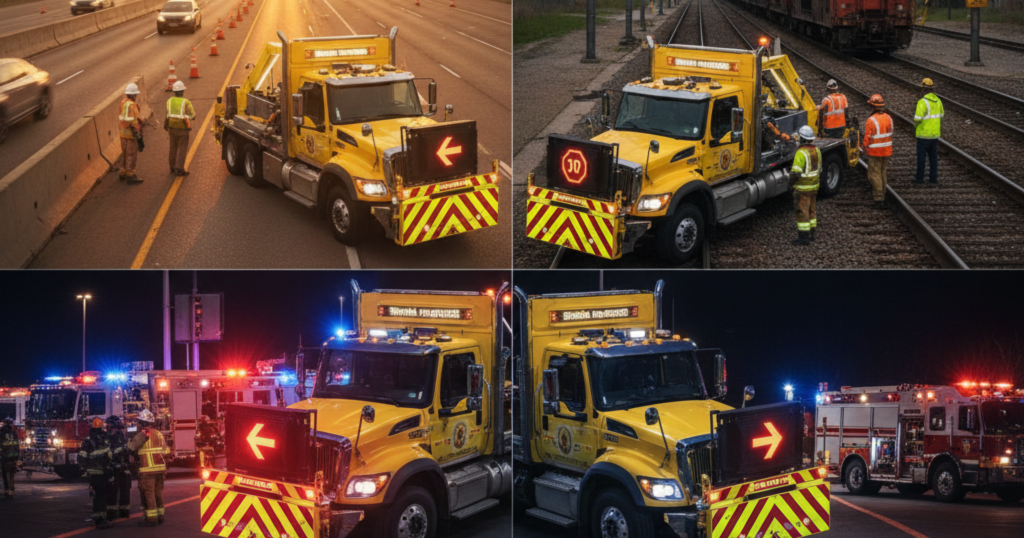
When most people think of TMA (Truck Mounted Attenuator) trucks, they picture orange-and-white vehicles protecting construction crews on Interstate highways. That mental image is accurate—but it’s only scratching the surface of what these versatile safety machines actually do. Walk through any utility yard in New Jersey, peek into a railroad maintenance facility in Pennsylvania, or observe an emergency response staging area in New York, and you’ll see TMA trucks hard at work in TMA trucks’ utility work applications that have nothing to do with traditional highway construction. These specialized vehicles protect workers in environments most people never see: beneath bridges during infrastructure inspections, alongside active railroad tracks during signal maintenance, inside industrial facilities during equipment installation, and at emergency scenes where every second counts. The reality is that TMA trucks’ utility work applications have expanded dramatically over the past decade. As workplace safety regulations have tightened and as organizations have recognized the life-saving value of mobile impact protection, TMA technology has migrated from highways into dozens of specialized applications. Utility companies depend on them for roadside pole work. Railroads can’t operate maintenance crews without them. Emergency responders deploy them at crash scenes and hazmat incidents. Industrial facilities use them during equipment moves and facility modifications. Let’s talk about this in detail here! Understanding TMA Technology Beyond Highway Applications Before diving into specific applications, let’s establish what makes TMA trucks valuable across such diverse work environments. The Core Protection Principle At its heart, a TMA truck provides mobile impact protection. The truck positions itself between workers and approaching traffic, absorbing collision energy if an errant vehicle strikes the work zone. The mounted attenuator system—essentially a sophisticated crash cushion—crushes in a controlled manner during impact, decelerating the striking vehicle while protecting both the work crew and the TMA truck occupants. This protection principle applies whether you’re on Interstate 287 or on a rural county road doing utility work. The physics of impact protection don’t change by location, which is precisely why TMA technology translates so effectively across diverse applications. Mobility as the Key Advantage Unlike stationary barriers or water-filled crash cushions, TMA trucks move with the work zone. When utility crews work their way down a street replacing poles, the TMA truck repositions every few hundred feet. When railroad maintenance moves from one signal location to the next, the hi-rail TMA truck travels right along the tracks. This mobility means continuous protection regardless of how frequently work locations change. For operations involving multiple short-duration work sites—which describes most utility, rail, and emergency applications—mobility is essential. Setting up and breaking down stationary barriers at each location would be impossibly time-consuming and expensive. Visibility and Warning Enhancement Beyond physical impact protection, TMA trucks provide crucial visibility enhancement. Their size, conspicuity striping, warning lights, and often-integrated arrow boards or message boards make work zones dramatically more visible to approaching traffic. This visibility component is particularly valuable in utility and emergency applications where work zones pop up unexpectedly in locations where motorists don’t anticipate encountering workers. The TMA truck’s presence draws the driver’s attention and prompts appropriate speed reduction and lane changes. Utility Company Applications Electric, gas, water, and telecommunications utilities represent one of the largest and fastest-growing segments of TMA truck deployment beyond traditional highway construction. Overhead Line Work and Pole Replacement Electric utilities replacing damaged poles or upgrading distribution lines work alongside active roadways constantly. These operations require bucket trucks, material staging, and work crews—all positioned in or adjacent to travel lanes. TMA trucks provide mobile protection as crews move from pole to pole. The attenuator truck positions downstream of the work site, protecting against errant vehicles while bucket truck operators focus on overhead work rather than watching for approaching traffic. Many utilities now require TMA protection for any pole work on roads with posted speeds above 35 mph or ADT (Average Daily Traffic) counts exceeding 2,000 vehicles. Underground Infrastructure Work Water utilities, sewer departments, and gas companies frequently excavate in roadways for main repairs, service line replacements, and infrastructure upgrades. These excavations create significant traffic hazards—open trenches, excavation equipment, material piles, and work crews all occupying travel lanes or shoulders. TMA trucks protect these work zones by positioning upstream of excavation sites. As work progresses along a street—common when replacing aging water mains or gas distribution lines—the TMA truck advances with the crew, maintaining consistent protection. For utilities, TMA trucks often provide better value than deploying and retrieving multiple crews to set up and take down traffic control devices at each location. One TMA truck can protect sequential work sites throughout a shift, with minimal setup and takedown time compared to traditional traffic control. Telecommunications and Fiber Optic Installation Telecommunications companies installing fiber optic networks work extensively in roadway right-of-ways. Boring equipment, splice vaults, and cable installation require protected work zones, often in locations with moderate-to-high traffic volumes. The mobile nature of fiber installation—progressing continuously along routes rather than remaining stationary for extended periods—makes TMA trucks an ideal protection solution. The truck advances as installation progresses, providing continuous protection without constant reconfiguration of traffic control. Many telecommunications contractors have added TMA trucks to their fleets specifically for fiber installation projects. The investment pays off through faster project completion (fewer hours spent on traffic control setup), improved safety records (fewer vehicle incursions into work zones), and better regulatory compliance. Emergency Utility Response When storms knock down power lines, or accidents damage gas mains, utilities must respond immediately—often in the dark, in bad weather, and amid chaotic traffic. These emergency responses can’t wait for an elaborate traffic control setup. TMA trucks deployed for emergency utility response provide immediate work zone protection. Crews arrive, position the TMA truck appropriately, and begin emergency repairs, confident that they have professional-grade impact protection between them and approaching traffic. Railroad and Hi-Rail Applications Railroad maintenance is a specialized TMA application that requires unique vehicle configurations—namely, hi-rail trucks capable of operating on both highways and railroad tracks. Track Maintenance Protection Railroad track maintenance crews replace rails, adjust switches, or repair
Highway Work Zone Safety Statistics: Fatalities & Prevention

The New York work zone fatalities statistics are sobering, and they’re getting worse. In 2025, New York State recorded 47 work zone fatalities—an 18% increase from the previous year. Across the tri-state area, including northern New Jersey, where SPA Safety Systems is based, another 31 workers lost their lives in highway construction zones. These aren’t just statistics. They’re fathers, mothers, sons, and daughters who left for work one morning and never came home. If you’re a contractor, project manager, or safety director working on New York highways, these numbers should keep you up at night. Because behind every fatality is a cascade of consequences: a family destroyed, a company facing potential criminal charges, insurance costs that can bankrupt smaller operations, and the psychological trauma that ripples through entire crews who witnessed something no one should ever see. This comprehensive analysis examines what’s happening on New York roadways in 2026, why work zone fatalities continue climbing despite decades of safety improvements, which corridors present the highest risks, what regulatory changes NYSDOT implemented this year, and, most importantly, what actually works to keep workers alive when you’re operating on some of the most dangerous highways in America. The Disturbing Reality: New York Work Zone Deaths Are Rising The 47 work zone fatalities recorded in New York during 2025 represent the highest annual total since 2018. Even more concerning, preliminary data from the first quarter of 2026 suggests this trend isn’t reversing. Between January and March 2026, New York already recorded 14 work zone deaths, putting the state on pace for potentially 55-60 fatalities by year’s end if current trends continue. Compare this to a decade ago. In 2016, New York recorded 32 work zone fatalities. We’ve seen a 47% increase over ten years despite significant investments in safety technology, training programs, and enforcement efforts. Something fundamental isn’t working, and understanding why requires looking beyond simple explanations. The demographics of victims tell an important story. Contrary to what many assume, the majority of work zone fatalities aren’t construction workers—they’re motorists and passengers in vehicles that crashed in work zones. Of the 47 deaths in 2025, 29 were vehicle occupants, 14 were construction workers, and 4 were pedestrians or cyclists who entered work zones. This distribution matters because it reveals that work zone safety isn’t just about protecting workers from traffic—it’s about preventing the crashes that kill everyone involved. Geographic concentration reveals patterns that should inform where we focus resources. Three corridors accounted for 43% of all New York work zone fatalities in 2025: The I-95 corridor through the Bronx, Westchester, and into Connecticut claimed 9 lives. This stretch carries some of the highest traffic volumes in the nation—over 150,000 vehicles daily in some sections. Work zones on I-95 combine everything dangerous: high speeds, heavy truck traffic, frequent congestion that creates stop-and-go conditions where inattentive drivers rear-end slower vehicles, and limited space for protective buffers between workers and traffic. The Long Island Expressway (I-495) accounted for 7 fatalities. The LIE has earned its nickname “the world’s longest parking lot” because of chronic congestion, but that congestion creates a false sense of security. Traffic alternates between crawling gridlock and sudden high-speed flows when congestion clears. Drivers frustrated by delays take risks—aggressive lane changes, distracted phone use, speeding between bottlenecks—that turn deadly when work zones appear. The times when fatalities occur reveal important patterns about causation. Nighttime work zone deaths are disproportionately high relative to the amount of nighttime work performed. While only about 30% of highway work happens between 7 PM and 7 AM, these overnight hours account for 52% of work zone fatalities. Visibility limitations, driver fatigue, and higher rates of impaired driving at night all contribute to this disparity. Weather conditions factor into about one-third of work zone crashes. Rain, snow, fog, and ice don’t just make roads slippery—they reduce visibility of warning signs and traffic control devices, create conditions where drivers focus intensely on the road immediately ahead rather than watching for work zones, and encourage some drivers to follow vehicles ahead too closely because they can’t see far enough to maintain safe distances. Why New York’s Highways Are Particularly Dangerous New York presents unique challenges that make work zone safety harder than in many other states. Understanding these factors helps explain why our fatality rates exceed national averages and what strategies might actually work in our specific context. Proximity to urban centers means that many work zones have nowhere to stage equipment, store materials, or establish safe buffer zones. When you’re working on the Cross Bronx with buildings immediately adjacent to the highway, you can’t create the ideal 500-foot approach taper or position attenuator trucks with generous spacing. You work in constrained spaces where best practices must be adapted to physical reality. The sheer variety of work occurring on New York highways creates complexity that increases risk. On any given day, NYSDOT manages hundreds of active work zones across the state—everything from minor pothole patching to multi-year bridge reconstructions. Each project has different traffic control requirements, different hazards, and different contractors with varying safety cultures. This diversity makes standardization difficult and creates situations where motorists encounter different types of work zones in rapid succession, leading to confusion about what to expect. The Human Factor: Why Drivers Kill Workers While much attention focuses on work zone design, equipment, and regulations, the uncomfortable truth is that most work zone fatalities result from human error—specifically, drivers making bad decisions or losing attention at the worst possible moment. The psychological phenomenon called “inattentional blindness” explains why drivers sometimes literally don’t see work zones despite prominent warning signs. When drivers focus intensely on one task (like checking their phone or adjusting navigation), their brain effectively filters out other visual information. Multiple studies have shown that drivers looking directly at motorcycles, pedestrians, or warning signs sometimes have no conscious awareness of seeing them. Their eyes may have recorded the information, but their brain didn’t process it. This isn’t about intelligence or driving skill—it’s fundamental human neurology.