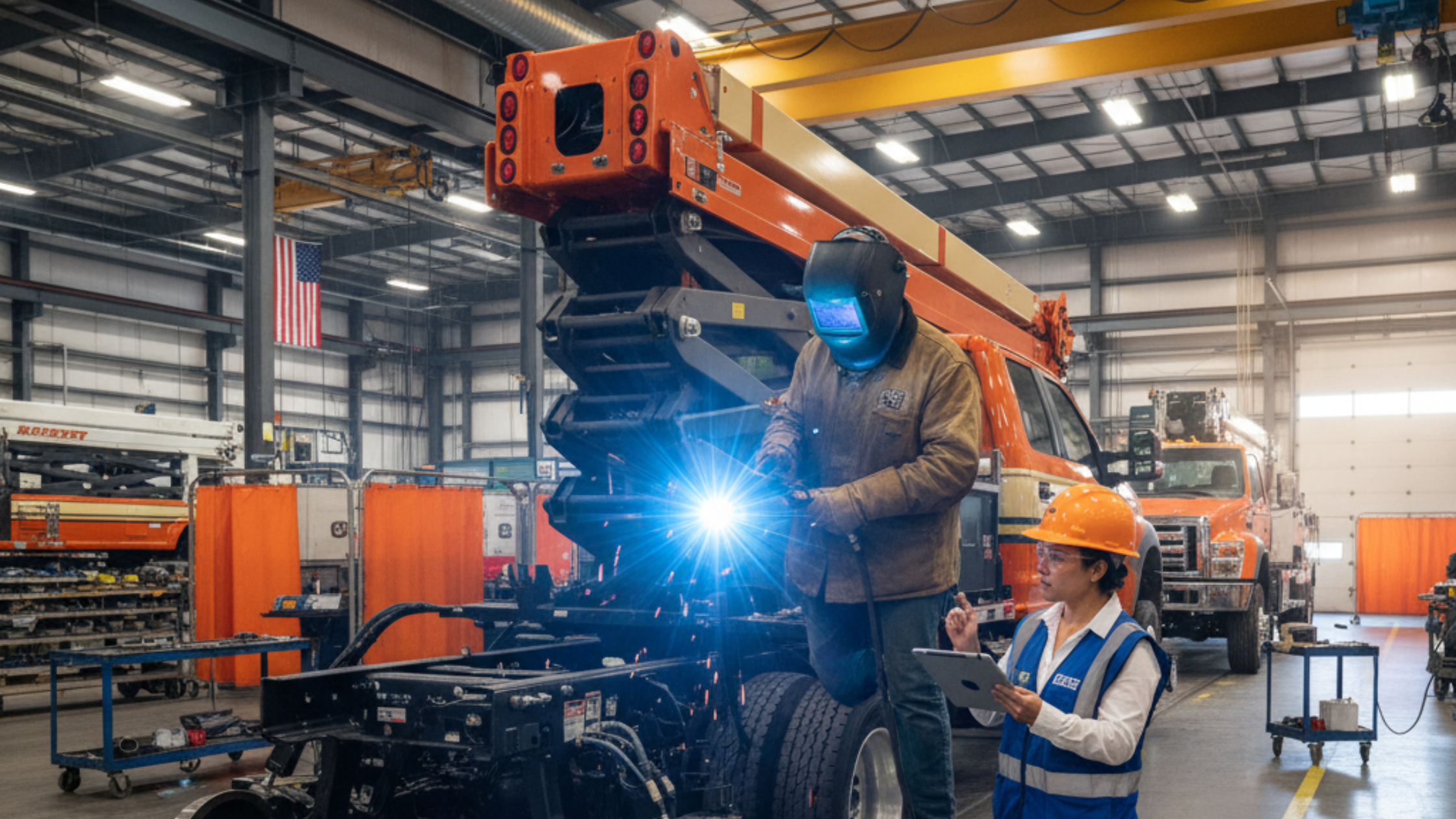
The email came in on a Tuesday morning last September. New Jersey Transit needed something that didn’t exist—a truck that could operate on both highway and rail, equipped with a scissor lift for overhead work, configured to meet both DOT highway specifications and Federal Railroad Administration requirements, and delivered in time for a critical infrastructure project starting in four months. Most custom fabrication experts would have politely declined. The complexity, the dual regulatory requirements, the timeline—any one of those factors makes a project challenging. All three together make it nearly impossible.
We said yes.
Not because we’re reckless or overconfident, but because this is exactly the type of problem our custom fabrication capabilities were developed to solve. Standard off-the-shelf equipment works for standard problems. When clients face unique challenges requiring tailored solutions, custom fabrication delivers real value.
This is the story of that build—what made it complex, how we solved problems nobody had solved before, and what the finished product looks like in operation.
The Initial Challenge Definition
New Jersey Transit’s infrastructure team had identified a specific operational problem. They needed to perform routine inspection and maintenance on overhead catenary systems along commuter rail lines. The work involved checking wire tension, inspecting insulators, and performing minor repairs on electrical components suspended 18 to 22 feet above the tracks.
Their current approach uses separate equipment for different aspects of the job. A hi-rail truck to access the rail line. A separate scissor lift positioned on a road crossing to reach overhead components. Coordination between crews. Equipment movements. Setup time.
The inefficiency was obvious. So was the safety concern. Working around active rail lines requires extensive safety protocols. Every additional piece of equipment, every crew member, every movement increases risk and complexity.
What they wanted was a single vehicle that could drive to the location on public roads, transition to rail operation, position itself on the tracks, and provide elevated work capability for technicians to access overhead systems—all with minimal crew size and setup time.
That vehicle didn’t exist in any manufacturer’s catalog.
Why This Build Was Technically Complex
Creating a hi-rail scissor lift truck isn’t just a matter of bolting a scissor lift onto a hi-rail chassis. Every aspect of the design creates technical challenges that require careful engineering.
Dual Operating Environment Requirements
The truck needs to meet Federal Motor Vehicle Safety Standards (FMVSS) for highway operation. It must be licensed, insured, and operated legally on public roads. That means proper lighting, braking systems, weight distribution, and crash safety features.
It also needs to meet Federal Railroad Administration requirements for on-track equipment. That means hi-rail wheels that properly engage rail, braking systems that work in rail mode, railroad lighting and warning signals, and dead-man switches to prevent runaway equipment.
These two regulatory frameworks weren’t designed to work together. They evolved separately in different environments. Making a vehicle that satisfies both sets of requirements simultaneously requires deep knowledge of beach and creative problem-solving when they conflict.
Weight and Balance Considerations
A scissor lift extending 20 feet into the air, with a worker and tools on the platform, creates an enormous overturning moment. The truck’s center of gravity shifts dramatically when the lift is deployed and extended.
This requires careful calculation of weight distribution, strategic placement of ballast, and the engineering of stabilization systems that are specifically designed for the rail environment.
Power System Requirements
A scissor lift requires substantial hydraulic power. Raising and lowering the platform, extending outriggers, and maintaining position all demand consistent hydraulic pressure.
The truck’s engine provides power, but it can’t run continuously during hours-long maintenance operations. That would waste fuel, create excessive noise, and produce emissions in enclosed or semi-enclosed rail environments.
The Design Phase
We started with extensive consultation with New Jersey Transit’s engineering team. Our goal was to understand not just what they wanted, but why they wanted it and how it would be used in actual operations.
Operational Requirements
The truck needed to operate on roads for up to 50 miles between rail access points. That meant a comfortable cab configuration, highway-appropriate speed capability, and fuel efficiency for extended driving.
Once at a rail access point, it needed to transition from highway to rail mode in under five minutes with a single operator. The previous hi-rail equipment that New Jersey Transit operated required 15 to 20 minutes to transition, with multiple crew members.
On the rail line, the truck would travel at slower speeds (typically 5 to 15 MPH) over distances of up to 3 miles between work locations.
At each work location, the scissor lift needed to deploy, extend to working height, and provide a stable platform for technicians in under ten minutes. Previous procedures using separate equipment required 30 to 40 minutes of setup.
The lift platform needed a 500-pound capacity to accommodate two technicians plus tools and materials. The platform needed sufficient size for workers to move and position themselves for various tasks.
Environmental Considerations
The truck would operate year-round in New Jersey weather conditions. That means summer heat exceeding 95°F, winter cold below 20°F, rain, snow, and high winds.
All hydraulic systems, electrical systems, and mechanical components needed to function reliably across this temperature range. Operators couldn’t be expected to perform complex maintenance in the field when systems failed due to weather.
The cab needed heating and air conditioning for operator comfort during potentially hours-long positioning and monitoring activities.
Maintenance and Service Requirements
New Jersey Transit operates a fleet of specialized vehicles. They have maintenance facilities and trained technicians, but they’re not equipped to support highly customized one-off equipment that requires unique parts or specialized knowledge.
The design needed to use standard components wherever possible. Hydraulic cylinders, pumps, valves, and fittings should be readily available from standard suppliers. Custom components should be limited to areas where standard parts genuinely wouldn’t work.
Budget Parameters
New Jersey Transit provided a budget range for the project. They weren’t looking for the cheapest possible solution, but they also couldn’t justify spending unlimited funds on a specialized vehicle.
The budget needed to account for design work, materials, fabrication labor, testing, regulatory approval costs, documentation, and training—the finished vehicle needed to deliver clear operational value relative to its cost.
The Build Process
Once the design was finalized and approved, fabrication began at our Flanders facility. The project took approximately 14 weeks from initial metalwork to final delivery.
Chassis Selection and Modification
We started with a commercial truck chassis appropriate for the weight and performance requirements—a medium-duty truck with sufficient GVW rating, adequate wheelbase for stability, and proven reliability.
The chassis required extensive modification. We reinforced the frame to handle the additional loads from the scissor lift and hi-rail system. Standard truck frames aren’t engineered for the lateral loads created by extended scissor lifts or the unique stress patterns of rail operation.
Reinforcement involved welding additional steel plating to specific areas of the frame, installing cross-bracing to enhance torsional rigidity, and modifying mounting points for specialized equipment.
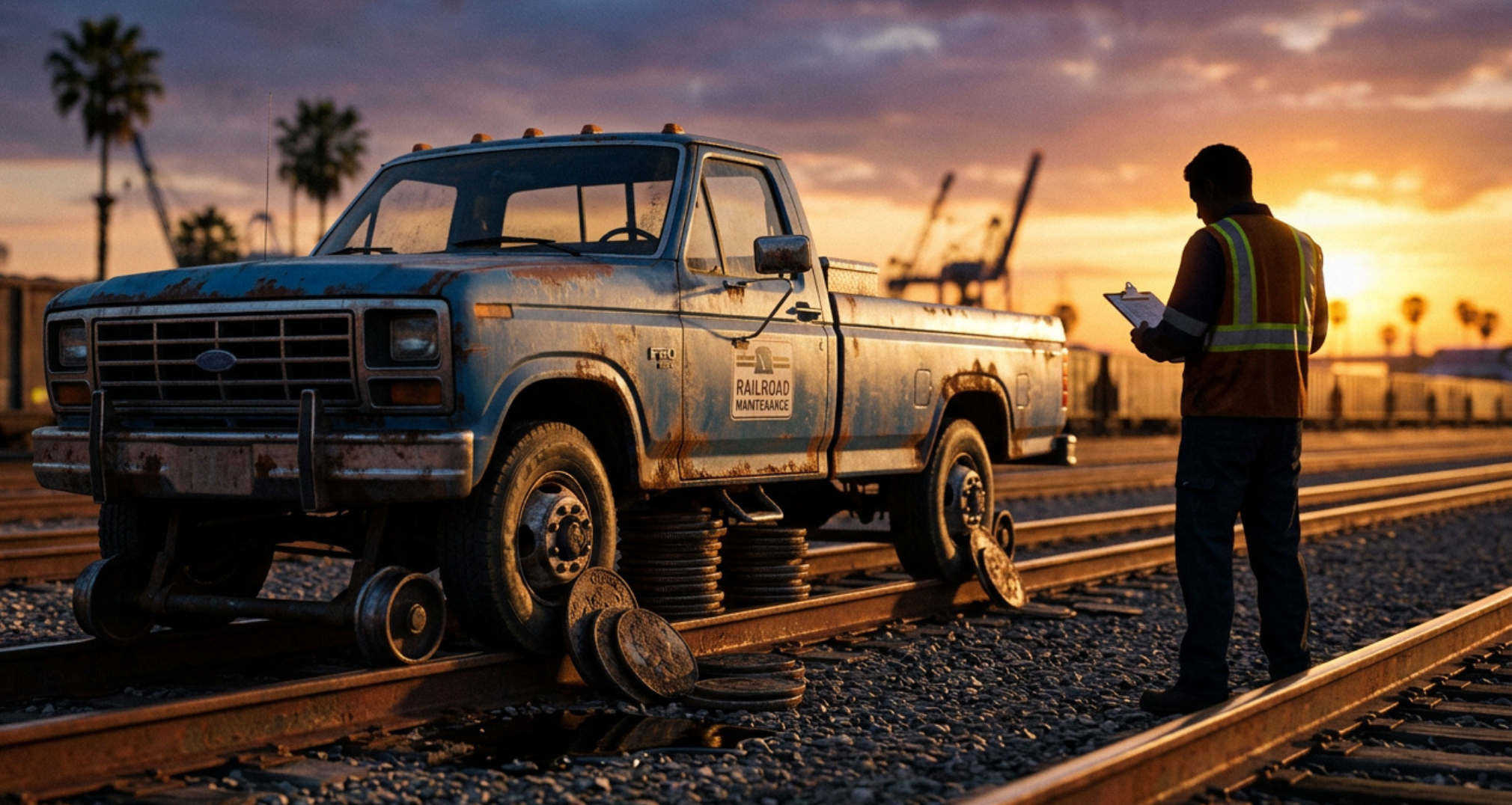
The hi-rail wheel system mounts to the truck frame and extends downward to engage the railroad tracks. This system includes hydraulic cylinders for raising and lowering the rail wheels, guide wheels that ensure proper tracking, and braking systems that work in rail mode.
Scissor Lift Integration
The scissor lift mechanism mounts to a turntable base installed in the truck bed. This allows the lift to rotate, positioning the platform where technicians need to work regardless of truck orientation.
We selected a scissor lift design with a 22-foot maximum platform height and 500-pound capacity. The lift mechanism itself came from an established manufacturer with proven reliability, but we modified the mounting system and integration for this specific application.
We fabricated the turntable from heavy-duty steel with precision bearings capable of handling multi-ton loads. The rotation mechanism uses a hydraulic motor for powered rotation or can be operated manually if hydraulic power is unavailable.
Stabilization outriggers deploy from the sides of the truck before the scissor lift extends. These outriggers significantly widen the truck’s effective base, preventing tipping when the lift is extended and loaded.
Hydraulic System Design
The hydraulic system is the heart of this truck’s functionality. It powers the hi-rail wheel deployment, scissor lift operation, turntable rotation, and outrigger extension.
We designed a system with primary and secondary circuits. The primary circuit operates directly from the truck’s engine-driven hydraulic pump. This circuit provides full power during active deployment and adjustment operations.
The secondary circuit includes a hydraulic accumulator—essentially a pressurized storage tank that maintains hydraulic pressure for extended periods without running the engine. The accumulator stores enough energy to operate the lift through an entire work cycle, with the engine only needing to run periodically to recharge it.
This design significantly reduces noise, fuel consumption, and emissions during extended work periods. Technicians working on overhead systems can operate in relative quiet without constant engine noise.
Electrical and Control Systems
The truck’s electrical system required substantial custom work. It needs to power standard truck functions (lights, instruments, accessories), specialized railroad equipment (warning lights, communication systems), and the scissor lift controls.
We installed a heavy-duty alternator and dual battery system to handle the electrical loads. The railroad lighting system includes red warning lights visible from both directions on the track, plus amber warning lights for use during setup and takedown operations.
Control systems for the hi-rail wheels, scissor lift, and outriggers are mounted in a console accessible from the operator’s position. Controls are clearly labeled and include safety interlocks to prevent dangerous operation sequences.
For example, the scissor lift cannot extend unless the outriggers are fully deployed and locked. The hi-rail wheels cannot be lowered unless the truck is in neutral and the parking brake is engaged. The truck cannot be driven on roads if the hi-rail wheels are deployed.
These interlocks prevent operator error that could damage equipment or create dangerous conditions.
Safety Systems
Safety systems go beyond the basic interlocks mentioned above. The truck includes multiple emergency stops positioned where operators and technicians can access them from various locations.
An emergency stop button on the scissor lift platform allows workers to halt all hydraulic motion if a problem develops immediately. Additional emergency stops are located at the operator console and on the truck’s exterior.
The truck includes a dead-man switch that must be held during rail travel. If the operator releases the switch, the truck immediately applies brakes and comes to a stop. This prevents runaway situations if an operator becomes incapacitated.
Communication equipment allows workers on the platform to maintain constant contact with the operator. This coordination is essential when positioning the truck and lift in relation to overhead work areas.
Documentation Package
Delivering the truck wasn’t just delivering physical equipment. New Jersey Transit needed comprehensive documentation to operate and maintain the vehicle.
We provided operator manuals detailing all systems. Step-by-step procedures for transitioning between highway and rail modes. Instructions for deploying and operating the scissor lift. Emergency procedures for various scenarios.
We provided maintenance manuals with complete parts lists, service intervals, specifications, and troubleshooting guides. New Jersey Transit’s maintenance team needed to service this equipment without relying on outside support for routine work.
We provided engineering drawings showing all custom fabrication work. If future modifications or repairs are needed, these drawings allow engineers to understand exactly how the truck is built.
We provided regulatory compliance documentation showing the truck met both highway and railroad requirements. This documentation supports the vehicle’s continued legal operation.
The Finished Product
The completed truck delivered to New Jersey Transit in December met all specifications and passed both highway and railroad regulatory inspections.
The truck operates on roads as a standard commercial vehicle. It handles normally, accelerates adequately, and can maintain highway speeds. Operators report it drives similarly to other medium-duty trucks in New Jersey Transit’s fleet.
The platform provides a stable working surface for two technicians. The 500-pound capacity allows workers to bring tools and materials aloft without making multiple trips. Platform controls allow technicians to make fine positioning adjustments without needing to communicate with the operator for every small movement.
Real-World Performance
New Jersey Transit has been operating the truck for about six months now. Their feedback provides valuable insight into how well the design meets actual operational needs.
The truck has performed approximately 85 catenary maintenance operations ranging from quick inspections to multi-hour repair projects. System reliability has been excellent with no major component failures.
Minor issues after custom fabrication have arisen—a hydraulic fitting that developed a small leak, an electrical connection that corroded and needed cleaning, and a control cable that required adjustment. These are normal for any specialized equipment and were resolved quickly during routine maintenance.