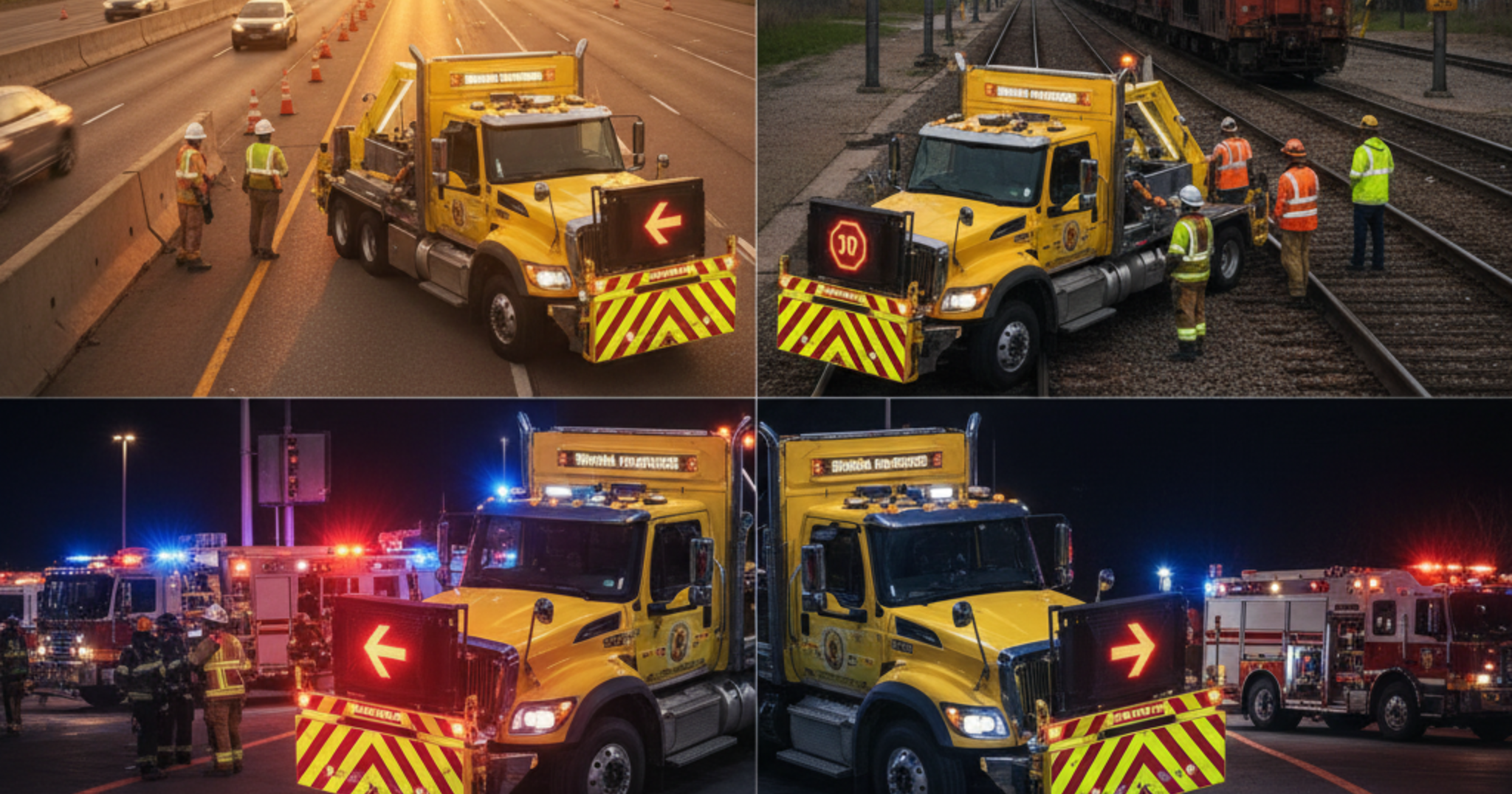
When most people think of TMA (Truck Mounted Attenuator) trucks, they picture orange-and-white vehicles protecting construction crews on Interstate highways. That mental image is accurate—but it’s only scratching the surface of what these versatile safety machines actually do. Walk through any utility yard in New Jersey, peek into a railroad maintenance facility in Pennsylvania, or observe an emergency response staging area in New York, and you’ll see TMA trucks hard at work in TMA trucks’ utility work applications that have nothing to do with traditional highway construction. These specialized vehicles protect workers in environments most people never see: beneath bridges during infrastructure inspections, alongside active railroad tracks during signal maintenance, inside industrial facilities during equipment installation, and at emergency scenes where every second counts.
The reality is that TMA trucks’ utility work applications have expanded dramatically over the past decade. As workplace safety regulations have tightened and as organizations have recognized the life-saving value of mobile impact protection, TMA technology has migrated from highways into dozens of specialized applications. Utility companies depend on them for roadside pole work. Railroads can’t operate maintenance crews without them. Emergency responders deploy them at crash scenes and hazmat incidents. Industrial facilities use them during equipment moves and facility modifications.
Let’s talk about this in detail here!
Understanding TMA Technology Beyond Highway Applications
Before diving into specific applications, let’s establish what makes TMA trucks valuable across such diverse work environments.
The Core Protection Principle
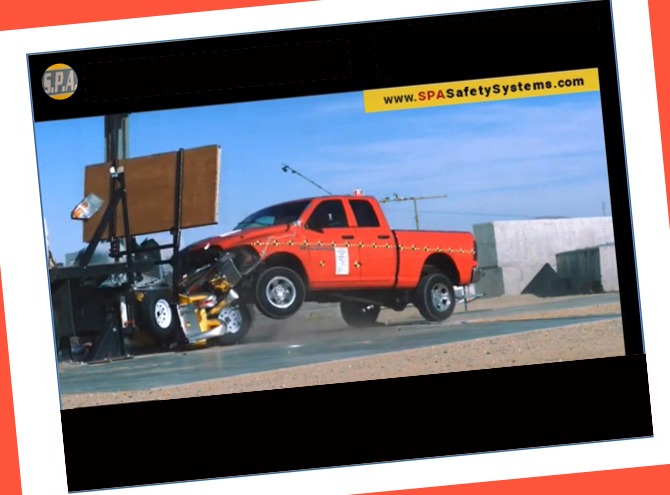
At its heart, a TMA truck provides mobile impact protection. The truck positions itself between workers and approaching traffic, absorbing collision energy if an errant vehicle strikes the work zone. The mounted attenuator system—essentially a sophisticated crash cushion—crushes in a controlled manner during impact, decelerating the striking vehicle while protecting both the work crew and the TMA truck occupants.
This protection principle applies whether you’re on Interstate 287 or on a rural county road doing utility work. The physics of impact protection don’t change by location, which is precisely why TMA technology translates so effectively across diverse applications.
Mobility as the Key Advantage
Unlike stationary barriers or water-filled crash cushions, TMA trucks move with the work zone. When utility crews work their way down a street replacing poles, the TMA truck repositions every few hundred feet. When railroad maintenance moves from one signal location to the next, the hi-rail TMA truck travels right along the tracks. This mobility means continuous protection regardless of how frequently work locations change.
For operations involving multiple short-duration work sites—which describes most utility, rail, and emergency applications—mobility is essential. Setting up and breaking down stationary barriers at each location would be impossibly time-consuming and expensive.
Visibility and Warning Enhancement
Beyond physical impact protection, TMA trucks provide crucial visibility enhancement. Their size, conspicuity striping, warning lights, and often-integrated arrow boards or message boards make work zones dramatically more visible to approaching traffic.
This visibility component is particularly valuable in utility and emergency applications where work zones pop up unexpectedly in locations where motorists don’t anticipate encountering workers. The TMA truck’s presence draws the driver’s attention and prompts appropriate speed reduction and lane changes.
Utility Company Applications
Electric, gas, water, and telecommunications utilities represent one of the largest and fastest-growing segments of TMA truck deployment beyond traditional highway construction.
Overhead Line Work and Pole Replacement
Electric utilities replacing damaged poles or upgrading distribution lines work alongside active roadways constantly. These operations require bucket trucks, material staging, and work crews—all positioned in or adjacent to travel lanes.
TMA trucks provide mobile protection as crews move from pole to pole. The attenuator truck positions downstream of the work site, protecting against errant vehicles while bucket truck operators focus on overhead work rather than watching for approaching traffic.
Many utilities now require TMA protection for any pole work on roads with posted speeds above 35 mph or ADT (Average Daily Traffic) counts exceeding 2,000 vehicles.
Underground Infrastructure Work
Water utilities, sewer departments, and gas companies frequently excavate in roadways for main repairs, service line replacements, and infrastructure upgrades. These excavations create significant traffic hazards—open trenches, excavation equipment, material piles, and work crews all occupying travel lanes or shoulders.
TMA trucks protect these work zones by positioning upstream of excavation sites. As work progresses along a street—common when replacing aging water mains or gas distribution lines—the TMA truck advances with the crew, maintaining consistent protection.
For utilities, TMA trucks often provide better value than deploying and retrieving multiple crews to set up and take down traffic control devices at each location. One TMA truck can protect sequential work sites throughout a shift, with minimal setup and takedown time compared to traditional traffic control.
Telecommunications and Fiber Optic Installation
Telecommunications companies installing fiber optic networks work extensively in roadway right-of-ways. Boring equipment, splice vaults, and cable installation require protected work zones, often in locations with moderate-to-high traffic volumes.
The mobile nature of fiber installation—progressing continuously along routes rather than remaining stationary for extended periods—makes TMA trucks an ideal protection solution. The truck advances as installation progresses, providing continuous protection without constant reconfiguration of traffic control.
Many telecommunications contractors have added TMA trucks to their fleets specifically for fiber installation projects. The investment pays off through faster project completion (fewer hours spent on traffic control setup), improved safety records (fewer vehicle incursions into work zones), and better regulatory compliance.
Emergency Utility Response
When storms knock down power lines, or accidents damage gas mains, utilities must respond immediately—often in the dark, in bad weather, and amid chaotic traffic. These emergency responses can’t wait for an elaborate traffic control setup.
TMA trucks deployed for emergency utility response provide immediate work zone protection. Crews arrive, position the TMA truck appropriately, and begin emergency repairs, confident that they have professional-grade impact protection between them and approaching traffic.
Railroad and Hi-Rail Applications
Railroad maintenance is a specialized TMA application that requires unique vehicle configurations—namely, hi-rail trucks capable of operating on both highways and railroad tracks.
Track Maintenance Protection
Railroad track maintenance crews replace rails, adjust switches, or repair roadbed work in extraordinarily hazardous environments. Beyond normal traffic hazards, they face risks from trains traveling at high speeds on adjacent tracks with minimal warning.
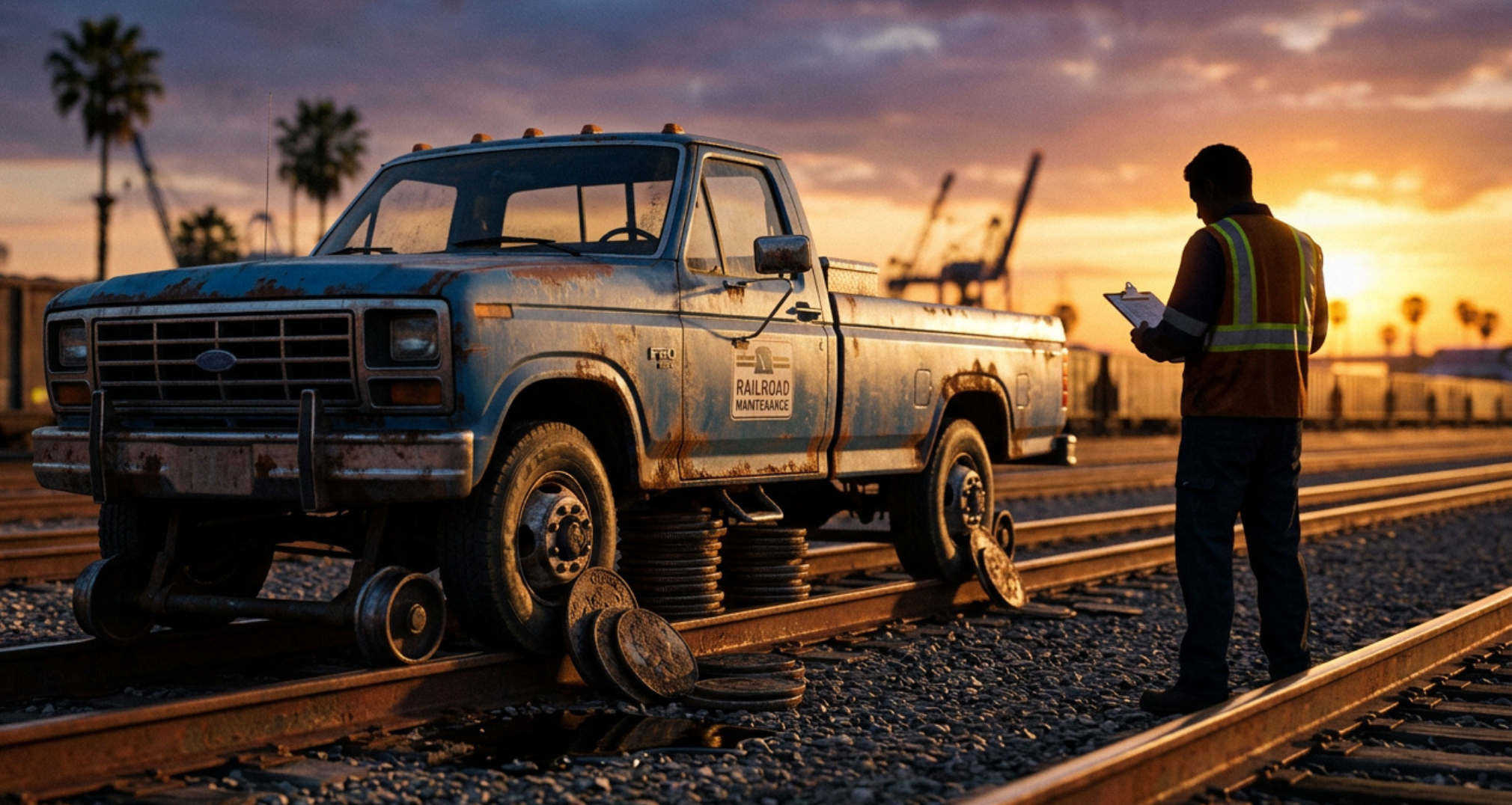
Hi-rail TMA trucks provide mobile work zone protection that travels along tracks with maintenance crews. These specialized vehicles lower the hi-rail gear to engage with railroad wheels, allowing them to drive along railways like railroad maintenance vehicles.
The TMA system protects crews from:
- Errant highway vehicles at grade crossings where crews work
- Impacts from railroad equipment or vehicles traveling on adjacent tracks
- Collisions during movements between work sites along the tracks
Federal Railroad Administration (FRA) regulations increasingly require positive protection for track workers in certain circumstances. Hi-rail TMA trucks help railroads meet these requirements while maintaining operational efficiency.
Signal and Communication System Maintenance
Railroad signal systems require regular maintenance and periodic upgrades. Signal maintainers work at bungalows, signal bridges, and wayside equipment—often located in areas where highway traffic crosses or runs parallel to tracks.
Hi-rail TMA trucks position at these work sites, protecting while maintainers focus on technical work. The trucks can access locations miles from highway crossings by traveling directly along railroad right-of-way, eliminating the need for highway vehicles to reach remote work sites.
This access advantage dramatically improves maintenance efficiency. Rather than walking long distances carrying tools and equipment, maintainers ride in hi-rail trucks directly to work locations, with TMA protection in place throughout the workday.
Grade Crossing Maintenance and Upgrades
Highway-railroad grade crossings require constant maintenance—signal systems, crossing surfaces, warning devices, and safety equipment all need regular attention. These locations pose particularly high hazards because railroad workers operate at the intersection of highway and rail traffic.
Hi-rail TMA trucks protect both highway vehicles and railroad equipment at these crossings. Positioned appropriately, they protect workers from vehicles approaching on highways while also providing visibility and warning for railroad equipment approaching on tracks.
Many railroad contractors specializing in grade crossing work maintain hi-rail TMA fleets as essential equipment for every project. The protection, mobility, and dual highway-rail capability make these trucks indispensable for their operations.
Railroad Construction and Capital Projects
Major railroad capital projects—installing second tracks, upgrading yards, building new intermodal facilities—involve extensive work along active railroad rights-of-way. These projects employ hundreds of workers and operate continuously for months or years.
Hi-rail TMA trucks protect these long-term projects by providing mobile work zone protection that adapts as construction progresses. Multiple trucks may protect different areas of large projects, repositioning daily as work locations shift.
Emergency Response and Public Safety Applications
Fire departments, police agencies, DOT emergency response teams, and hazmat units increasingly deploy TMA trucks for incident scene protection.
Traffic Crash Scene Protection
When serious crashes occur on highways, emergency responders work in extraordinarily dangerous environments. Rescue operations, medical treatment, crash investigations, and vehicle recovery all take place alongside high-speed traffic. Secondary crashes—vehicles striking emergency scenes—kill and injure responders with tragic frequency.
TMA trucks positioned upstream of crash scenes provide critical protection for responders. Fire departments, police agencies, and DOT units deploy TMA trucks immediately upon arrival at major incidents, establishing protected work zones before rescue operations begin.
This protection allows responders to focus completely on victims and crash operations rather than constantly watching for approaching traffic. The psychological benefit is substantial—responders work more effectively when they’re not constantly afraid of being struck.
Incident Command and Scene Management
Large emergency incidents require command posts and equipment staging areas. When these areas must be established on or near highways—common for crashes, hazmat spills, and infrastructure emergencies—they need protection from traffic.
Many emergency response agencies now include TMA trucks in their incident management system planning, treating them as standard resources for complex highway incidents.
Special Event and Planned Lane Closure Support
Emergency services agencies often provide traffic control for special events—marathons, parades, VIP motorcades, utility work, and planned highway maintenance. These operations require temporary lane closures and traffic diversions.
TMA trucks provide quick-deploy protection for these planned operations. Rather than extensive setup with cones, barriers, and signs, agencies deploy TMA trucks as primary protective devices, supplemented by minimal additional traffic control.
This capability allows emergency services agencies to support more requests with fewer resources. Two personnel in a TMA truck can provide protection that might otherwise require a crew of four or five deploying traditional traffic control devices.
Construction and Contractor Applications Beyond Highways
While highway construction is traditional TMA territory, many other construction types benefit from TMA protection.
Bridge Construction and Rehabilitation
Bridge construction projects involve extensive work adjacent to or over active roadways. Even when bridges themselves close to traffic during construction, approach roadways remain active—and workers on scaffolding, under bridges, or on access platforms face traffic hazards.
TMA trucks protect bridge construction work zones on approach roadways and beneath bridge structures. Contractors position trucks to protect work areas from approaching traffic while bridge crews focus on complex structural work.
Many bridge contractors maintain TMA trucks as standard equipment for projects. The trucks deploy on every bridge job, positioned wherever work areas intersect with active traffic.
Parking Structure Construction and Repairs
Parking garage construction and repair often occur while garages remain partially operational. Construction zones must be protected from vehicle traffic circulating through operational portions of garages.
TMA trucks protect within parking structures, positioned at construction zone perimeters to prevent vehicles from entering active work areas. The trucks’ compact configurations allow operation in tight garage environments where larger construction equipment might not fit.
Contractors specializing in parking structure work sometimes maintain TMA trucks specifically for this application. The trucks protect work zones across multiple projects, moving from garage to garage as projects progress.
Choosing the Right TMA Configuration for Specialized Applications
TMA trucks for specialized applications require thoughtful configuration matching specific operational requirements.
Chassis Selection Considerations
Utility applications often benefit from a compact chassis that navigates residential streets easily. Emergency response applications might require a chassis that meets emergency vehicle specifications.
At SPA Safety Systems, we work with clients to select the optimal chassis for intended applications. Our 19,200-square-foot facility in Flanders allows us to configure trucks on various chassis types, matching vehicle size and capability to application requirements.
Attenuator System Specifications
Different attenuator systems provide different test-level protection. TL-2 attenuators protect against impacts up to 70 mph. TL-3 attenuators protect against impacts up to 62 mph, but from heavier vehicles.
Application environments determine appropriate attenuator specifications. Highway-speed applications generally require TL-3 systems. Lower-speed urban and industrial applications can effectively use TL-2 systems.
We help clients match attenuator specifications to regulatory requirements and operational environments, ensuring compliant and effective protection.
Maintenance and Support Considerations
TMA trucks in utility, rail, and industrial applications often operate in harsher environments than traditional highway construction trucks. Salt exposure, chemical environments, railroad conditions, and industrial atmospheres all accelerate wear.
Selecting trucks built for durability and supported by comprehensive parts and service programs ensures long service life and minimal downtime. At SPA Safety Systems, our parts and repair services support trucks throughout their operational lives, keeping specialized applications running reliably.
SPA Safety Systems: Engineering TMA Solutions for Every Application
At SPA Safety Systems, we’ve built our reputation on understanding that different applications require different solutions. Our approach to specialized TMA applications reflects decades of experience and thousands of trucks engineered for demanding environments.
Custom Configuration Expertise
Our 19,200-square-foot facility in Flanders, NJ, provides the space and capability to configure TMA trucks to exactly match your application requirements. We’re not simply installing attenuators on standard trucks—we’re engineering comprehensive solutions.
Whether you need hi-rail capability for railroad applications, a compact chassis for utility work, emergency vehicle features for public safety, or specialized equipment integration for industrial applications, we have the expertise and capabilities to deliver optimal solutions.
Quality Manufacturing Standards
We set the standards for TMA trucks on the road today. That’s not marketing hyperbole—it’s a commitment to manufacturing quality that ensures trucks perform reliably in demanding applications over long service lives.
Comprehensive Support Throughout Ownership
Purchasing a TMA truck is just the beginning of our relationship with clients. Our parts and service programs support trucks throughout their operational lives:
- Replacement parts availability for all truck components
- Repair services for attenuator systems and truck equipment
- Inspection and certification services meeting regulatory requirements
- Technical support for operational and maintenance questions
- Upgrade services as technology and requirements evolve
Sales and Rental Options
We understand that different organizations have different preferences for equipment acquisition. Our rentals and sales programs provide flexibility:
Purchase options for organizations wanting dedicated fleet assets, tax advantages through asset ownership, and long-term equipment availability.
Rental options for organizations wanting operational expense treatment, short-term project requirements, or trial periods before purchase commitments.
Rent-to-own programs combine rental flexibility with eventual ownership, allowing organizations to build equity while meeting immediate equipment needs.
Application-Specific Consultation
Not sure exactly what TMA configuration you need? Our team provides consultation services, helping you evaluate requirements, understand options, and select optimal solutions.
Visit our facility at 278 Old Ledgewood Rd, Flanders, NJ 07836 during business hours (Monday-Friday, 7:30 am to 4:30 pm) to see TMA trucks in various configurations and discuss your requirements in person.
The Future of TMA Technology in Specialized Applications
TMA trucks’ utility work applications continue to expand as technology advances and safety awareness grows across industries.
Autonomous and Semi-Autonomous Operation
Emerging TMA truck designs incorporate semi-autonomous positioning capabilities—trucks that can position themselves precisely without operators physically driving them into position. This technology is particularly valuable for emergency response applications where rapid deployment matters.
Enhanced Visibility and Communication Systems
Advanced LED lighting, variable message boards, and vehicle-to-vehicle communication systems are making TMA trucks more effective at warning approaching traffic and managing traffic flow around work zones.
Integration with Fleet Management Systems
Modern TMA trucks increasingly integrate with organizational fleet management systems, providing real-time location data, utilization tracking, maintenance monitoring, and compliance documentation.
Specialized Designs for Emerging Applications
As more industries recognize the value of TMA, manufacturers are developing specialized designs for new application types. Expect to see TMA trucks configured specifically for solar farm construction, wind turbine maintenance, disaster response, and other emerging applications.
Sustainability and Alternative Fuels
TMA truck manufacturers are exploring electric and alternative-fuel powertrains, particularly for applications that involve extended idling or operation in emissions-sensitive environments. These technologies will expand the applicability of TMA while reducing environmental impacts.
At SPA Safety Systems, we’re actively engaged in these technology developments, ensuring our trucks incorporate the latest advances while maintaining the proven reliability our clients depend on.
FAQs: TMA Trucks Utility Work Applications
Q: Can TMA trucks really be used effectively for utility work and other applications beyond highway construction, or are they primarily designed for highway use?
TMA trucks work exceptionally well for utility, railroad, emergency, and industrial applications—in many ways, they’re even more valuable in these specialized applications than in traditional highway construction. Here’s why: Highway construction typically involves long-duration work sites, allowing time to establish elaborate traffic control with cones, barriers, signs, and stationary crash cushions. Utility work, emergency response, and railroad maintenance involve short-duration, frequently moving work sites where an elaborate traffic control setup isn’t practical.
Q: What’s involved in operating a hi-rail TMA truck on railroad tracks, and can our regular maintenance crews learn to operate these specialized vehicles?
Justifying TMA truck investment for occasional use requires looking beyond simple cost-per-use to understand total value and risk mitigation. A single serious work zone incident can cost millions in medical expenses, workers’ compensation, lawsuits, equipment damage, project delays, regulatory fines, and increased insurance premiums—far exceeding the $120,000– 80,000 TMA investment. Organizations often discover their “occasional” needs aren’t as infrequent as assumed—utilities typically have 4-6 work sites per week, and emergency services respond to 8-12 highway incidents per month that require protection. At 150 deployments annually over a 10-year service life, per-deployment cost drops to $1,000-1,500 for professional-grade impact protection.
Your Partner in Work Zone Safety
Whether you’re protecting utility crews on distribution lines, railroad maintainers on tracks, emergency responders at crash scenes, or industrial workers in facility operations, TMA trucks deliver proven protection that saves lives and reduces injuries.
The question isn’t whether TMA protection is valuable—decades of data prove its effectiveness across all application types. The question is how to implement TMA solutions optimally for your specific operational requirements.
SPA Safety Systems stands ready to help you answer that question. Our experience spans every application discussed in this guide—utility work, railroad maintenance, emergency response, and industrial operations. We’ve configured hundreds of trucks for these specialized applications, accumulating knowledge and expertise that directly benefits every new client.
We don’t just sell TMA trucks—we engineer safety solutions matching your unique requirements. That engineering approach means you get trucks that are truly optimal for your operations rather than generic equipment that requires compromises.
Our commitment through TMA trucks’ utility work applications extends beyond initial delivery. We’re with you throughout ownership, providing parts, service, technical support, and consultation as your needs evolve. Your success is our success—your workers’ safety is our mission.
For more information about TMA trucks for utility work, rail applications, emergency response, or industrial operations, contact SPA Safety Systems today:
Phone: 973-347-1101
Email: austin@westchestermachinery.com
Address: 278 Old Ledgewood Rd, Flanders, NJ 07836
Hours: Monday-Friday, 7:30 am to 4:30 pm
Browse our trucks for sale to see the current inventory available for immediate delivery or rental.
Your workers deserve the best protection available. TMA trucks provide that protection across every application where people work near traffic. Let SPA Safety Systems help you implement TMA solutions that keep your workers safe, your operations compliant, and your organization confident that you’re doing everything possible to prevent work zone tragedies.