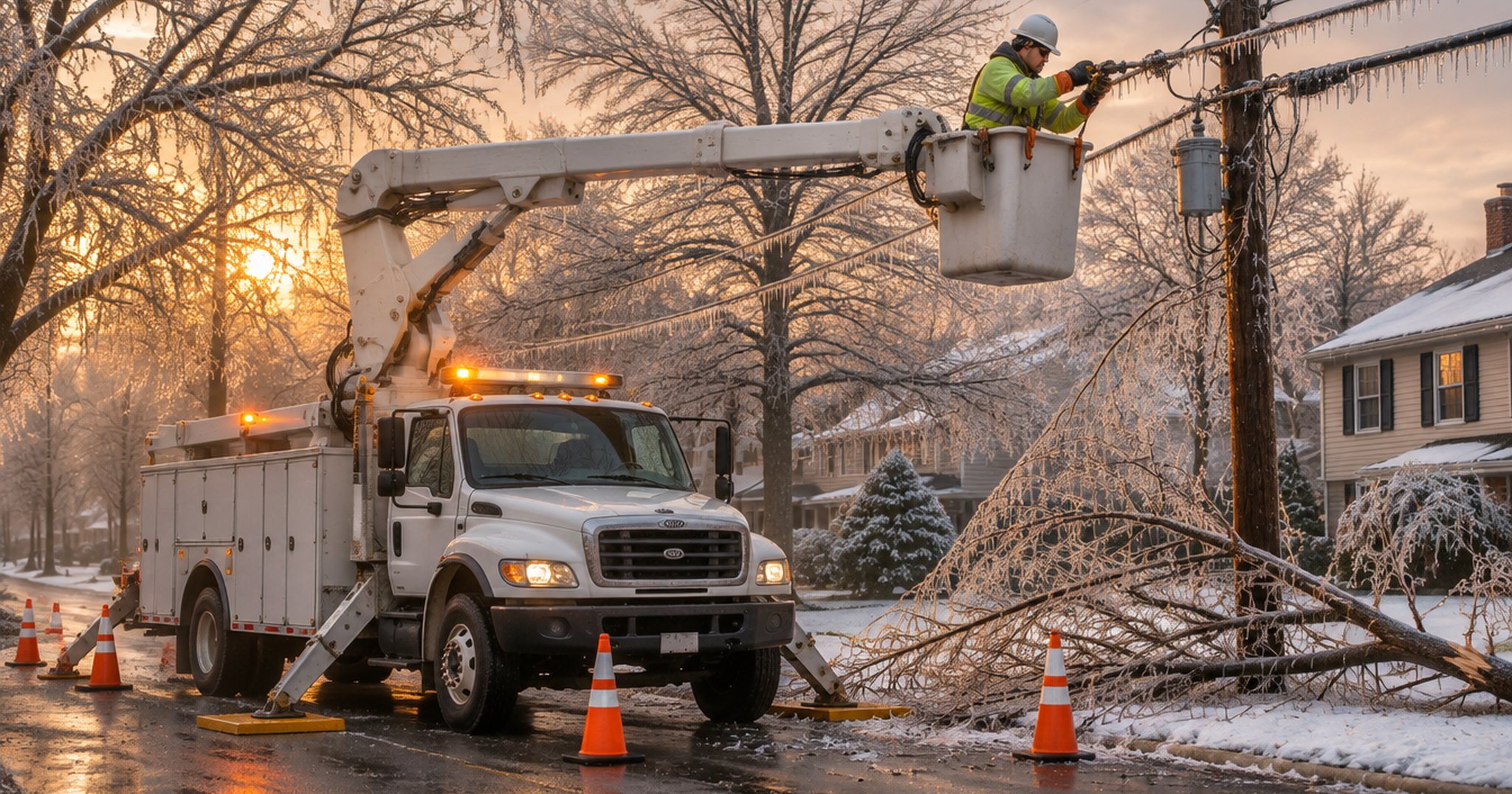
When an ice storm drops lines across three townships overnight, nobody has time to research equipment. The calls start at 5 a.m., and the crews who get back to work first are the ones who already know what truck they need and where to get it.
That’s why the best time to plan a bucket truck rental is before the weather turns. This guide walks through how to match a truck to the job: working height, boom style, insulated versus non-insulated units, chassis size, and the OSHA rules your operators are expected to follow from the minute the outriggers go down.
No sales pitch. Just the questions you should answer before you sign a rental agreement.
Why Contractors Rent Bucket Trucks Instead of Buying
A bucket truck is a big commitment. It needs a driver, an annual inspection, dielectric testing if it’s insulated, insurance, storage and a mechanic who knows hydraulics. For a lot of contractors and municipalities, the truck only earns its keep for part of the year.
Renting makes sense when:
- The work is seasonal. Storm restoration, holiday lighting installs, tree trimming around lines and sign work all spike at certain times of year.
- You need a different height for one job. Your 40-foot truck handles 90% of the work, but one project needs 55 feet or more.
- Your own truck is down. A failed inspection or a hydraulic leak shouldn’t stop a crew for two weeks.
- You’re bidding something new. Renting lets you take on a contract before you know whether that type of work will keep coming.
SPA Safety Systems offers bucket trucks from 36 to 70 feet on daily, weekly and monthly terms, so you can size the rental to the job instead of the other way around.
Step 1: Figure Out the Height You Actually Need
Height is the first question every rental desk asks, and it’s the one crews most often get wrong.
Platform height vs. working height
Spec sheets usually list two numbers:
- Platform height: how high the floor of the bucket goes.
- Working height: platform height plus an assumed reach for a person standing in the bucket.
Some quotes use one and some use the other. Before you compare trucks, confirm which number you’re looking at. A “40-foot truck” can mean very different things depending on the sheet.
Measure the job, then add margin
Look at the highest point your crew has to reach, not the average. Then add margin for:
- Setup distance. You rarely park directly under the work. Ditches, parked cars, curbs and traffic all push the truck back.
- Terrain. Outriggers on a slope or soft shoulder can limit how far the boom extends.
- Clearance from lines. Your operator needs room to keep the required distance from energized conductors (more on that below).
A good rule of thumb: if your measurement lands at the top end of a truck’s range, size up.
Common height ranges and typical uses
| Height range | Typical jobs |
|---|---|
| 36 to 42 ft | Street lights, traffic signals, signs, service drops, light tree work |
| 45 to 55 ft | Distribution line work, taller poles, commercial signage, parking lot lights |
| 60 to 70 ft | Transmission-adjacent work, tall structures, large tree removal, wide setbacks |
Step 2: Choose the Right Boom Style
Bucket trucks come in two main boom designs, and each one handles obstacles differently.
Straight (telescopic) boom
A telescopic boom extends in a straight line. It’s simple, it reaches far, and it’s great when you have a clear path to the work.
Best for: open roadsides, sign and light work, jobs where you can park close and go straight up.
Articulated (knuckle) boom
An articulated boom has a hinge that lets it bend up and over obstacles. That makes it the better choice in tight spaces or when you need to reach around tree limbs, fences or other lines.
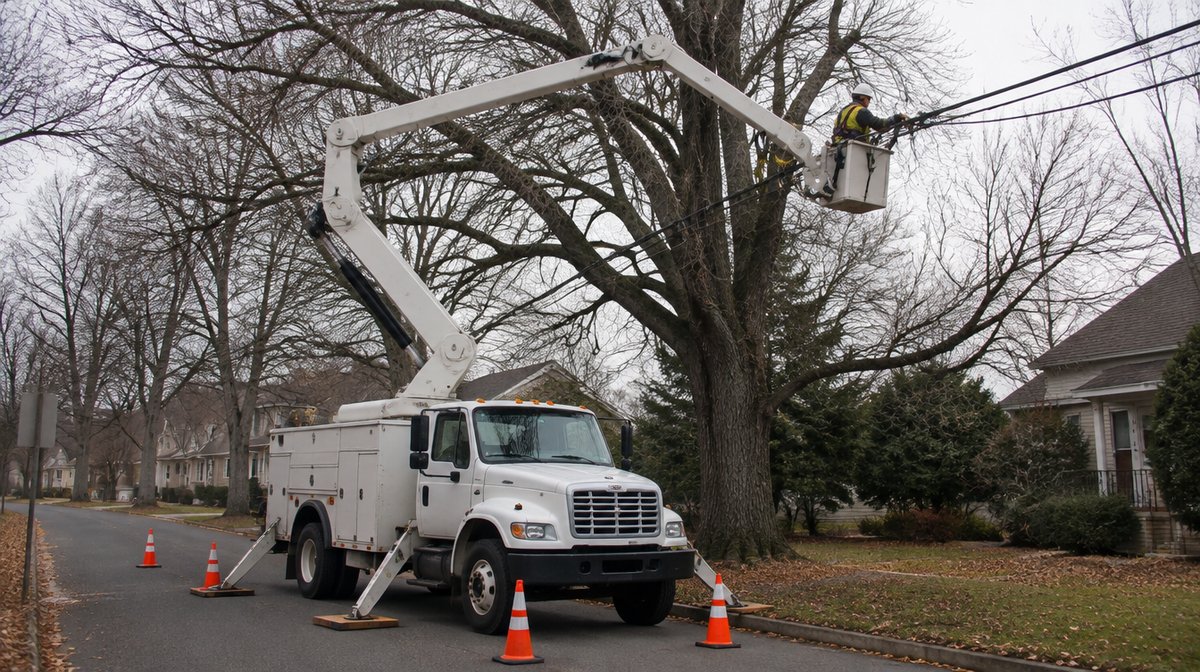
Best for: urban streets, backyard easements, tree work near lines, anywhere the straight path is blocked.
Some trucks combine the two with an articulating lower section and a telescopic upper section. SPA Safety Systems carries both straight boom and articulated telescopic units, so ask about the site conditions and the rental team can point you to the right one.
Step 3: Insulated or Non-Insulated?
This is the question that matters most for safety, and it isn’t optional if your crew works near energized lines.
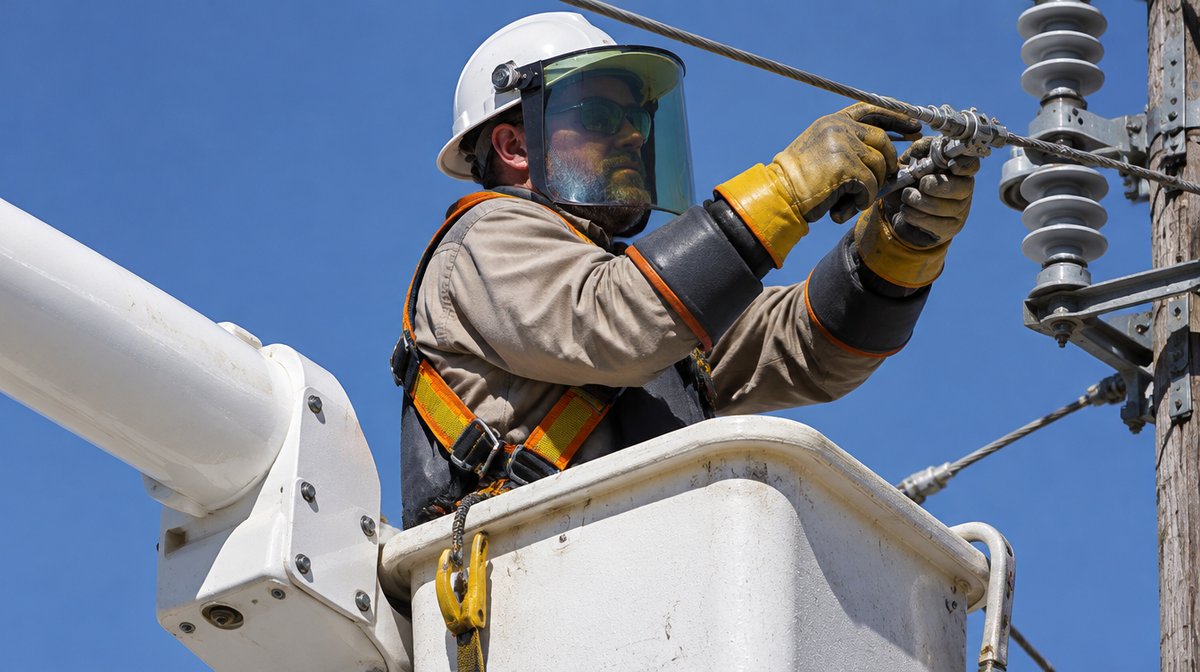
OSHA defines an insulated aerial device as “an aerial device designed for work on energized lines and apparatus” (29 CFR 1910.67). Those units are built and tested so the boom provides a layer of electrical protection.
A few things to know:
- Insulated units must be electrically tested. OSHA requires electrical tests in line with the ANSI A92.2 standard. When you rent, ask for the date of the most recent dielectric test.
- Nobody can modify the insulated section. OSHA states that “the insulated portion of an aerial lift shall not be altered in any manner that might reduce its insulating value.” That includes drilling, mounting accessories or making field repairs to the fiberglass.
- Insulation is a backup, not a license. Your crew still has to keep minimum approach distances and follow your company’s electrical safety program.
If your work is nowhere near power lines (sign installation on a highway gantry, building maintenance, holiday lights on a commercial building), a non-insulated truck may be fine. If there’s any chance of contact with a conductor, rent insulated.
Step 4: Check the Chassis and Who Can Drive It
The truck under the boom matters as much as the boom.
CDL requirements
Under federal rules, a single vehicle with a gross vehicle weight rating (GVWR) of 26,001 lb or more generally requires a commercial driver’s license. Many 36 to 40 foot bucket trucks are mounted on Class 4 or 5 chassis such as the Ford F-550 or Ram 4500 and 5500, which typically fall below that line. Larger units often ride on heavier chassis that do require a CDL.
Check the GVWR on the door sticker and match it to the drivers you actually have available on a storm callout.
Four-wheel drive
For storm work, backyard easements and soft shoulders, four-wheel drive can be the difference between reaching the pole and getting stuck in the yard next to it. If your jobs are off pavement, ask for it.
Storage and bins
Utility bodies with compartments keep tools, hardware and PPE organized. If your crew carries a lot of gear, a rental with good storage saves trips back to the yard.
Step 5: Know the OSHA Rules Before the Truck Arrives
Renting a truck doesn’t transfer your safety obligations to the rental company. The employer is responsible for training and safe operation. OSHA’s rules for vehicle-mounted aerial devices (29 CFR 1910.67 for general industry and 1926.453 for construction) include these basics:
- Test the lift controls every day before use.
- Only trained persons may operate an aerial lift.
- Wear fall protection. A personal fall arrest or travel restraint system must be worn and attached to the boom or basket.
- No belting off to a pole or structure while working from the bucket.
- Stand on the floor of the basket. No sitting or climbing on the edge, and no planks or ladders inside the bucket.
- Respect load limits set by the manufacturer.
- Set the brakes and position outriggers on pads or solid ground. Use wheel chocks on an incline.
- Don’t drive with the boom up and workers in the basket, unless the truck is specifically designed for it.
- Lower controls must be able to override upper controls, and nobody should operate the lower controls without permission from the person in the bucket, except in an emergency.
Line clearance
For work near overhead lines, OSHA’s electrical rules (29 CFR 1910.333(c)(3)) require unqualified persons and their equipment to keep at least 10 feet from lines rated 50 kV or less, with more clearance as voltage goes up. Qualified line workers follow separate minimum approach distances under 1910.269. Make sure everyone in the bucket knows which rules apply to them.
Step 6: Inspect the Rental Before You Accept It
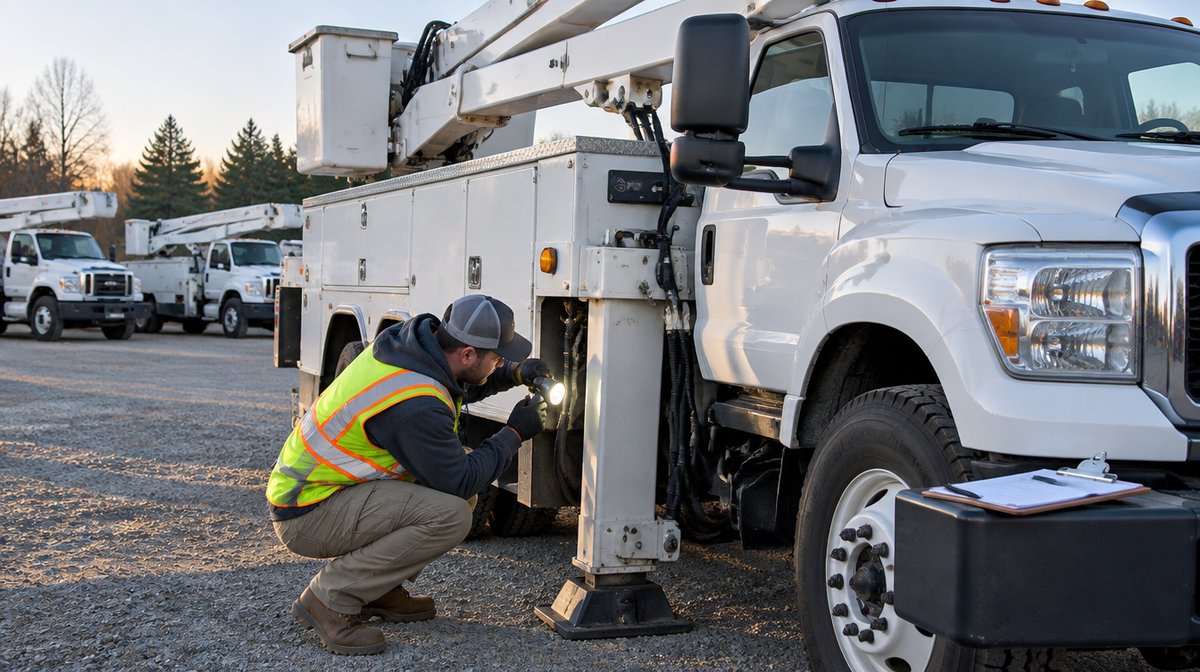
A reputable rental company will hand you a truck that’s ready to work, but your operator should still do a walkaround at delivery. Look for:
- Hydraulic leaks at cylinders, hoses and fittings
- Cracks or damage on the boom, especially the fiberglass insulated section
- Working upper and lower controls, including emergency stop and emergency lowering
- Outriggers that deploy and retract smoothly with intact pads
- Lights and beacons working for roadside setups
- Current inspection and dielectric test records
- Clear load charts and decals in the bucket and at the lower controls
If anything looks wrong, flag it before the truck leaves the lot. Document the condition with photos so there’s no question at return.
Getting Ready for Storm Season
If your crews handle winter storm response, a little planning goes a long way:
- Line up rental capacity before the first big storm. When a nor’easter hits the whole region, everybody calls at once.
- Confirm which drivers are licensed for which trucks. A CDL-required truck does you no good if your CDL drivers are already out.
- Stage PPE and fall protection with each truck.
- Review your cold-weather procedures. Hydraulic fluid behaves differently in freezing temperatures, and ice on the boom, platform and outrigger pads changes how the truck performs.
- Plan traffic control too. A bucket truck working in a travel lane still needs a proper work zone setup. Pair the truck with arrow boards, signs and, on higher-speed roads, a TMA truck.
How SPA Safety Systems Helps
SPA Safety Systems, based in Flanders, New Jersey, rents and sells bucket trucks from 36 to 70 feet, including straight boom and articulated telescopic models. Our rental fleet is maintained by the same in-house technicians who handle our parts and repairs work, so the truck you get is ready for the job.
What you can expect:
- Flexible terms. Daily, weekly and monthly rentals.
- Help choosing the right truck. Tell us the height, site conditions and whether you’re near energized lines, and we’ll match a unit to it.
- One call for the whole work zone. We also supply TMA attenuator trucks, cone trucks, arrow boards and message boards, so your traffic control and your aerial equipment come from the same place.
- Purchase options if renting starts costing more than owning.
Call (973) 347-1101 or request a quote to check availability before storm season fills the calendar.
FAQs: Bucket Truck Rental
1. What size bucket truck do I need to rent?
Measure the highest point your crew has to reach, then add margin for how far the truck will park from the work, uneven ground and required line clearance. Most street light, sign and signal work fits a 36 to 42 foot truck. Distribution line work usually needs 45 to 55 feet, and tall structures or wide setbacks may need 60 to 70 feet.
2. Do I need a CDL to drive a rented bucket truck?
It depends on the chassis. A single vehicle with a GVWR of 26,001 lb or more generally requires a CDL. Many 36 to 40 foot trucks on Class 4 or 5 chassis fall below that, while larger units often don’t. Check the GVWR before the truck is assigned to a driver.
3. What’s the difference between an insulated and non-insulated bucket truck?
An insulated bucket truck is designed for work on or near energized lines and must be electrically tested to the ANSI A92.2 standard. A non-insulated truck has no rated electrical protection and should only be used where there’s no risk of contact with live conductors.
4. Does the rental company handle OSHA training?
No. The employer is responsible for training operators and making sure they follow OSHA rules for aerial lifts. The rental company is responsible for delivering a truck that’s in safe working condition. Many rental companies can walk your operator through the specific controls at delivery.
5. Can I rent a bucket truck for just one day?
Yes. SPA Safety Systems offers daily, weekly and monthly rental terms. For storm response or multi-week projects, weekly or monthly terms are usually the better fit.