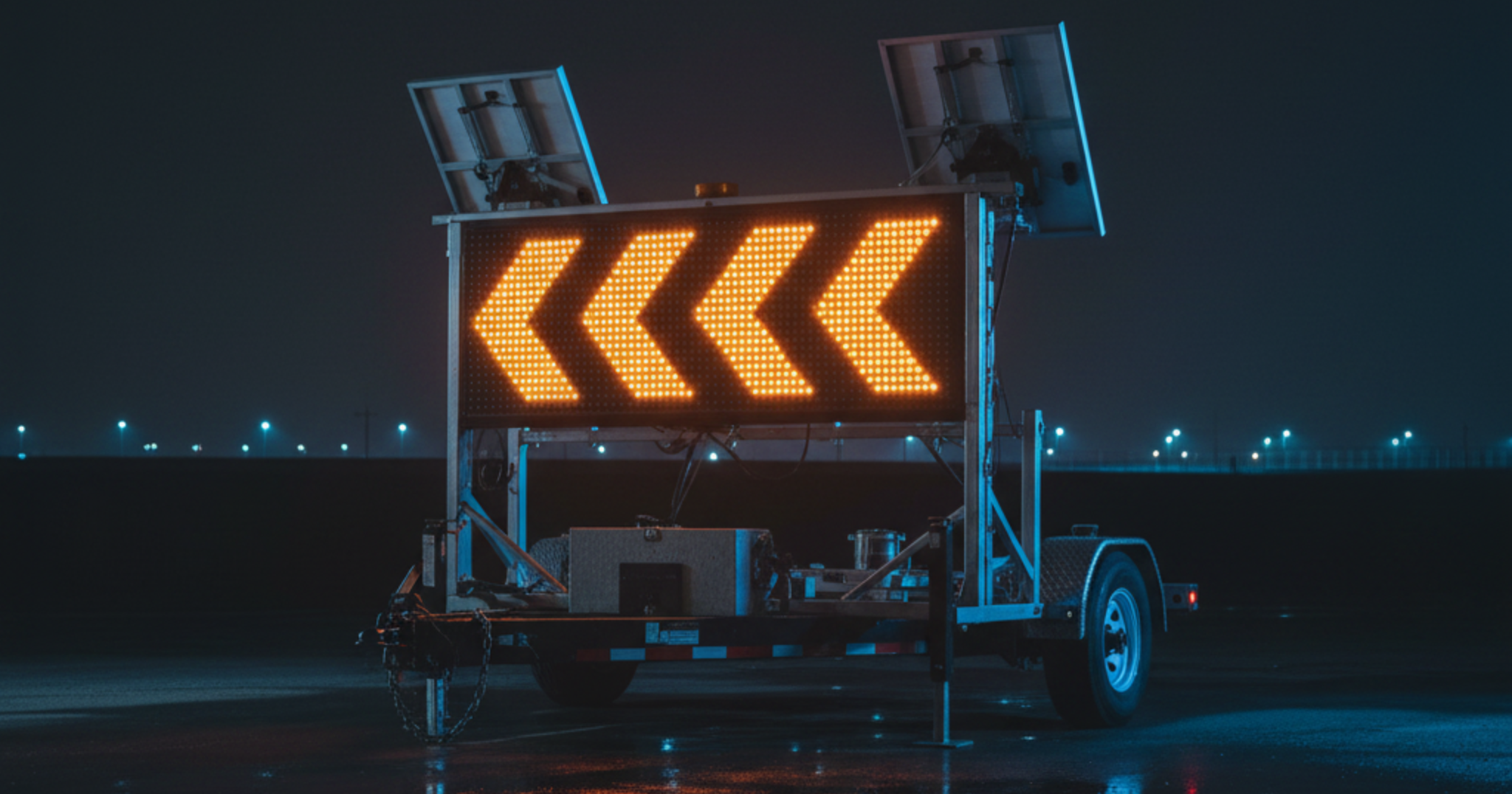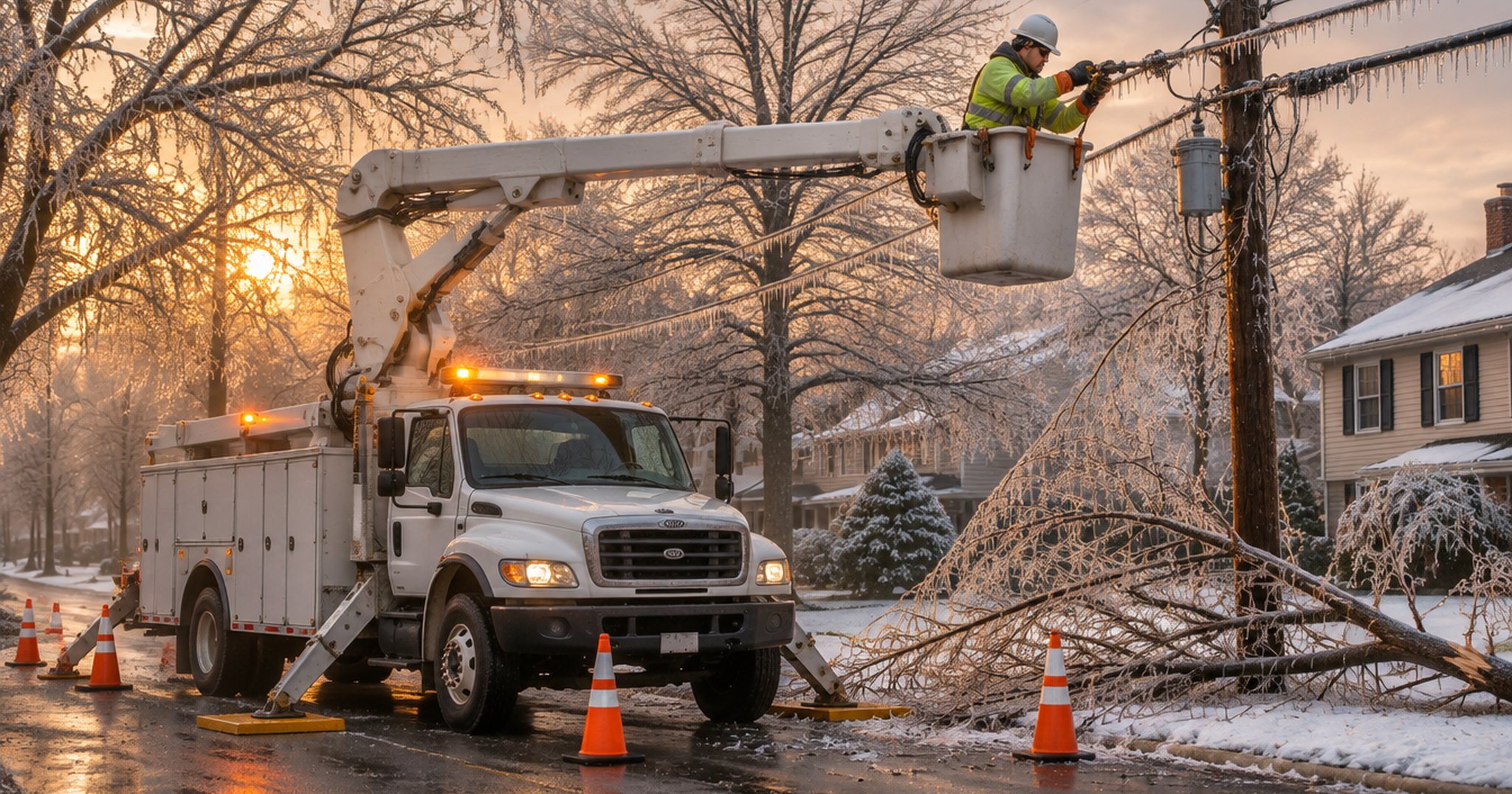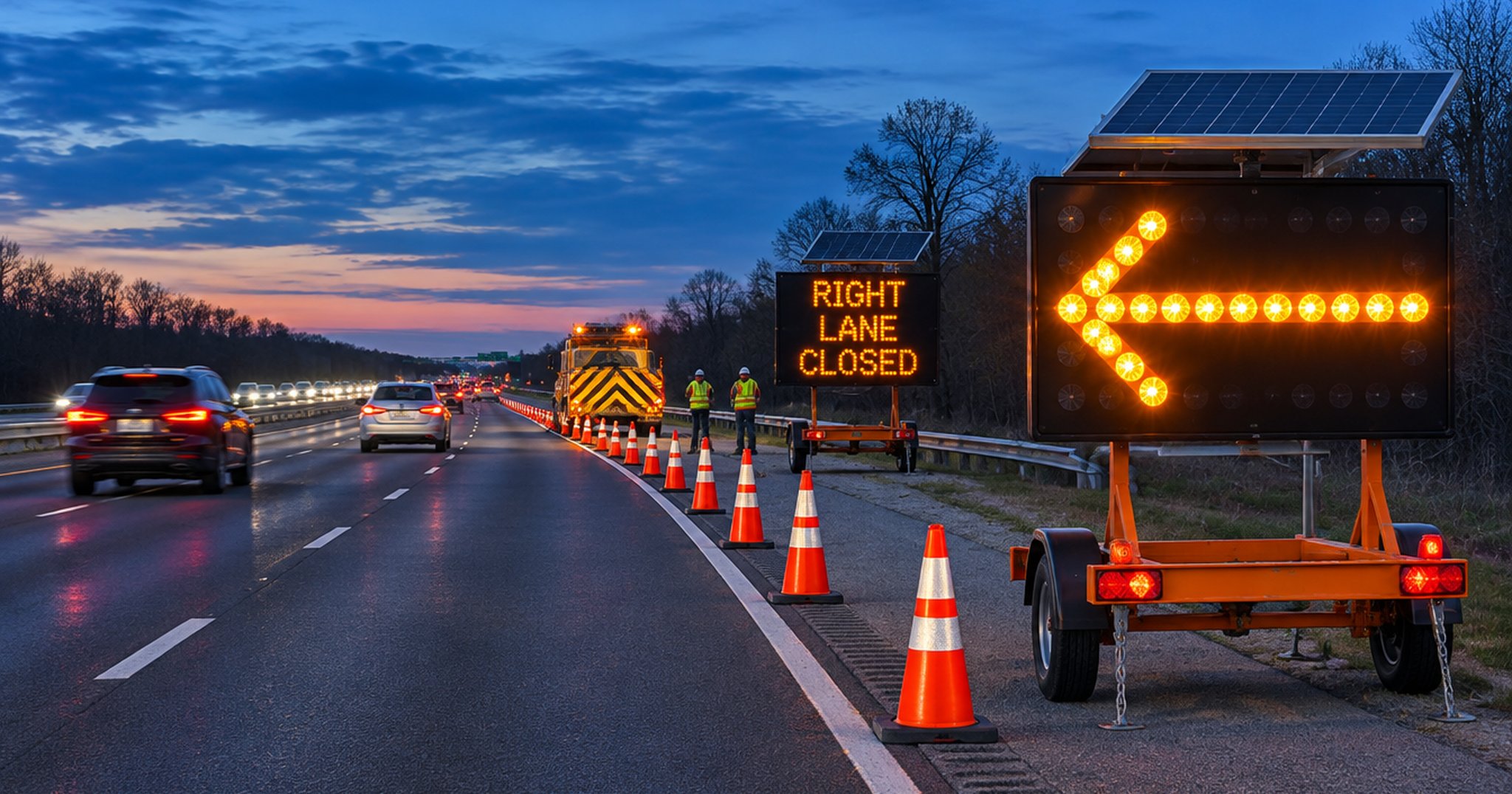
Walk any highway job in New Jersey and you’ll see both: a trailer with a flashing yellow arrow at the taper, and a bigger board a half mile back telling drivers “RIGHT LANE CLOSED AHEAD.” They look like they do the same thing. They don’t.
An arrow board tells drivers which way to move. A message board tells them why and what’s coming. Get the combination right and traffic merges early and smoothly. Get it wrong and you’ve got late merges, hard braking and rear-end risk right where your crew is working.
Here’s how to settle the arrow board vs message board question, based on what the federal Manual on Uniform Traffic Control Devices (MUTCD, 11th Edition) actually says.
What an Arrow Board Does
The MUTCD defines an arrow board as “a sign with a matrix of elements capable of either flashing or sequential displays” that provides “additional warning and directional information to assist in merging and controlling road users through or around a TTC zone” (MUTCD 11th Edition, Section 6L.06).
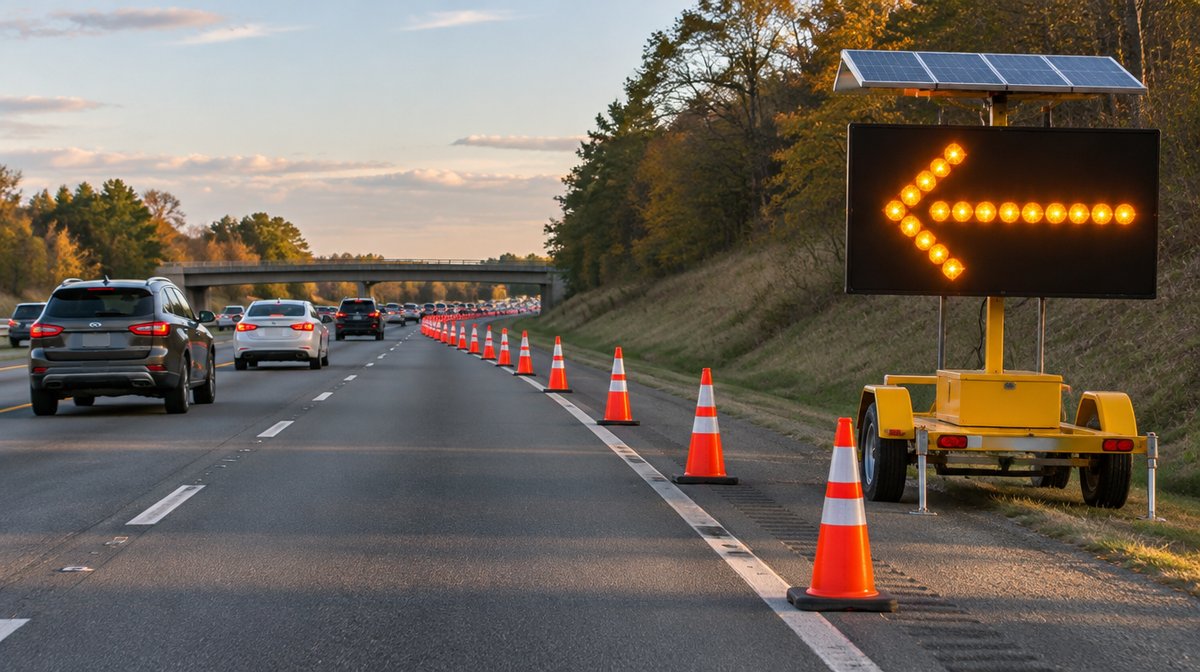
In plain terms: it’s a directional signal for a lane closure.
Required display modes
Every arrow board has to offer three types of display:
- A flashing arrow, sequential arrow or sequential chevron (merge left or merge right)
- A flashing double arrow (merge left or right)
- A flashing caution or alternating diamond (warning only, no direction)
The rule crews get wrong most often
The arrow or chevron modes can only be used for stationary or moving lane closures on multi-lane roadways. For shoulder work, blocking the shoulder, roadside work near the shoulder, or closing one lane on a two-lane, two-way road, the MUTCD says the arrow board shall be used only in caution mode.
Why? On a two-lane road, an arrow pointing left tells drivers to move into the oncoming lane. That’s not a merge. That’s a head-on crash waiting to happen. On shoulder work, an arrow tells drivers to change lanes when nothing is closed, which teaches them to ignore the next arrow they see.
Arrow board types and sizes
The MUTCD sets minimum sizes by type (Figure 6L-3):
| Type | Minimum size | Minimum legibility distance | Minimum elements | Intended use |
|---|---|---|---|---|
| A | 48 x 24 in | 1/2 mile | 12 | Low-speed urban streets |
| B | 60 x 30 in | 3/4 mile | 13 | Intermediate-speed roads, maintenance or mobile operations on high-speed roads |
| C | 96 x 48 in | 1 mile | 15 | High-speed, high-volume traffic control projects |
| D | Arrow shape (48 in arrow) | 1/2 mile | 12 | Vehicles authorized by the State or local agency |
A few more requirements worth knowing:
- Elements must be yellow.
- The board must be able to dim at least 50%, and the dimmed mode must be used at night. Full brightness at night blinds drivers.
- Flash rate must be between 25 and 40 flashes per minute.
- When you close more than one lane, you need a separate arrow board for each closed lane.
- For a stationary lane closure, the board should sit on the shoulder at the start of the merging taper, or in the closed lane if the shoulder is narrow.
What a Message Board Does
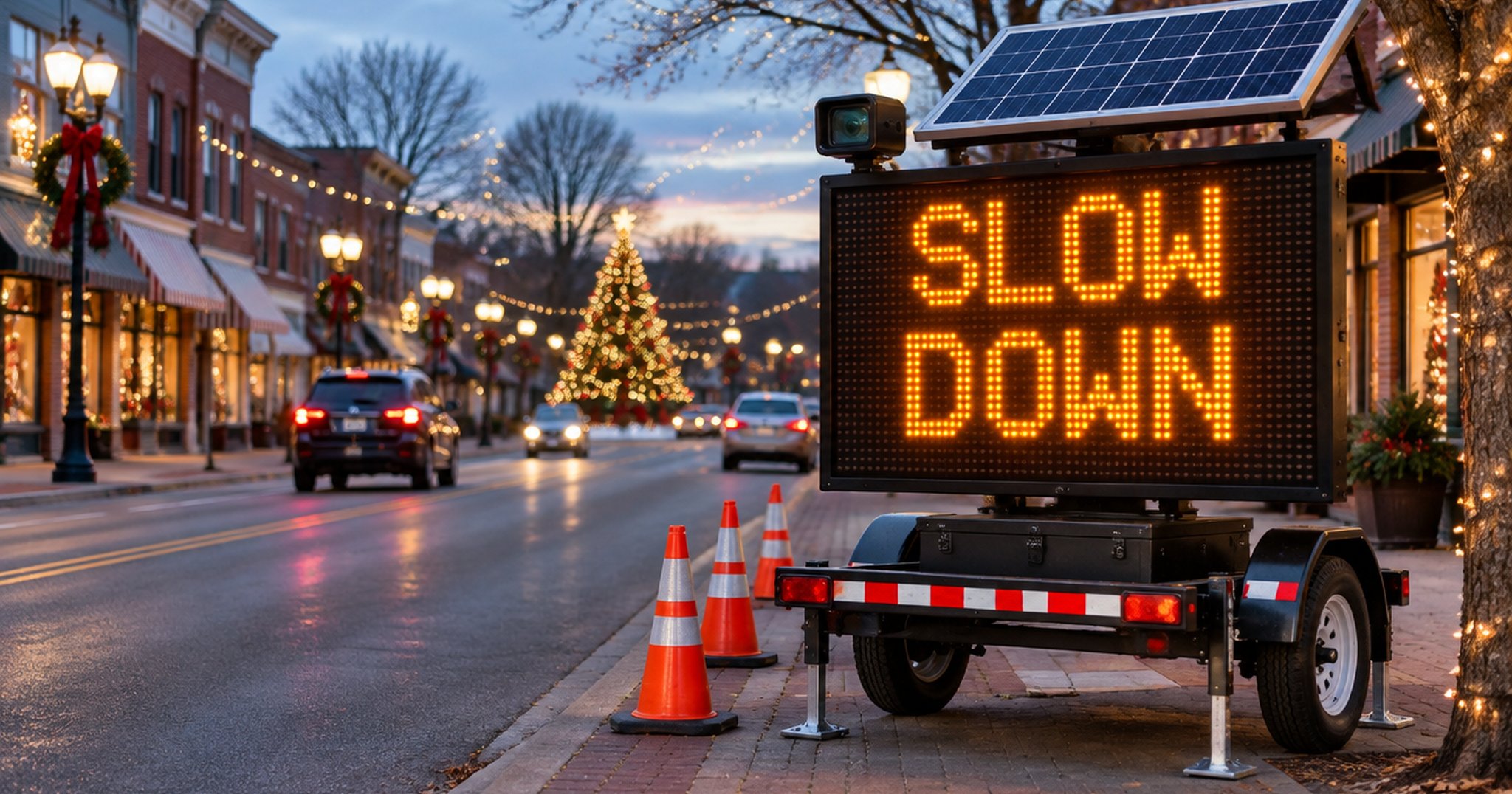
A portable changeable message sign (PCMS), usually just called a message board, displays text. The MUTCD says its main purpose in a work zone is “to advise the road user of unexpected situations” (Section 6L.05).
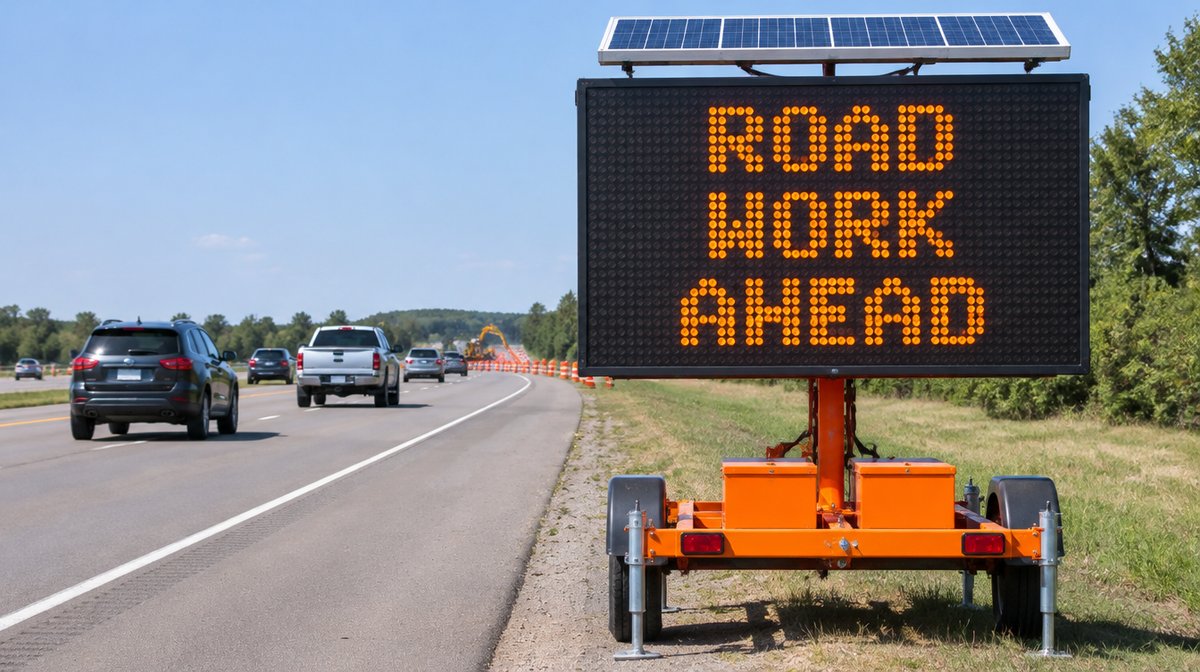
That means message boards are built for information an arrow can’t carry:
- Lane, ramp or road closures ahead
- Expected delays and queuing
- Speed reductions
- Detours and route diversions
- Work schedules (“NIGHT WORK 9PM-5AM”)
- Incidents, weather and special events
Our guide on when to use message boards for traffic control walks through more of these situations.
How to write a message board message
The MUTCD’s guidance is specific, and following it keeps your message readable at highway speed:
- Three lines of eight characters per line (or a full matrix display)
- No more than two phases (screens), each understandable on its own
- Each phase shown for at least 2 seconds, with both phases totaling no more than 8 seconds
- Letters at least 18 inches tall in most applications
- Visible from 1/2 mile day and night
- No scrolling, animation or flashing text (except when simulating an arrow board display)
- Traffic information only. No advertising.
A good message covers three things: the problem, where it is, and what the driver should do. For example:
Phase 1: RIGHT / LANE / CLOSED
Phase 2: 2 MILES / MERGE / LEFT
If you need more than two phases, the MUTCD says to add another board, spaced at least 1,000 feet apart on freeways and 500 feet on other highways.
Arrow Board vs. Message Board: Side by Side
| Arrow board | Message board | |
|---|---|---|
| Main job | Direct the merge | Explain what’s ahead |
| Where it goes | At the start of the merging taper | Well upstream, before the decision point |
| What it shows | Arrow, chevron, double arrow or caution | Text, up to two phases |
| Lane closures on multi-lane roads | Yes, arrow or chevron mode | Yes, as advance warning |
| Shoulder work | Caution mode only | Yes |
| Two-lane, two-way roads | Caution mode only | Yes |
| Detours and delays | No | Yes |
| Speed and schedule info | No | Yes |
When You Need Both
On most multi-lane highway lane closures, the answer isn’t one or the other. It’s both, doing different jobs at different distances.
A typical setup looks like this:
- Message board upstream gives drivers early notice: “LEFT LANE CLOSED 1 MILE.” Drivers who read it start looking for a gap well before the taper.
- Advance warning signs reinforce the message as drivers get closer.
- Arrow board at the taper shows exactly where and which way to merge.
- Channelizing devices (cones, drums) form the taper itself.
- TMA truck protects the crew at the start of the work space.
The MUTCD says message boards should supplement conventional signs and pavement markings, not replace them. The same logic applies to arrow boards: if used, they go with the appropriate signs and channelizing devices.
Night work
Night lane closures are where the combination matters most. Drivers are tired, speeds are often higher with less traffic, and depth perception drops. A dimmed arrow board at the taper paired with a message board that warns of the closure early gives drivers two chances to react. Our earlier post on illuminating night work zones with LED arrow and message boards goes deeper on nighttime setups.
Mobile operations
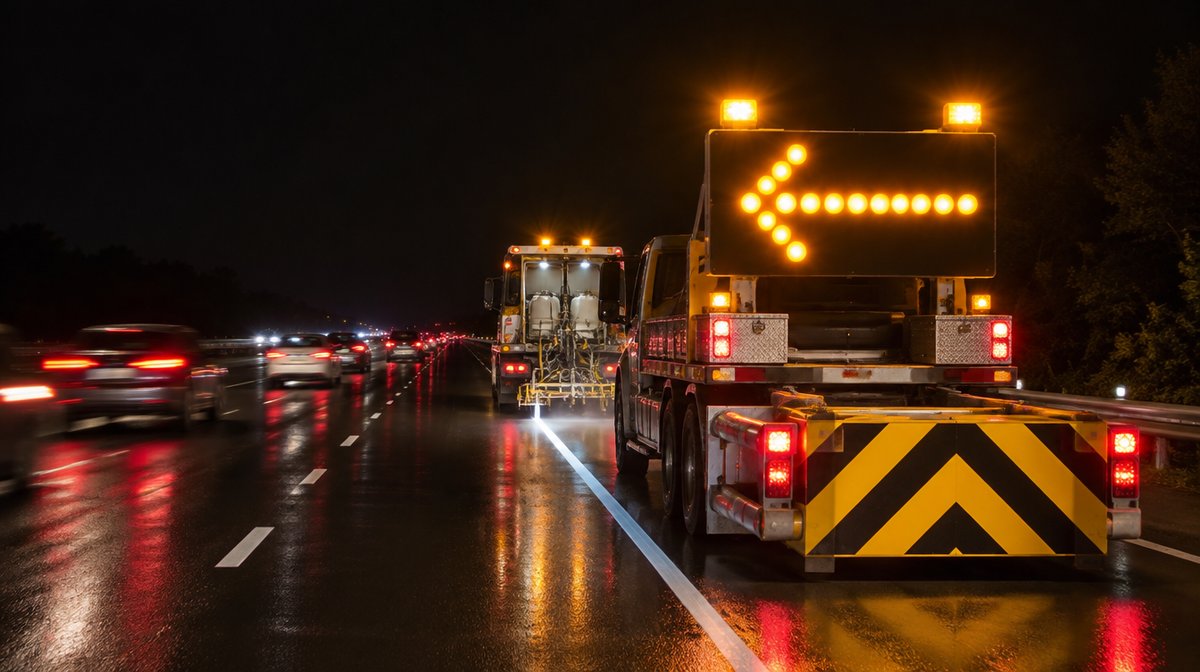
For moving lane closures like line striping, sweeping or pothole patching, a truck-mounted arrow board on a shadow vehicle or TMA truck does the directional work. The MUTCD says vehicle-mounted arrow boards should have remote controls and sit as high as practicable. A message board staged at the start of the work area can warn drivers that slow-moving equipment is ahead.
Placement Mistakes to Avoid
- Arrow mode on shoulder work. Use caution mode.
- One arrow board for a two-lane closure. Each closed lane needs its own board.
- Message board too close to the taper. Drivers need time to read and react. Put it upstream of the decision point.
- Too many phases. Three or four screens means drivers miss half the message.
- Full brightness at night. Glare reduces legibility and is a violation of the dimming requirement.
- Boards left in place when the work is done. The MUTCD says unused boards should be removed, shielded or delineated. A board showing an old message trains drivers to ignore it.
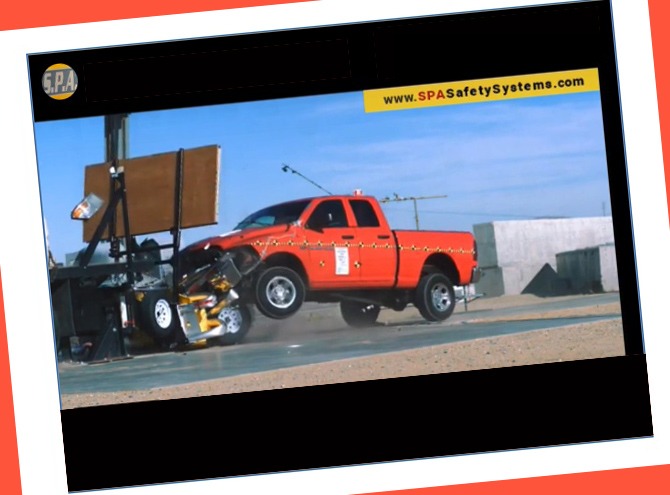
- Unprotected trailers. When practicable, place boards off the shoulder and behind barrier. If not, delineate them with retroreflective devices.
Why Solar and Remote Control Matter
Older boards ran on generators or needed a crew member to drive out and change the message. Modern solar boards solve both problems.
The MUTCD requires message boards to automatically adjust brightness, keep their message memory when power drops, and have a battery backup. Solar units with remote cellular control go a step further: you can update a message from the office when the closure moves, confirm the board is on, and track where every unit is through GPS.
How SPA Safety Systems Helps
SPA Safety Systems rents and sells solar-powered arrow boards and message boards featuring SolarTech’s Silent Messenger line. Every arrow board and message board we supply comes with GPS tracking and cellular control.
Arrow board features include:
- 10.4-inch LCD touch-screen console that’s waterproof, backlit, icon-driven and multi-lingual
- 15 sealed-housing LED lamps built by Solar Technology
- “Auto track” intensity control and an integral, temperature-compensated solar charge controller
- Multi-color LED indicators for battery level, charger status and lamp intensity
Message board features include:
- Full-matrix display panels that work together to show one large message
- The same touch-screen console and solar charging system
- Optional radar for speed detection
- A 5-year bumper-to-bumper warranty on SolarTech message boards
We also supply the rest of the work zone, from TMA attenuator trucks to cone trucks, so one call can cover your whole setup.
Call (973) 347-1101 or request a quote to rent or buy arrow boards and message boards for your next job.
FAQs: Arrow Boards and Message Boards
1. What is the difference between an arrow board and a message board?
An arrow board shows a directional arrow, chevron or caution display to guide drivers through a lane closure. A message board shows text to warn drivers about closures, delays, detours, speed changes and other conditions ahead. Arrow boards direct the merge, and message boards explain what’s coming.
2. Can I use an arrow board in arrow mode for shoulder work?
No. Under the MUTCD 11th Edition, an arrow board must be used only in caution mode for shoulder work, blocking the shoulder, roadside work near the shoulder, or temporarily closing one lane on a two-lane, two-way road.
3. How many lines and characters can a message board display?
The MUTCD recommends a portable changeable message sign be limited to three lines of eight characters per line, or use a full matrix display. Messages should use no more than two phases.
4. Where should an arrow board be placed?
For a stationary lane closure, the arrow board should be on the shoulder at the beginning of the merging taper. If the shoulder is narrow, place it in the closed lane. When closing multiple lanes, use a separate arrow board for each closed lane.
5. What size arrow board do I need for a highway?
For high-speed, high-volume traffic control projects, the MUTCD calls for a Type C arrow board, at least 96 by 48 inches with a minimum legibility distance of one mile. Type B boards are appropriate for intermediate-speed roads and for maintenance or mobile operations on high-speed roads.