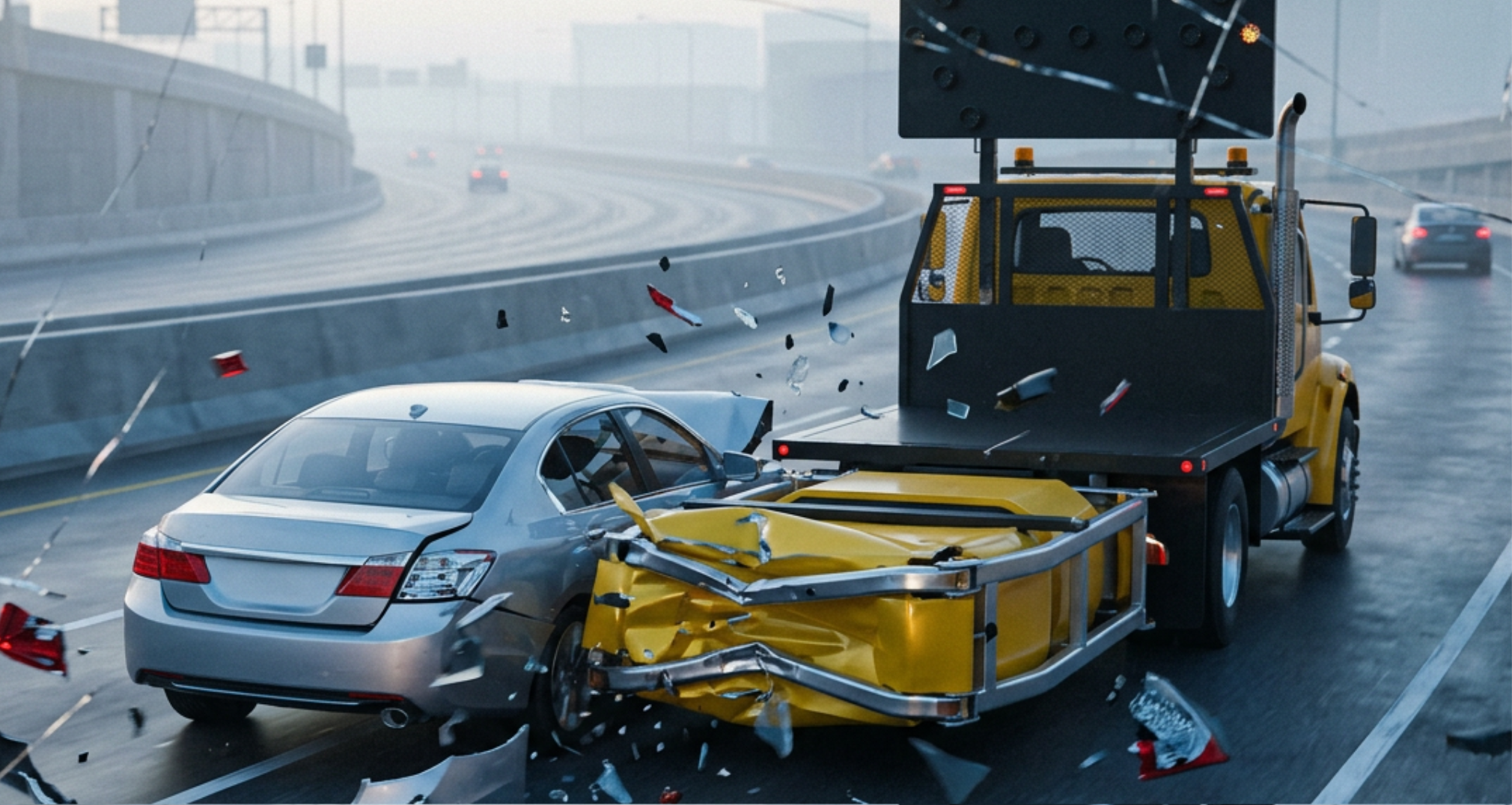
Here’s a number that should stop every foreman, contractor, and DOT engineer cold: according to the Federal Highway Administration (FHWA), rear-end crashes are the single most frequent type of collision in work zones. They aren’t just common; they are the dominant threat to your crew and the traveling public. For 25 years, I’ve seen the aftermath. The twisted metal, the project delays, the gut-wrenching phone calls. But I’ve also seen how a smart, layered safety plan can virtually eliminate the risk of work zone rear-end collisions. It’s not about luck; it’s about strategy.
Why Rear-End Crashes Dominate Work Zones
A work zone is a disruption. It forces drivers to do something they don’t want to do: slow down and pay attention. The core problem is speed variance—the dangerous difference between a car traveling at 65 mph and your stationary operation. When you combine that with today’s epidemic of distracted driving and visibility gaps at night or in bad weather, you have a recipe for disaster.
The National Safety Council puts the average cost of a non-fatal injury crash at over $78,000, and that’s before you factor in project downtime, insurance hikes, and potential litigation. Preventing these incidents isn’t just a safety imperative; it’s a financial one.
The 5-Layer Defense Against Work-Zone Rear-End Collisions
You wouldn’t send a worker into a trench without shoring, so why send them onto a highway without a complete defense system? A single sign or a few cones isn’t enough. You need layers, each one designed to capture a driver’s attention and modify their behavior.
Layer 1: Advance Warning Signage & Message Boards
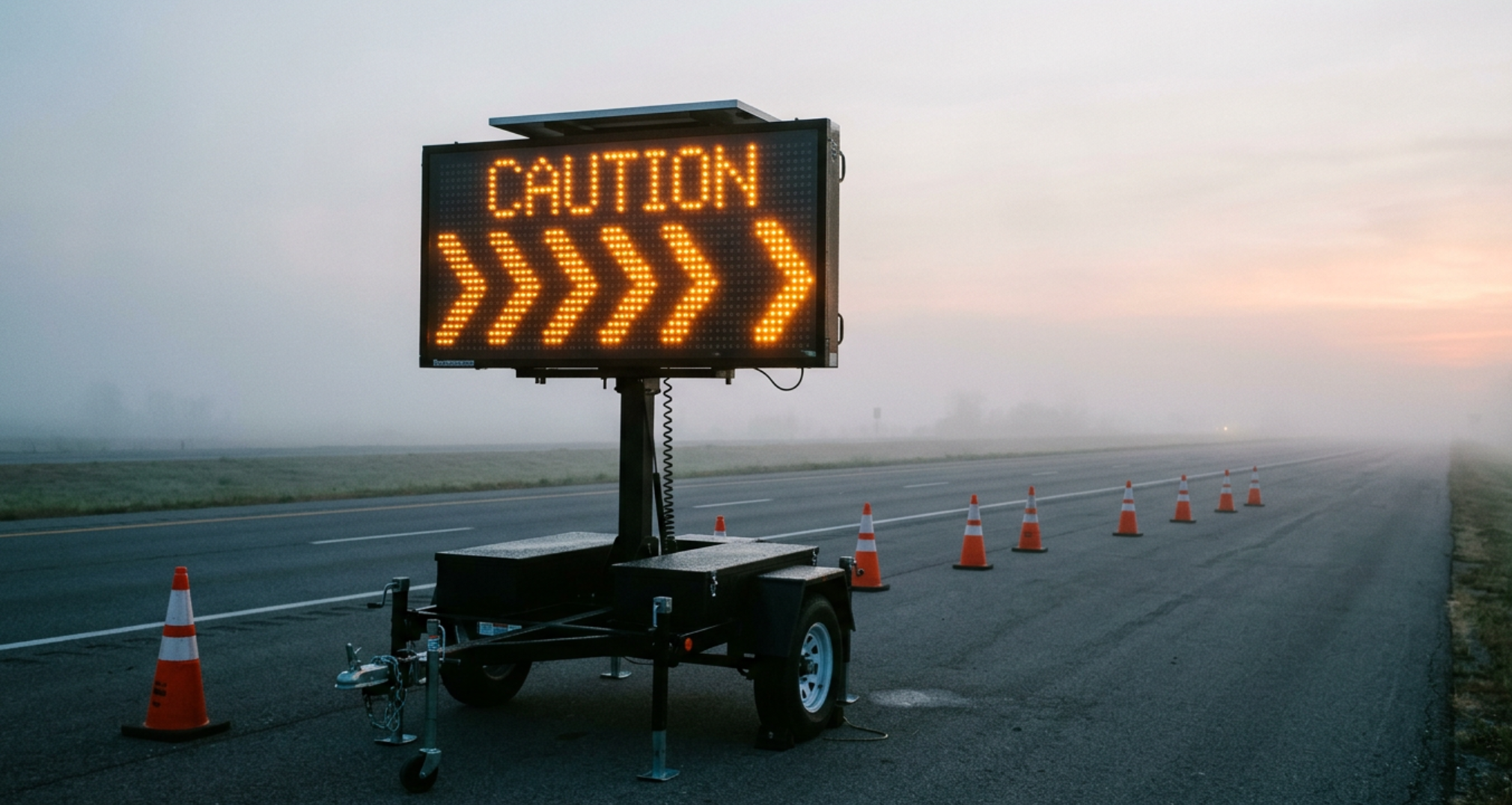
Your first line of defense starts long before the first cone. Static signs are the bare minimum. To truly grab attention, you need high-intensity, LED-powered changeable message signs (CMS). These boards allow you to post real-time, dynamic messages like “LEFT LANE CLOSED 1 MILE” or “TRAFFIC SLOWING AHEAD.” Per MUTCD guidelines, this warning should begin at least a half-mile out on high-speed roads, giving even the most distracted driver a chance to process the information and prepare to slow down.
Layer 2: Proper Taper Length & Cone Pattern
The taper is where you guide traffic out of the closed lane. A taper that’s too short or poorly defined invites chaos. The standard formula is a 15:1 ratio for every 1 mph of posted speed, but I always err on the side of a longer, more gradual transition. It gives drivers more time and space to merge smoothly. High-visibility cones with reflective collars are non-negotiable, especially for night work. This is a fundamental component of rear-end crash prevention.
Layer 3: TMA Crash Trucks as Rolling Guardrails
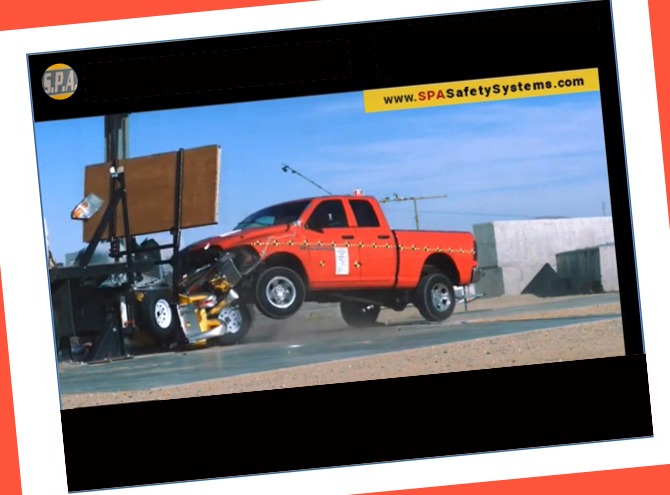
This is your crew’s last line of defense, and it’s the most important. A Truck-Mounted Attenuator (TMA) is a mobile crash cushion. It’s a rolling guardrail designed to absorb the kinetic energy of a multi-ton vehicle traveling at highway speeds. Proper TMA crash truck safety dictates placing it upstream of your crew to create a physical barrier. If a driver fails to respond to all other warnings, the TMA sacrifices itself to save your workers’ lives. The energy-absorbing cartridges are designed to be replaced after an impact, a small price to pay for a life saved.
Layer 4: Dynamic Speed Feedback & Smart-Work-Zone Tech
The best way to manage speed is to make drivers aware of it. Radar speed feedback signs that flash “YOUR SPEED” followed by “SLOW DOWN” are incredibly effective. They break the hypnosis of highway driving. For more complex projects, smart-work-zone systems link message boards, sensors, and even traffic apps like Waze. These systems can detect slowing traffic and automatically update upstream signs, providing real-time warnings that prevent the deadly chain-reaction pileups common in rear-end work-zone collisions.
Layer 5: Night- and Low-Light Visibility Kit
At night, visibility is everything. Your safety plan must be amplified after sundown. This means using brilliant, full-size Type C [Arrow Boards] that are impossible to ignore, even from a mile away. It means ensuring all your equipment and barricades use high-intensity prismatic (HIP) reflective sheeting. And for the work area itself, portable balloon lights provide 360-degree, glare-free illumination, making your crew and operation visible without blinding oncoming drivers. This is non-negotiable for work zone speed management in low-light conditions.
Defense Layer Summary
|
Defense Layer |
Key Gear | Primary Crash-Reduction Effect |
|
1. Advance Warning |
Changeable Message Signs (CMS) | Grabs driver attention early; provides clear instructions. |
|
2. Taper & Channelizing |
High-Viz Cones, Proper Taper Length | Guides traffic smoothly; reduces late-merge conflicts. |
| 3. Physical Protection | TMA Crash Trucks |
Absorbs impact energy; physically shields workers from errant vehicles. |
| 4. Speed Management | Radar Speed Feedback Trailers |
Makes drivers aware of their speed and encourages voluntary slowdowns. |
| 5. High Visibility | Type C Arrow Boards, Balloon Lights |
Overcomes darkness and weather; ensures maximum conspicuity. |
Mini Case Study: Slashing Rear-End Incidents on the Parkway
A paving contractor tackling a series of overnight milling and paving jobs on the Garden State Parkway was plagued by near-misses and two minor rear-end impacts in the first month. Their static sign setup wasn’t enough. After partnering with S.P.A. Safety Systems, they deployed a comprehensive package: two [Attenuator Trucks] for shadow and barrier protection, a radar speed feedback trailer at the start of the warning area, and a smart-work-zone system that linked traffic sensors to their message boards. The result? They cut rear-end incidents by over 60% for the remainder of the project and finished ahead of schedule.
10-Step Traffic-Control Plan (TCP) Checklist
Before any cones hit the pavement, run your plan through this checklist:
- Have you reviewed the MUTCD guidelines for your specific roadway type?
- Are warning signs placed at the correct distances for the posted speed limit?
- Is your taper length sufficient for the traffic speed and volume?
- Is a TMA truck specified as the primary shadow vehicle?
- Have you incorporated dynamic elements, such as a CMS or a speed feedback trailer?
- Does the plan account for night work with enhanced lighting and reflectivity?
- Is there a clear plan for ingress/egress for work vehicles?
- Has the TCP been communicated to all crew members and subcontractors?
- Is there a contingency plan for incidents or sudden weather changes?
- Are all devices (TMAs, boards, signs) inspected daily before deployment?
Cost-Benefit Snapshot: Prevention vs. Reaction
The numbers don’t lie. Investing in proactive safety is exponentially cheaper than reacting to a single incident.
| Scenario | Associated Cost | Long-Term Impact |
| One Rear-End Collision | Average Claim: $78,000+ | Project delays, OSHA investigation, insurance premium hikes, potential lawsuits. |
| Weekly TMA & Smart Sign Rental | Approx. Fee: $2,500 | Predictable operating cost, enhanced crew safety, reduced liability, improved project efficiency. |
A top-tier safety rental package costs a fraction of the cost of a single collision. For less than the price of a single damaged pickup truck, you can shield your entire operation with a TMA and smart signs for a month. It’s the smartest investment a project manager can make.
FAQs: Eliminating Work Zone Rear-End Collisions
1. Can we get an insurance discount for using TMA trucks?
Many insurance carriers offer reduced premiums for contractors who consistently use TMAs. It demonstrates a commitment to risk management. Ask your broker to inquire about “loss control” discounts.
2. Who operates the TMA truck? Do they need special training?
Yes. The driver must be a trained and certified operator who understands proper positioning, sight distances, and emergency procedures. S.P.A. can assist with operator training resources.
3. We have an emergency job. How quickly can we get a TMA and other gear?
We are built for rapid response. We offer same-day and next-day delivery throughout our service area for emergency deployments. Your emergency is our priority.
4. Who is responsible for maintaining the rental equipment?
S.P.A. Safety Systems handles all routine maintenance and inspections. Every piece of equipment arrives on your site fully serviced, compliant, and ready to work.
5. What happens if a TMA is hit or a board fails mid-shift?
Call our 24/7 emergency support line. We will immediately dispatch a replacement unit to your location to ensure your work zone remains protected and your project stays on track.
Your Crew’s Safety is Not a Line Item
You can’t put a price on a human life. The decision to deploy a complete, layered defense system is the most important one you’ll make. It protects your people, your project, and your company’s reputation. Don’t leave it to chance.
Call the team at S.P.A. Safety Systems today at (973) 347-1101 or send a message through our Contact page. Let’s build a safety plan to make rear-end collisions in work zones a thing of the past for your crew.