Here’s a number that keeps me up at night: roadway workers are more likely to be struck by a vehicle than workers in any other profession. On a bridge job, with nowhere to run, that risk multiplies. That’s why, for me, the most important piece of steel on the job isn’t in the superstructure—it’s the crash trucks for bridge construction crews use as mobile shields.
For two decades, I’ve seen these trucks do their job. They are the difference between a close call and a catastrophe. They aren’t just a good idea; they are the last, and most important, line of defense for your crew.
Crash Trucks 101: The Last Line of Defense
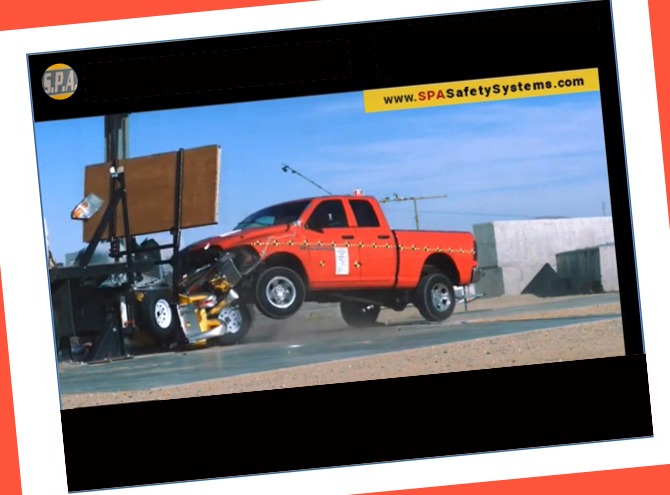
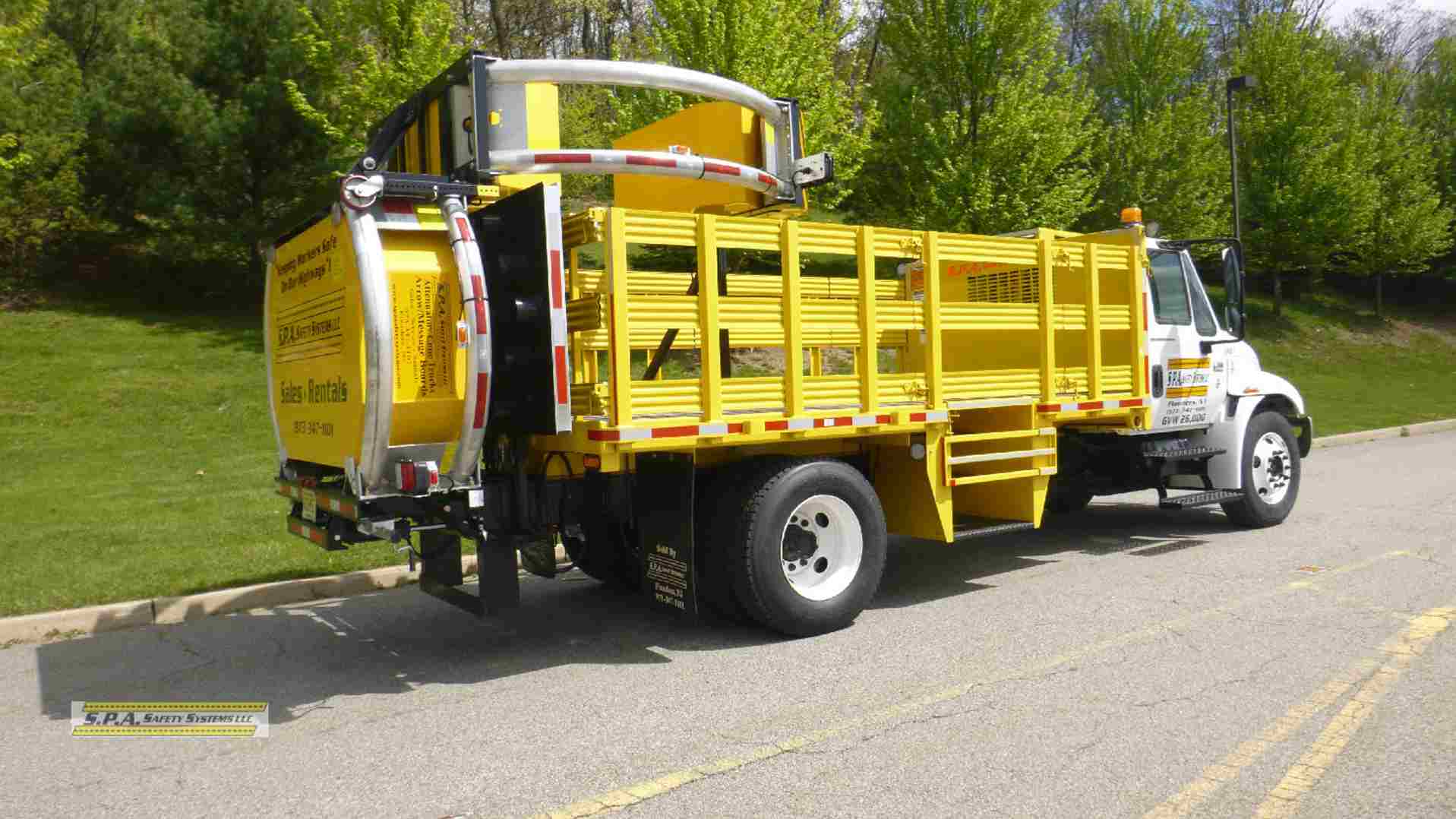
So, what exactly is a crash truck? Officially, it’s a vehicle equipped with a Truck-Mounted Attenuator, or TMA. But for those of us in the field, it’s a guardian angel on wheels. Its purpose is brutally simple: to absorb the full force of an errant vehicle, sacrificing itself to protect the lives of the workers ahead.
Think of it like a giant, industrial-strength shock absorber. The attenuator itself is a cartridge made of honeycombed, energy-absorbing materials. When a car or truck hits it, the cartridge crumples in a controlled, predictable way. This process dissipates the kinetic energy of the impact over a few critical seconds, bringing the vehicle to a much safer stop than if it had slammed into a concrete barrier or the back of a stationary work truck.
A properly equipped TMA crash truck includes several key components:
- The Attenuator Cartridge: The heart of the system, designed to be destroyed upon impact.
- Heavy-Duty Underride Guard: Prevents a smaller vehicle from sliding underneath the truck chassis during a collision.
- High-Lumen Arrow Board: A bright, clear directional board to guide traffic, visible from a mile away.
- Backup Camera & Alarms: Essential for safely positioning the truck in a tight, active work zone.
Why Bridge Jobs Amplify Risk
Working on a bridge isn’t like working on a typical highway. The risks are compressed and magnified.
- No Escape Routes: On a standard road, a worker might have a shoulder or median to dive into. On a bridge deck, you have a concrete barrier on one side and a sheer drop on the other.
- Narrow Lanes: Lane widths are often restricted, leaving less room for error for both your crew and passing motorists.
- Overhead Hazards & Distractions: Steel girders, scaffolding, and cranes can create a visually cluttered environment that distracts drivers.
- Higher Speeds: Traffic often approaches bridges at full highway speed, reducing reaction time.
These factors increase the potential for severe accidents. According to the Federal Highway Administration (FHWA), the average cost of a fatal work zone crash is staggering, but even a non-fatal injury claim can easily exceed six figures, not to mention the project delays and OSHA investigations that follow. Protecting your bridge work zone safety isn’t just about protecting people—it’s about protecting the project itself.
Spec’ing the Right Crash Truck for Bridge Work
Not all crash trucks are suitable for the unique demands of a bridge project. You need to spec the right machine for the job.
- MASH TL-3 Rating: This is non-negotiable. The AASHTO Manual for Assessing Safety Hardware (MASH) Test Level 3 (TL-3) certification ensures the attenuator can safely stop a 2,270 kg pickup truck traveling at 100 km/h (about 62 mph). Anything less is a gamble.
- Host Truck Weight: The truck carrying the TMA must meet a minimum weight requirement (often 15,000 lbs or more) to provide enough resistance during an impact. However, on weight-restricted bridges, you need a truck that meets this requirement without exceeding the bridge’s load limits. This is a critical balancing act.
- Arrow Board Lumens: Glare from the sun reflecting off water or concrete can wash out a weak arrow board. You need a high-output board that remains piercingly bright even in direct sunlight.
Here’s a quick guide to help you select the right setup.
| Bridge Scenario | Recommended TMA Setup | Minimum Buffer Distance* | Typical Crew Size |
| Short-Span, Low-Speed | Single TL-3 TMA Truck | 150 ft | 2-4 |
| Multi-Lane Deck Repair | Two TL-3 TMA Trucks (one per closed lane) | 250 ft | 5-8 |
| Overnight Girder Placement | TL-3 TMA + Advance Warning Arrow Board | 500 ft + | 8-12+ |
| Mobile Operation (e.g., line striping) | TL-3 TMA in “shadow” position | 100-150 ft (dynamic) | 2-3 |
*Buffer distance is the space between the TMA and the first worker/piece of equipment.
S.P.A. Safety Systems can help you navigate these choices. Our fleet of attenuator truck rentals is specifically configured for the challenges of crash trucks and bridge construction, ensuring you get a MASH-compliant unit that fits your project’s weight and visibility needs.
Averted Disaster on the Turnpike
It was 3 a.m. during a bearing replacement on a New Jersey Turnpike overpass. The crew was focused, sparks flying from a grinder. Suddenly, a box truck, its driver likely asleep, veered out of the open lane and headed straight for the closure. He never hit the brakes. The truck slammed into our S.P.A. TMA at nearly 60 mph. The attenuator imploded, just like it was designed to. The driver was shaken but unhurt. My crew? They barely looked up. The TMA did its job, and the project continued after a short delay.
Deployment Best Practices
Having the right truck is only half the battle. Deploying it correctly is just as important.
- Calculate Your Buffer Zone: The “roll-ahead” distance is the space a TMA truck will travel after being hit. Your buffer space—the empty area between the TMA and your crew—must be greater than this distance. A common rule of thumb is to use the formula provided by the attenuator manufacturer, but always err on the side of caution.
- Master the Taper: Your lane closure taper should be gradual, with at least 5-7 cones before the TMA to guide drivers smoothly. The length of the taper (in feet) should be the speed limit (mph) multiplied by the width of the lane closure (in feet).
- Light It Up at Night: For night work, the TMA’s arrow board is critical, but it should be part of a larger lighting strategy. Ensure the entire work area is well-lit without creating glare for oncoming traffic. The TMA should be the first and most obvious warning drivers see.
Maintenance That Keeps TMAs Bridge-Ready
A neglected TMA is a liability. A pre-shift inspection is mandatory.
- Hydraulics Check: Ensure the system that raises and lowers the attenuator operates smoothly and shows no signs of leaks.
- Cartridge Inspection: Look for any signs of damage, corrosion, or cracks in the attenuator cartridge. Even minor damage can compromise its performance.
- Arrow Board & Light Diagnostics: Cycle through all arrow patterns and check all running lights, brake lights, and strobes.
- Brake & Tire Service: The host truck’s own safety systems must be in perfect working order. Check tires and test the brakes before moving into position.
- Post-Impact Protocol: After any impact, no matter how minor, the attenuator cartridge must be considered compromised. It needs to be professionally inspected and almost certainly replaced. It is a one-time-use safety device.
Cost-Benefit Snapshot
When you look at the numbers, the value of a TMA becomes crystal clear. The weekly rental fee is a rounding error compared to the cost of a single serious incident.
| Scenario | Associated Cost | 52-Week (1 Year) Projection |
| One Serious Injury Claim | Average Cost: $125,000+ (OSHA, 2022) | $125,000+ |
| Weekly TMA Rental | Average Fee: $1,400 | $72,800 |
Renting a TMA for an entire year costs significantly less than a single injury claim. This isn’t an expense; it’s an investment in your people, your project, and your company’s reputation.
FAQs: Bridge Construction Safety
1. What kind of insurance do we need for an attenuator truck rental?
You’ll need a Certificate of Insurance (COI) showing general liability and coverage for rented equipment. We can provide the exact requirements for your insurance agent.
2. Does the driver need a special certification?
While a CDL is often required to drive the truck, the operator should also receive specific training on the proper deployment, operation, and inspection of the TMA system itself.
3. We have an emergency bridge repair. How quickly can we get a crash truck?
We maintain a ready-to-deploy fleet for situations like these. In most cases, we can deliver to your site the same or the next day. Call us 24/7.
4. Can we mix rented TMAs with our company-owned fleet?
Absolutely. Many contractors use our rentals to supplement their fleet during busy seasons or for jobs with specific weight or height requirements that their own trucks don’t meet.
5. What happens if a rented TMA is hit?
Your first call is to 911. Your second is to us. We will immediately dispatch a replacement truck to your location to ensure your work zone remains protected and minimize project downtime.
Your Crew’s Safety Is Not Negotiable
On a bridge project, there are no second chances. The forces at play are too great, and the consequences are too severe. A properly specified, deployed, and maintained TMA crash truck is the single most effective tool you have to ensure every member of your crew goes home safely.
Don’t leave that to chance.
Explore our fleet of MASH-rated Crash Trucks and our specialized Bridge Construction Solutions. When you’re ready to secure your work zone, call us at (973) 347-1101 or send a message through our Contact page. Let’s build a plan to protect your people.