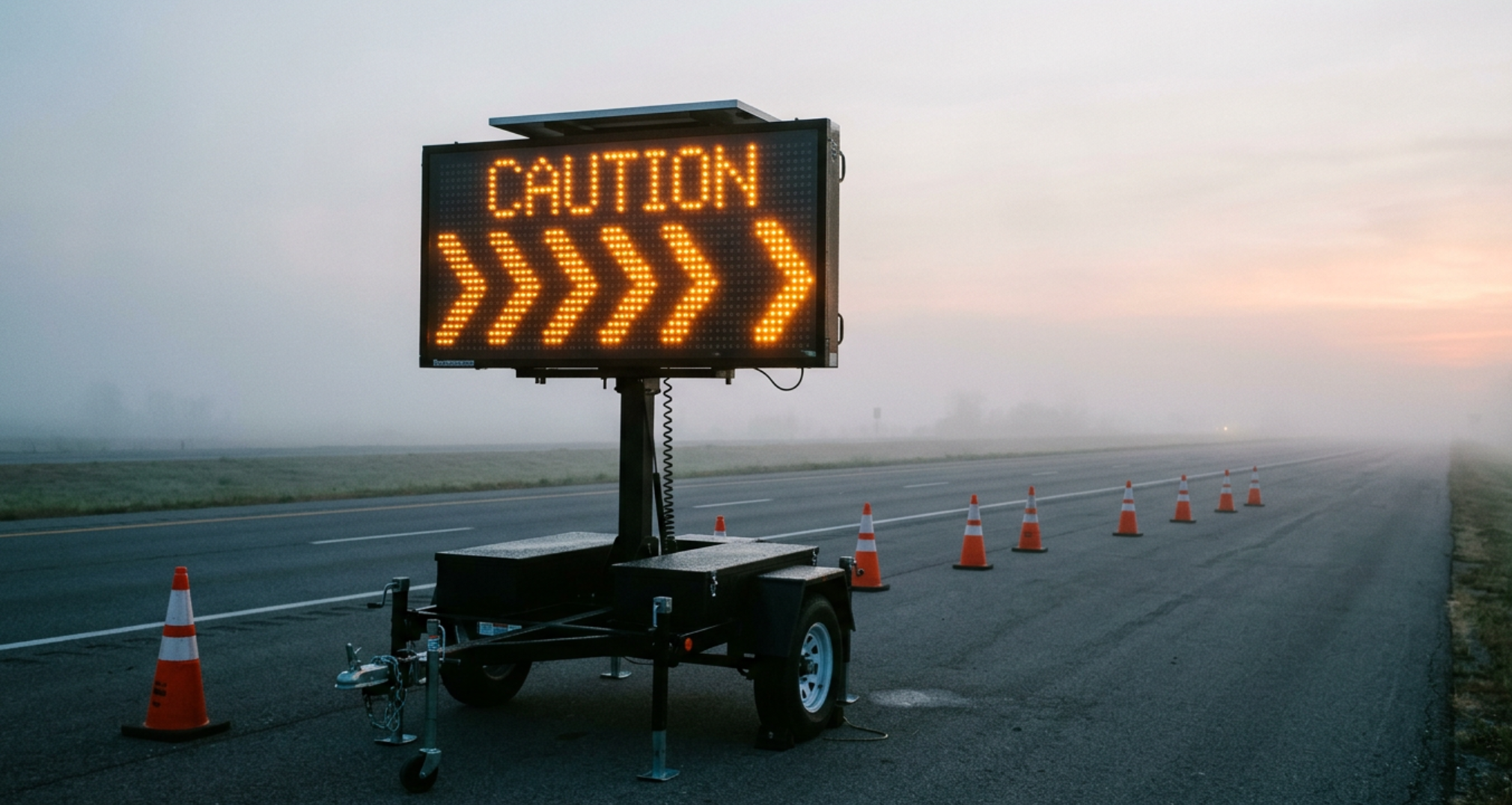
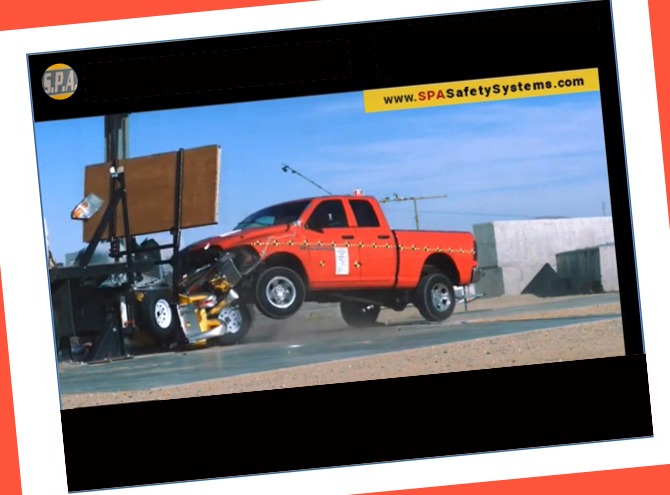
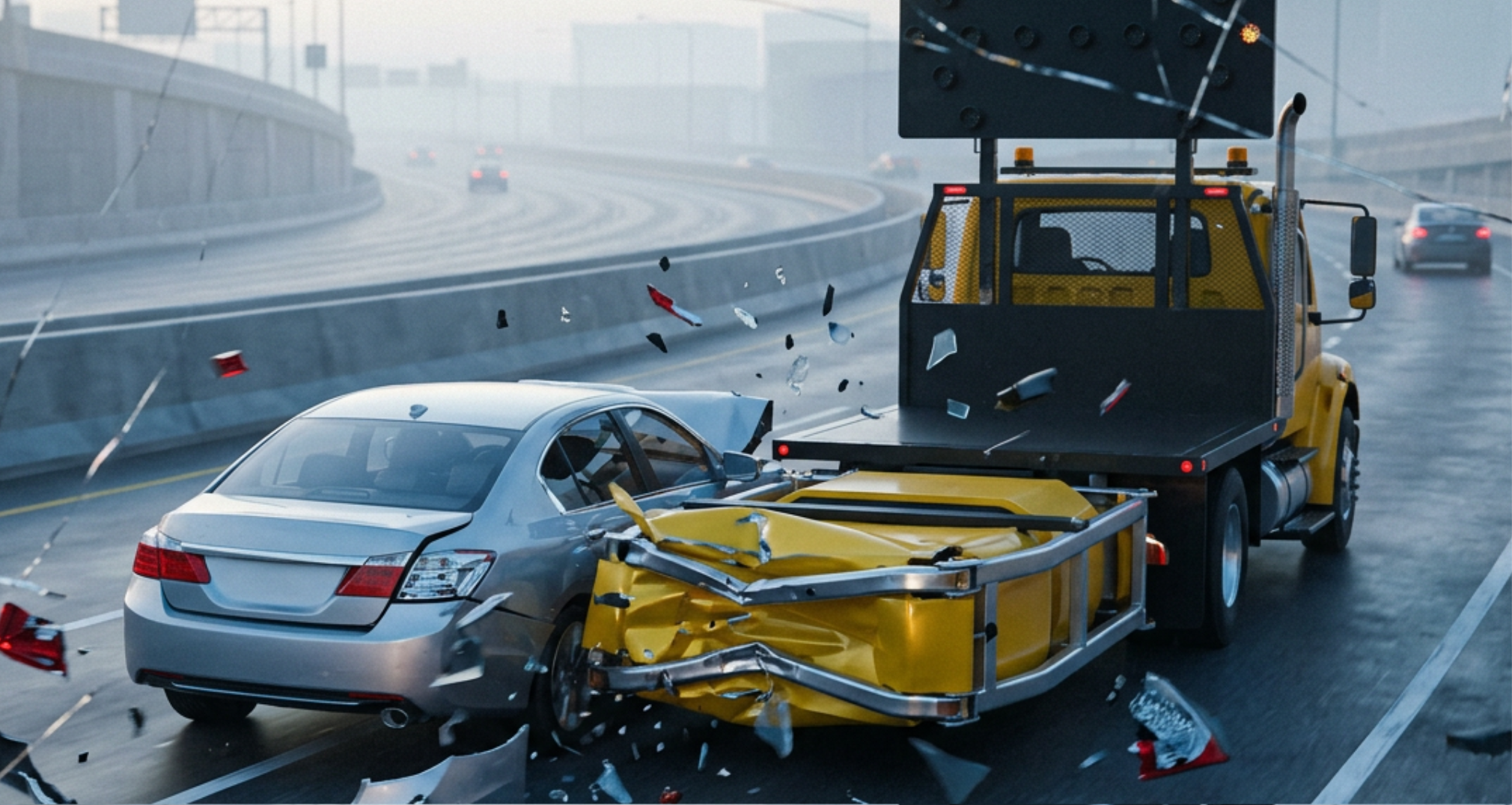
Last month, a highway crew in Pennsylvania was setting up cones for emergency pothole repair on I-476. Standard procedure: TMA truck positioned as a barrier, arrow board flashing, workers doing their jobs. Then, a distracted driver going 70 mph plowed straight into the attenuator. The TMA truck absorbed the impact exactly as designed, the attenuator compressed, and every single worker walked away without a scratch. The truck? Totaled. But here’s the thing – the fleet manager knew about the impact within 15 seconds. GPS coordinates, impact force, speed at collision, everything. Emergency response to highway work-zone safety was already underway before the dust settled.
That’s not science fiction. That’s telematics and AI working exactly as they should in 2026, and it’s completely changing how highway work zone safety operates in America. We’re not talking about minor improvements or fancy gadgets that sound cool but don’t matter. We’re talking about technology that’s actively preventing deaths, reducing injuries, and fundamentally transforming how construction crews, DOT workers, and utility companies protect their people on active highways.
I’ve been in the highway safety truck business long enough to remember when “advanced technology” meant an arrow board that actually worked consistently. Now we’re dealing with trucks that communicate with each other, predict dangerous driver behavior before impact, and generate safety data that’s reshaping how entire states approach work zone protection. The change has been massive, and most people working in highway construction don’t fully understand what’s available right now – not five years from now, but today.
The Brutal Reality of Highway Work Zone Deaths (And Why Traditional Safety Isn’t Enough)
Let’s start with the numbers that keep safety managers awake at night. According to the Federal Highway Administration, there were 857 fatalities in highway work zones in 2020. That’s not just workers – it includes motorists too – but when you dig into the data, roughly 132 of those deaths were people who showed up to work that morning expecting to go home that evening. They didn’t. Because someone wasn’t paying attention, or weather conditions changed, or visibility was poor, or any of a hundred reasons that boil down to the same thing: work zones on active highways are incredibly dangerous places.
The traditional approach to highway work zone safety has been pretty straightforward for decades.
You set up warning signs starting a mile or more before the work zone.
You deploy arrow boards to direct traffic.
You position a TMA attenuator truck as the last line of defense between workers and traffic.
You train everyone on proper procedures.
And you hope – genuinely hope – that every driver approaching your work zone is alert, sober, and capable of processing what they’re seeing in time to slow down.
That system works most of the time. But “most of the time” isn’t good enough when we’re talking about people’s lives. The problem is that human drivers are increasingly unreliable. Distracted driving from phones has skyrocketed. Driver assist systems like adaptive cruise control can create complacency. People are tired, stressed, impaired, or just flat-out not paying attention. And when a 5,000-pound vehicle going 60+ mph hits a work zone, the results are catastrophic, whether you followed every safety protocol or not.
This is where AI and telematics come in, and why they’re not just helpful additions but a necessary evolution. Because the old approach assumed drivers would see your warnings and respond appropriately. The new approach assumes they won’t, and builds multiple layers of technological protection to compensate for human failure.
What Telematics Actually Means for Highway Safety Trucks (Beyond Just GPS Tracking)
Most people hear “telematics” and think it’s just fancy GPS tracking – knowing where your trucks are at any given time. That’s part of it, but it’s like saying a smartphone is just a device for making phone calls. Modern telematics systems on TMA trucks and other highway safety equipment are collecting and transmitting dozens of data points in real-time, creating a complete picture of what’s happening in and around every work zone.
Here’s what a properly equipped telematics system is tracking right now on a modern attenuator truck:
Location data: Obviously, precise GPS coordinates, but also geofencing capabilities that automatically alert dispatchers when trucks enter or leave designated work zones. This matters because you need to know if a TMA truck is where it’s supposed to be, and telematics makes accountability automatic rather than relying on radio check-ins.
Impact detection: Advanced accelerometers detect when the attenuator is struck. The system immediately records impact force, speed, angle and sends automatic alerts to fleet managers and emergency services. This has been absolutely game-changing because it eliminates the delay between incident and response. Workers don’t need to radio for help while they’re potentially injured or amid chaos – help is already on the way.
Vehicle diagnostics: Engine performance, brake system status, hydraulic pressure on scissor lifts, and electrical system health. Modern highway safety trucks are complex machines with multiple safety-critical systems. Telematics monitors everything continuously and alerts maintenance teams to problems before they cause breakdowns in active work zones. Breaking down in live traffic isn’t just inconvenient – it’s dangerous.
Arrow board and lighting status: Are your warning lights actually functioning? Is your arrow board displaying the correct pattern? Telematics monitors this constantly. If a bulb burns out or the arrow board malfunctions, you know immediately, rather than discovering it during a DOT site inspection or, worse, after an incident.
All of this data flows to central management systems, where it can be monitored in real time, analyzed for patterns, and used to improve safety protocols continuously. But here’s where it gets really interesting – that’s just the telematics side. When you add AI into the mix, the capabilities jump to another level entirely.
How AI Is Making Highway Safety Trucks Actually Intelligent
Artificial intelligence in highway work zone safety isn’t about robots replacing workers – it’s about computers processing vast amounts of data far faster than humans can, identifying dangerous patterns, and providing warnings or automatic responses that prevent incidents before they happen.
The most significant AI application right now is predictive collision warning systems. These systems use cameras and radar sensors mounted on TMA attenuator trucks to monitor approaching traffic. The AI processes vehicle speed, trajectory, and behavior patterns to identify vehicles that pose collision risks. If a car is approaching too fast or showing erratic movement that suggests the driver isn’t paying attention, the system can trigger enhanced warning lights, send alerts to workers to clear the area, and notify the driver through the truck’s external speaker system.
Here’s why this matters: most TMA truck impacts happen because drivers literally don’t see the work zone until it’s too late to stop. They’re looking at their phone, dealing with kids in the back seat, or zoned out after hours of highway driving. By the time they look up and see the arrow board, physics takes over – they can’t stop from 65 mph in the distance remaining. Predictive AI gives you those extra 10-15 seconds of warning before impact, which is enough time for workers to get behind barriers or for the system to activate additional warnings that might snap the driver back to attention.
Another powerful AI application is behavioral analysis to improve fleet safety. The system doesn’t just record what happens – it learns from it. If you’re running a fleet of scissor lift trucks and cone trucks across multiple job sites, AI can identify patterns that human managers might miss. The AI identifies these patterns and recommends targeted interventions: additional warning signs at problem locations, modified work schedules to avoid high-risk times, and enhanced training for specific scenarios.
Automated documentation and compliance are other areas where AI is proving incredibly valuable. Highway work zone safety involves mountains of paperwork – incident reports, equipment inspections, training records, and regulatory compliance documentation. AI systems can now automatically generate much of this from telematics data.
Some of the most advanced systems now include vehicle-to-vehicle (V2V) communication capabilities. Your TMA truck can broadcast warnings directly to approaching vehicles equipped with compatible systems. This is still an emerging technology because not all vehicles have V2V receivers yet, but adoption is growing. Within a few years, your work zone equipment will be directly communicating with cars a mile away, giving drivers a warning before they even see your signs.
Real-World Applications: How Companies Are Actually Using This Technology Today
The gap between what’s technically possible and what’s actually being used in the field is narrowing fast. Major DOT contractors, utility companies, and highway maintenance operations across America are deploying AI and telematics-equipped safety trucks right now. Let me walk you through how this looks in practice.
State DOT fleet management: Several state transportation departments have fully integrated telematics across their highway safety truck fleets. When maintenance crews deploy for emergency repairs or scheduled work, the central operations center has real-time visibility into the locations of every TMA truck, cone truck, and bucket truck. If weather deteriorates rapidly – say a sudden fog bank rolls in – operations can immediately identify which crews are in affected areas and make informed decisions about whether to continue work or evacuate. When incidents do occur, the automated impact detection means emergency response times have dropped dramatically. Some states report response time improvements of 40% or more compared to the old radio-call system.
Private contractors working on infrastructure projects: Large construction firms managing multi-year highway projects are using telematics data to optimize the deployment of safety equipment. Instead of following standard guidelines that might over-deploy or under-deploy protection based on actual risk, they’re using historical data and AI analysis to determine exactly what level of protection each work zone needs. This isn’t about cutting corners – it’s about being smarter. Some situations need more protection than guidelines suggest, some need less. Data-driven decisions beat assumptions every time.
Utility companies doing roadside work: Electric, gas, and telecommunications companies constantly have crews working on highway shoulders and medians. They’re using telematics-equipped scissor lift trucks with impact prediction systems to protect workers during elevated work. The AI monitors approaching traffic and can automatically lower the lift if a collision appears imminent, potentially saving lives in those seconds before impact.
Equipment rental operations: Companies that rent out TMA trucks and other highway safety equipment are finding telematics invaluable for both safety and business reasons. They can monitor how renters are using equipment, ensure proper deployment procedures are followed, and identify when equipment needs maintenance based on actual use rather than arbitrary schedules. This has reduced equipment failures in the field, directly translating into better safety outcomes. If you’re looking for TMA truck rental or considering purchasing equipment, telematics integration should be a non-negotiable requirement at this point.
The Data Revolution: How Telematics Is Changing Industry-Wide Safety Standards
Beyond individual company benefits, the aggregation of telematics data from thousands of highway safety trucks across America is creating something unprecedented: a comprehensive, data-driven picture of work zone safety that’s informing policy, design improvements, and industry standards.
High-risk locations: Certain highway stretches, interchange configurations, and geographic areas show statistically higher incident rates. This data is driving infrastructure improvements, enhanced signage, and targeted enforcement. Some states are now using this data to determine where to invest in permanent concrete barriers for long-term construction projects rather than relying solely on movable equipment.
Equipment effectiveness: Which configurations of warning signs, arrow boards, and attenuator positioning actually reduce impacts? The data is answering this definitively. Some traditional approaches that seemed logical turn out to be less effective than alternatives. The industry is evolving based on evidence rather than assumptions.
Impact severity and attenuator performance: Every time a TMA truck takes a hit, detailed impact data goes into databases that engineers use to improve attenuator design. The crash attenuators on modern TMA trucks are dramatically better than units from even five years ago, largely because of iterative improvements driven by real-world impact data.
Driver behavior trends: The data is revealing some uncomfortable truths about how drivers interact with work zones. Distracted driving isn’t just increasing – it’s becoming the dominant factor in work zone incidents. This is driving policy discussions about phone use while driving, automated enforcement, and even the potential mandate of collision warning systems in all new vehicles.
The entire regulatory framework for highway work zone safety is being rebuilt on a foundation of actual data rather than theoretical models and limited field observations.
Integration Challenges and What They Mean for Smaller Operations
All this technology sounds great, but the reality is implementation isn’t always smooth, and smaller contractors or municipal operations face legitimate challenges that larger organizations can more easily absorb.
Cost is the obvious first barrier. A basic TMA truck runs $150,000-$250,000. Add comprehensive telematics and AI systems, and you’re adding $15,000-$30,000 to that price tag. For a large DOT fleet buying dozens of trucks, that’s absorbable. For a small contractor running three trucks, it’s a significant percentage increase that directly hits profitability. This is creating a technology gap where larger operations have substantial safety advantages over smaller ones, which isn’t ideal from an industry-wide safety perspective.
Training requirements increase significantly. Operators need to understand not just how to drive and position the truck, but how to interact with the technology systems, interpret alerts, and troubleshoot when things go wrong. For companies with high turnover in entry-level positions, this adds to training costs and complexity.
System compatibility and standardization remain a frustration. Different manufacturers use different telematics platforms, different data formats, and different interfaces. If you’re running a mixed fleet with equipment from multiple sources – which most operations are – getting everything to communicate and present data in unified dashboards is difficult. The industry hasn’t settled on standards yet, which creates vendor lock-in concerns and integration headaches.
Connectivity reliability in remote areas is a real issue. Telematics systems rely on cellular connectivity to transmit data in real time. In rural areas or mountainous terrain, coverage can be spotty. The systems still collect data locally, but the real-time benefits disappear until connectivity is restored. This is improving as 5G coverage expands, but it’s still a limitation worth acknowledging.
Despite these challenges, the trend is clear: telematics and AI integration are becoming standard rather than optional. Equipment manufacturers are building these capabilities in from the start rather than offering them as expensive add-ons. Costs are coming down as technology matures and production scales up. Cloud-based data management platforms are becoming more user-friendly and accessible to smaller operations. The industry is moving toward standardization, even if it’s frustratingly slow.
What’s Coming Next: The Near Future of Smart Highway Safety Equipment
The technology available today is impressive, but what’s in development for the next 3-5 years is genuinely transformative. Here’s what to watch for:
Augmented reality for operators: AR systems that overlay real-time information onto the operator’s view – showing traffic patterns, highlighting dangerous approaching vehicles, displaying optimal positioning recommendations, and providing step-by-step guidance for complex deployments. Some systems are already in pilot testing with scissor lift operators to improve positioning accuracy and safety during elevated work.
Predictive maintenance AI: Current telematics monitors vehicle health, but next-generation AI will predict failures before they occur with much greater accuracy. The system will learn your specific equipment’s patterns and identify subtle changes that indicate impending problems, automatically scheduling maintenance during downtime rather than waiting for failures in the field.
Integrated traffic management: Work zone equipment communicating bidirectionally with smart traffic systems. Your TMA truck broadcasts its position to the highway management system, which automatically adjusts digital speed limit signs, activates warning messages on overhead displays miles upstream, and coordinates traffic signal timing to reduce congestion backups into work zones. This is moving from pilot programs to broader deployment.
Drone integration: Autonomous drones launching from highway safety trucks to provide aerial surveillance of work zones, monitor traffic patterns, and deliver supplies or equipment within large construction areas. This is particularly relevant for working on railroad crossings where visibility around curves is limited.
Biometric monitoring for workers: Wearable devices that monitor workers’ vital signs, location within the work zone, and exposure to hazards. If a worker’s location puts them in the path of approaching traffic, they receive immediate alerts. If someone collapses from heat exhaustion, an automatic medical response is triggered. This ties into the telematics ecosystem to create comprehensive safety monitoring.
The Human Element: Why Technology Enhances Rather Than Replaces Workers
There’s legitimate concern in some quarters that increasing automation and AI in highway safety trucks is a step toward replacing human workers. That’s not what’s happening, and it’s important to understand why.
Highway work zone safety requires human judgment, situational awareness, and adaptability that AI can’t replicate. Technology excels at monitoring, data collection, pattern recognition, and rapid response to defined scenarios. Humans excel at dealing with novel situations, making complex judgment calls, coordinating with other workers, and adapting plans when conditions change unexpectedly.
Think of it like the aviation industry. Modern airplanes are packed with automation that handles routine flight operations, continuously monitors systems, and can even land the plane automatically. But airlines haven’t reduced the number of flight crews because human pilots provide critical judgment, decision-making, and problem-solving when things don’t go as planned. The technology makes good pilots even better while reducing routine workload that can cause fatigue and errors.
The same principle applies to highway safety work. The technology makes experienced crews safer and more effective while reducing the cognitive load of monitoring multiple systems and traffic simultaneously. Rather than replacing workers, it’s creating new roles – fleet safety analysts, telematics technicians, system administrators – while making existing roles safer and more productive.
Taking the Next Step: How to Begin Your Technology Upgrade
If you’re managing a fleet of highway safety equipment and you’re still running older trucks without comprehensive telematics and AI capabilities, here’s a practical roadmap for upgrading:
Assess your current fleet and identify which units are candidates for technology retrofits versus which should be replaced. Trucks nearing the end of their useful life or requiring major mechanical work probably make more sense to replace with new technology-equipped units. Newer trucks with good mechanical condition might be candidates for telematics retrofits, though factory-integrated systems are generally superior to aftermarket installations.
Prioritize your highest-risk operations for early adoption. If you’re running TMA trucks on high-speed interstates with frequent impacts, those should get technology upgrades before cone trucks working on residential street projects. Focus resources where they’ll have the biggest safety impact.
Start with a pilot program rather than wholesale fleet replacement. Equip 10-20% of your fleet with advanced systems, use them for 6-12 months, measure results, refine your approach, and then scale up. This reduces risk and allows you to work through implementation challenges on a manageable scale.
Invest in training upfront. Don’t hand operators new technology-equipped trucks and expect them to figure it out. Comprehensive training ensures your people understand capabilities, know how to respond to alerts, and can troubleshoot basic issues without constantly calling for support.
Establish clear data usage policies and procedures. Decide who has access to telematics data, how it will be used for safety improvement versus performance monitoring, and how you’ll protect worker privacy. Be transparent with your team about how the technology works and what data gets collected.
Partner with experienced providers who understand highway safety operations, not just technology. Generic fleet management systems designed for delivery trucks don’t translate well to highway work zone safety. Work with specialists like S.P.A. Safety Systems, who understand the specific challenges of attenuator trucks, work zone configurations, and regulatory requirements for highway construction and maintenance.
The technology exists, the benefits are proven, and the costs are increasingly justified. The question isn’t whether AI and telematics will become standard in highway work zone safety – it’s whether your operation will be an early adopter reaping benefits and competitive advantages, or a laggard playing catch-up after your competitors have already moved ahead.
FAQs: Highway Work Zone Safety
Q: How much does it actually cost to add telematics and AI capabilities to existing TMA trucks, and is retrofitting worth it compared to buying new equipment?
Retrofitting existing trucks with comprehensive telematics and AI systems typically runs $12,000-$25,000 per truck, depending on the capabilities you want and the condition of your current equipment. Sounds like a lot, but compare that to $150,000-$250,000 for a new TMA attenuator truck, and the math often favors retrofitting if your mechanical systems are still solid. The catch is that retrofit systems are never quite as integrated as factory-built solutions – you’re dealing with aftermarket components that might not communicate as seamlessly. Reliability can be hit-or-miss depending on installation quality.
Q: What happens to all the data collected by telematics systems on highway safety trucks? Who owns it, who can access it, and could it be used against us in lawsuits or by insurance companies to raise rates?
This is a legitimate concern, and the answer depends heavily on your contracts and policies, which is why you need to read the fine print carefully before deploying telematics systems. Generally, you own the data generated by equipment you own or lease, but the telematics platform provider typically claims rights to use anonymized, aggregated data for research and system improvement. However, if you’re cutting corners or operating unsafely, then yes, the data will work against you – but that’s appropriate because you shouldn’t be operating unsafely in the first place. Regarding insurance, reputable carriers use telematics data to offer discounts for safe operations and lower premiums when the data shows reduced risk.
Q: Are there specific work zone situations or project types where AI and telematics don’t really add much value, or is this technology genuinely useful across all highway safety applications?
There’s definitely a hierarchy of value depending on the kind of work you’re doing and where you’re doing it. The technology delivers maximum benefit in high-risk scenarios: TMA trucks protecting work zones on high-speed interstates with heavy traffic, especially at night or in poor weather conditions. That’s where predictive collision AI, real-time impact alerts, and comprehensive data collection make huge differences in outcomes. For scissor lift trucks performing elevated work adjacent to live traffic lanes, the collision warning and automatic lift-lowering capabilities are genuinely lifesaving. On the other end of the spectrum, if you’re primarily doing low-speed residential street work with cone trucks where traffic is minimal and speeds are 25 mph or less, the advanced AI features provide less incremental benefit – basic telematics for location and equipment monitoring still makes sense. Still, paying a premium for predictive collision AI isn’t as justified. Similarly, if you’re working on closed roads or in areas with complete traffic control and no through traffic, the collision warning capabilities aren’t relevant.
The Bottom Line for Highway Work Zone Safety in 2026
We’re at an inflection point in highway work zone safety. For decades, the approach was fundamentally reactive – deploy protection, hope drivers pay attention, and respond after incidents occur. Technology is flipping this to proactive – predict problems before they happen, prevent incidents through early warning, and continuously improve based on comprehensive data.
AI and telematics in highway safety trucks aren’t luxury add-ons anymore – they’re becoming baseline requirements for responsible operation in 2026 and beyond. The companies embracing this technology are seeing real results: fewer incidents, lower costs, better compliance, and competitive advantages. Companies ignoring it are falling behind and taking unnecessary risks to their people’s safety.
If you’re ready to upgrade your highway safety equipment to include modern telematics and AI capabilities, or if you need guidance on what makes sense for your specific operation, reach out. We’re at 278 Old Ledgewood Rd in Flanders, NJ, and you can call us at 973-347-1101 or email austin@westchestermachinery.com. Whether you need sales, rentals, repairs, or custom-built trucks, we’ll give you straight answers about what technology actually makes sense for your situation – no overselling, no BS.
Your workers deserve better protection. Your business deserves better equipment. The technology to deliver both exists right now. The only question is when you’ll make it happen.