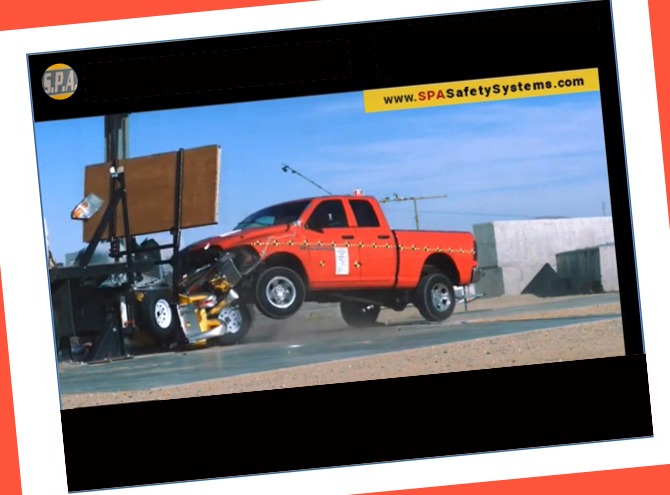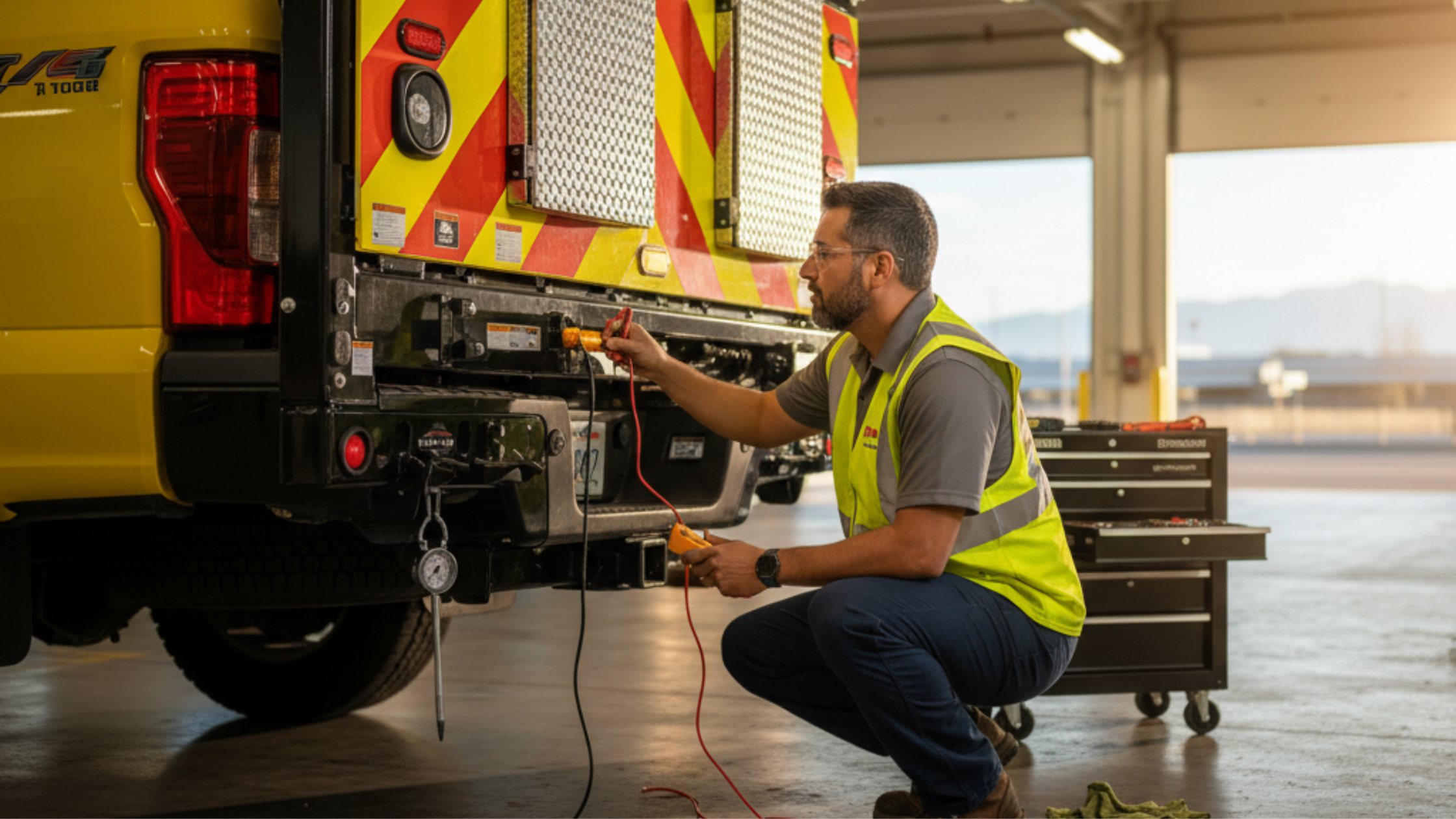
Last June, a contractor in Pennsylvania learned an expensive lesson about preventive maintenance. His crew was three weeks into a major highway resurfacing project when their TMA truck’s hydraulic system failed during morning setup. The attenuator wouldn’t deploy. Work stopped immediately.
The cost?
Two days of downtime, a $15,000 emergency repair bill, penalty fees from the state DOT, and crew wages for workers sitting idle. The worst part? A $200 pre-season inspection would have caught the issue before it became a crisis.
We see this scenario play out every summer. Construction season hits full throttle in June, and suddenly, equipment that’s been sitting through a mild winter or working sporadically in spring is expected to perform flawlessly for twelve-hour shifts in 90-degree heat. That’s when the cracks show up—literally and figuratively.
Why Summer Is Make-or-Break Season for Highway Safety Equipment
The summer construction window is sacred. In northern states, you’ve got maybe four to five months of optimal working weather. Contractors stack projects back-to-back, and state DOTs push to complete as much work as possible before the first frost. There’s zero tolerance for equipment failure because there’s zero room in the schedule to accommodate it.
Your TMA truck isn’t just another piece of equipment during these months. It’s the piece of equipment that determines whether your crew can work at all. No functioning attenuator means no MUTCD compliance, which means no work zone, which means no project.
Everything else on your site—the pavers, the rollers, the dump trucks—becomes irrelevant if your crash truck isn’t operational.
The Five Critical Checks That Save Your Season
1. Attenuator Cartridge Inspection and Crush Element Assessment
The attenuator is the heart of your TMA truck. It’s engineered to absorb impact and save lives, but that engineering only works if the system is maintained properly.
Start with a visual inspection of the cartridge housing. Look for any signs of corrosion, particularly around welds and mounting points. Salt from winter roads is insidious—it weeps into seams and joints, weakening metal over time. A corroded mounting bracket might look fine until an actual impact tests it, and by then it’s too late.
Run your hands along the surfaces. Feel for any soft spots, areas where the material gives more than it should. Look for any discoloration or rust bleeding through. If you’ve got any doubts at all about the integrity of a crush element, replace it. The cost of a new element is negligible compared to the cost of an attenuator that fails to perform during an actual crash.
Check all hydraulic lines running to the attenuator. These lines handle significant pressure during system deployment and retraction. Winter cold makes rubber brittle. Summer heat makes it expand. The combination creates stress points. Look for any cracking, especially near fittings and clamps. A hydraulic line that bursts while you’re deploying the attenuator in live traffic creates exactly the kind of dangerous situation your equipment is supposed to prevent.
2. Electrical System Analysis—The Part Everyone Neglects Until It’s Too Late
Electrical issues account for roughly 40% of the service calls we receive during the summer months. They’re also the most frustrating because they’re often intermittent.
A connection works fine in the morning, fails during the afternoon heat, then mysteriously works again the next day. By the time you bring the truck in for diagnosis, the problem has disappeared.
Start with the batteries.
Heat kills batteries faster than cold does, despite what most people think. Cold weather gets the blame because that’s when batteries fail, but the damage happens during summer. Heat accelerates the chemical reactions inside the battery, causing the electrolyte to evaporate and internal components to corrode.
Load-test your batteries.
A voltage reading isn’t enough. You need to know how they perform under actual operating conditions. Most auto parts stores will do this for free if you pull the batteries out, but it’s worth investing in your own load tester if you run multiple trucks. Battery failure in the middle of a project isn’t just an inconvenience—it can mean your arrow board doesn’t light up, your attenuator won’t deploy. Your truck becomes a very expensive paperweight.
Inspect every ground connection on the truck.
Grounds are boring, so people ignore them, but they’re the source of more electrical gremlins than any other single factor. Road vibration loosens connections over time. Moisture causes corrosion. A ground that’s 95% connected might work fine for basic functions, but fail when you’re drawing higher current for specialized equipment.
Remove each ground wire, clean the connection point down to bare metal, apply dielectric grease, and reattach it. Yes, this takes time and is tedious. But it will save you from pulling your hair out when you’re troubleshooting a mysterious electrical problem in three months.
Check your wiring harnesses.
Engine heat degrades wire insulation. Vibration causes wires to rub against metal brackets, slowly wearing through the protective covering. A wire that’s 90% intact will work until the day it doesn’t, usually at the worst possible moment.
Look at your fuse panel and relay box.
Are the fuses correctly rated? We’ve seen trucks where someone replaced a blown 15-amp fuse with a 30-amp because that’s what they had on hand. That’s not a repair—it’s an electrical fire waiting to happen. Fuses are safety devices. They’re designed to fail before something more expensive (or dangerous) does.
3. Hydraulic System Comprehensive Review
The hydraulic system on a TMA truck does more than deploy the attenuator. It often powers stabilizers, operates dump beds, controls lifts, and handles various other functions depending on your truck’s configuration. It’s a complex system with multiple potential failure points.
Start by checking your hydraulic fluid level and condition
Low fluid means you’ve got a leak somewhere, even if you can’t see it. Hydraulic systems are closed systems—fluid doesn’t just disappear. Find the leak before it becomes catastrophic.
Look at the fluid itself.
Draw a sample and examine it in good light. Fresh hydraulic fluid is clear or slightly amber. Dark fluid indicates contamination. Milky fluid means water has gotten into the system, which is serious. If you see metal particles, you’ve got component wear happening inside the system.
Inspect every hydraulic hose on the truck.k
Focus particularly on areas where hoses flex during operation. Flexing causes internal damage long before you see external signs. Squeeze the hoses—they should feel firm and resilient. If a hose feels spongy or you can feel the internal reinforcement wire breaking down, replace it immediately.
Run your hydraulic system through a complete cycle of all functions
Do this when the system is cold, then repeat it after 20 minutes of running. Some problems only show up when the fluid is at operating temperature. Listen for unusual noises—whining, grinding, or knocking—each indicating a different problem.
Check your hydraulic pu.mp
Is it maintaining consistent pressure? Does it make noise when it’s running? A hydraulic pump that’s starting to fail often becomes louder as internal components wear. Catch it early, and you’re replacing a pump.
Inspect your hydraulic cylinders.
Extend them fully and look for any pitting or scoring on the chrome rods. These rods need to be perfectly smooth. Any imperfection will tear up the seals inside the cylinder, causing leaks. A damaged rod usually means replacing the entire cylinder, because trying to polish out the damage rarely works in the long term.
4. Brake System and Tire Evaluation
Your TMA truck spends a lot of time moving slowly through work zones, but when you need to stop, you need to stop immediately. Brake failure in a work zone poses catastrophic risk not just to your operator but also to the road workers your truck is supposed to protect.
Start with a visual inspection of brake components
Look at the brake pads or shoes. Measure the remaining thickness. Don’t guess. Use calipers or a brake pad gauge.
Inspect the rotors or drum.s
Look for any scoring, cracking, or warping. Run your finger across the surface—it should be smooth. Deep grooves mean rotor replacement. Trying to save money by not replacing damaged rotors is false economy. New brake pads on damaged rotors wear out quickly and don’t perform well.
Check brake fluid level andconditioni.on
Brake fluid is hygroscopic—it absorbs moisture from the air. Over time, this moisture lowers the fluid’s boiling point and causes internal corrosion in brake components. If your brake fluid is dark or murky, it needs to be flushed and replaced.
Test your brake system under l.oad
Find a safe area and perform several hard stops from varying speeds. The truck should stop straight without pulling to either side.
Now move to the t.ires
TMA trucks are hard on tires. They frequently operate at slow speeds where tires build up heat, sit stationary for long periods in the sun and drive over construction debris. All of this accelerates tire wear and damage.
5. Auxiliary Equipment Function Testing
Your TMA truck likely has additional equipment beyond the basic attenuator function. Arrow boards, message boards, impact detection systems, cameras, and various other safety equipment. All of it needs to work correctly because all of it contributes to work zone safety.
Start with your arrow .board
Power it up and cycle through all the display patterns. Watch carefully for any segments that don’t illuminate or that flicker inconsistently. LED arrow boards are generally reliable, but individual LEDs do fail. A few dark LEDs might not seem like a big deal, but they reduce the board’s visibility, particularly in bright sunlight or at a distance.
If your truck has an impact detection system, test it
These systems are critical because they alert operators immediately if the attenuator is struck. A functioning impact detection system means an operator can radio for help immediately rather than discovering the damage during the next setup. Test both the detection mechanism and the alert system.
Check all cameras to see if your truck is equipped with them
Clean the lenses—dusty cameras are nearly useless. Verify that all cameras display properly on the monitor. Check that the system correctly switches between cameras when you change functions (such as shifting into reverse). Make sure the recording function works if your system records footage.
The Real Cost of Skipping Maintenance
Let’s talk numbers because that’s ultimately what drives decision-making in this business.
Project downtime: If your TMA truck fails and you can’t get a replacement immediately, your entire crew stops working. Let’s say you have a crew of eight workers at an average cost of $45 per hour, including benefits. That’s $360 per hour in labor cost for workers who aren’t working. A two-day delay costs you $5,760 in wasted labor alone.
Penalty fees: Many DOT contracts include penalty clauses for project delays. A breakdown that causes a three-day delay could cost you $15,000 in penalties alone.
Lost opportunity: Every day your truck is down is a day you could have been working on another project. During peak construction season, contractors with reliable equipment are turning down work because they’re fully booked. Your broken truck means you’re missing out on that revenue.
Reputation damage: This one is harder to quantify, but just as real. Word gets around in this industry. A contractor who can’t keep equipment operational develops a reputation for unreliability. When DOTs and general contractors are deciding who to hire, reliability matters. You might not lose the current project, but you might not get the call for the next one.
Add it all up, and a breakdown that could have been prevented with a $1,200 maintenance check can easily cost $25,000 to $50,000 when you factor in all the direct and indirect costs.
Creating a Maintenance Schedule That Actually Gets Followed
The problem isn’t that people don’t know maintenance is important. Everyone knows that. The problem is that maintenance keeps getting pushed to next week, next month, or the off-season. Then the off-season arrives,s and suddenly the truck needs to go out on a project right now, and there’s no time for maintenance.
Create a calendar-based maintenance schedule and stick to it religiously. Put it in your project management system. Set up automatic reminders. Assign someone specific to ensure it happens. Don’t let “we’re too busy” become an excuse because being too busy to do maintenance is how you end up with unscheduled downtime when you’re even busier.
Schedule major maintenance during your slowest periods. For most highway contractors in northern states, that’s November through March. Use that time to do the deep-dive maintenance that takes your truck out of service for several days. Replace components that are approaching end-of-life. Update systems that have better versions available. Make improvements while you have the time.
FAQs: TMA Truck Maintenance
How often should I have my TMA truck professionally inspected beyond my own pre-season check?
The answer depends on your usage patterns, but here’s the practical guidance we give most contractors.
If your truck operates daily or near-daily during construction season, you should have a professional inspection at least twice per year—once before the season starts and once mid-season around July or August. That mid-season check catches issues that develop under heavy use before they become failures. If your truck usage is lighter, operating maybe two or three days a week, an annual pre-season inspection combined with regular operator checks is usually sufficient.
What should I do if my truck fails a pre-season inspection and needs major repairs right when I need it for a project?
This is exactly the situation pre-season inspections are designed to prevent, but it happens. First, be realistic about the repair timeline. Pushing a repair shop to rush work increases the likelihood of mistakes and usually doesn’t save as much time as you think. A job done right takes the time it takes. Second, explore rental options immediately. We maintain rental TMA trucks specifically for situations like this. Yes, renting adds cost to your project, but it’s cheaper than breach-of-contract penalties or losing the project entirely.
Can I perform these maintenance checks myself, or do I need professional service?
This splits into two categories: what you can and should do yourself, and what requires professional service. The visual inspections we’ve discussed—looking for obvious wear, checking fluid levels and testing lights and electrical components—are things your maintenance staff or well-trained operators can and should handle regularly. Basic fluid changes, filter replacements, and similar routine maintenance can be done in-house if you have the facilities and trained personnel. However, certain maintenance requires specialized equipment, training, and certification.
The Safety Factor That Trumps Everything
Here’s the part that should matter more than any financial calculation: properly maintained equipment saves lives.
A TMA truck with a degraded attenuator that doesn’t absorb impacts properly doesn’t protect downstream workers. Faulty brakes mean your operator might not stop in time to avoid a collision. Failed lights mean other motorists can’t see your equipment until it’s too late. These aren’t theoretical risks. They’re real scenarios that happen every construction season somewhere in the country.
No one starts their workday thinking today is the day something terrible happens. But terrible things do happen, and usually they happen because something that should have been maintained wasn’t. A component that should have been replaced wasn’t. A warning sign that should have been heeded was ignored.
You can replace equipment, reschedule projectincurnd eat penalty fees and repair costs. What you can’t do is undo an injury or take back a fatality. That’s the real cost of skipped maintenance, and it’s infinite.