
The Hidden Cost of Highway Work Zone Fatalities: OSHA’s 2026 Compliance Crackdown

If you’re running highway construction projects in 2026, you’ve probably noticed OSHA isn’t playing around anymore. The fines are getting steeper, the inspections are getting more frequent, and the tolerance for outdated safety equipment is basically zero. But here’s what most contractors don’t realize until it’s too late – the real cost of highway work zone fatalities goes way beyond the initial OSHA penalty. We’re talking about project shutdowns, skyrocketing insurance premiums, wrongful-death lawsuits that can bankrupt a mid-size company, and a reputational hit that makes bidding on future contracts nearly impossible. OSHA work zone safety compliance is essential to ensure worker safety and to carry out actions with confidence. Let me paint you a picture. Last year, a contractor in Pennsylvania was slapped with a $436,000 OSHA fine after a work zone incident that could’ve been prevented with the proper placement of a TMA attenuator truck. The fine was just the beginning. Their insurance premiums tripled, they lost their pre-qualification status with the state DOT for 18 months, and three major clients terminated their contracts early. The total financial damage? North of $2.8 million. All because they were running old equipment that didn’t meet current OSHA work zone safety compliance standards. Why OSHA Is Coming Down Hard on Work Zone Safety in 2026 Highway work zone deaths keep going up, and the feds aren’t messing around anymore. The Bureau of Labor Statistics numbers tell a brutal story: 857 workers killed in roadway work zone incidents over the last two years. Every single one of those deaths left behind a devastated family. Everyone shut down a job site. The economic damage runs into hundreds of millions of dollars. OSHA saw those numbers and decided the kid gloves were coming off. They’ve completely overhauled how they inspect highway construction sites. Work zone traffic control and equipment standards are getting hammered now. Inspectors aren’t just walking through with clipboards anymore. They’re showing up with engineers. They’re out there with tape measures, checking stopping distances. They’re going through the traffic control plans line by line. Stuff that would’ve gotten you a warning in 2022? Now it’s a citation and a hefty fine. Regional OSHA offices got marching orders from the top: make highway work zones a priority. And they actually got the budget to do it. So what lit the fire under them? Politics played a big role. Federal infrastructure money is pouring into highway projects all over the country—billions of dollars. More projects mean more workers out there in traffic. More exposure to danger. More deaths. Congress wasn’t subtle about it either – show us you’re fixing the work zone safety problem, or we’ll cut your funding. OSHA got the message loud and clear. Here’s the part most people miss, though. Insurance companies are getting absolutely destroyed by wrongful death lawsuits. When a worker dies in a work zone, their family lawyers up and goes after everyone involved. The settlements are massive – often several million dollars per case. Insurance carriers started doing the math and realized they’re bleeding money on these claims. So they went to OSHA and basically said, “You need to enforce the rules harder because we can’t keep paying out like this.” When insurance money and federal oversight start working together, contractors are the ones who get caught in the middle. The Real Costs Nobody Warns You About Let’s break down what actually happens when OSHA catches you operating in a work zone where OSHA work zone safety compliance has not been met. The initial citation and fine are just the tip of the iceberg. Direct OSHA Penalties: Current willful violation fines max out at $156,259 per violation. Serious violations run $15,625 each. But here’s the kicker – they stack. If your TMA attenuator truck doesn’t meet MASH certification requirements, that’s one violation. Project Shutdown Costs: OSHA can issue stop-work orders for serious hazards. Your entire project stops immediately. Crews sit idle but still get paid. Equipment rental charges keep piling up. Your client starts assessing liquidated damages for every day you’re behind schedule. A three-day shutdown on a $5 million highway project can cost you $150,000-$300,000 in direct losses, and that’s before you factor in the domino effect on your other scheduled projects. Lost Bonding Capacity: Surety companies hate OSHA violations. Your bonding capacity – the total dollar amount of projects you can bond simultaneously – gets slashed. If you had $15 million in bonding capacity, you might drop to $8 million after a serious citation. That means you literally cannot bid on larger projects because you can’t get bonded. You’re stuck taking smaller jobs with thinner margins while your competitors eat your lunch on the profitable work. Pre-Qualification Nightmares: State DOTs and major private clients have gotten brutal about safety records. Most now require disclosure of OSHA citations within the past three years as part of pre-qualification. Some automatically disqualify contractors with willful violations. Others assign point systems that make your bids less competitive. New Jersey DOT, for example, can disqualify you from bidding on state contracts for up to three years after serious safety violations. In a state where 40% of highway work is state-funded, that’s a death sentence for many contractors. What OSHA Actually Checks When They Show Up Understanding what inspectors look for helps you know where your vulnerabilities are. OSHA doesn’t inspect randomly – they follow specific protocols, and highway work zones get the white-glove treatment. Equipment Certification and Maintenance: Your crash attenuator trucks better have current MASH certification documentation. Inspectors will ask to see it. They’ll also want maintenance records proving your equipment is in proper working condition. That TMA truck with the hydraulic leak you’ve been meaning to fix? That’s a citation. The attenuator that hasn’t been crash-tested or recertified after its last impact? That’s another citation. Keep detailed maintenance logs for every piece of highway safety equipment you own or rent. Traffic Control Plan Compliance: OSHA requires that your actual setup exactly match your approved traffic control plan.
Highway Work Zone Safety Statistics: Fatalities & Prevention

The New York work zone fatalities statistics are sobering, and they’re getting worse. In 2025, New York State recorded 47 work zone fatalities—an 18% increase from the previous year. Across the tri-state area, including northern New Jersey, where SPA Safety Systems is based, another 31 workers lost their lives in highway construction zones. These aren’t just statistics. They’re fathers, mothers, sons, and daughters who left for work one morning and never came home. If you’re a contractor, project manager, or safety director working on New York highways, these numbers should keep you up at night. Because behind every fatality is a cascade of consequences: a family destroyed, a company facing potential criminal charges, insurance costs that can bankrupt smaller operations, and the psychological trauma that ripples through entire crews who witnessed something no one should ever see. This comprehensive analysis examines what’s happening on New York roadways in 2026, why work zone fatalities continue climbing despite decades of safety improvements, which corridors present the highest risks, what regulatory changes NYSDOT implemented this year, and, most importantly, what actually works to keep workers alive when you’re operating on some of the most dangerous highways in America. The Disturbing Reality: New York Work Zone Deaths Are Rising The 47 work zone fatalities recorded in New York during 2025 represent the highest annual total since 2018. Even more concerning, preliminary data from the first quarter of 2026 suggests this trend isn’t reversing. Between January and March 2026, New York already recorded 14 work zone deaths, putting the state on pace for potentially 55-60 fatalities by year’s end if current trends continue. Compare this to a decade ago. In 2016, New York recorded 32 work zone fatalities. We’ve seen a 47% increase over ten years despite significant investments in safety technology, training programs, and enforcement efforts. Something fundamental isn’t working, and understanding why requires looking beyond simple explanations. The demographics of victims tell an important story. Contrary to what many assume, the majority of work zone fatalities aren’t construction workers—they’re motorists and passengers in vehicles that crashed in work zones. Of the 47 deaths in 2025, 29 were vehicle occupants, 14 were construction workers, and 4 were pedestrians or cyclists who entered work zones. This distribution matters because it reveals that work zone safety isn’t just about protecting workers from traffic—it’s about preventing the crashes that kill everyone involved. Geographic concentration reveals patterns that should inform where we focus resources. Three corridors accounted for 43% of all New York work zone fatalities in 2025: The I-95 corridor through the Bronx, Westchester, and into Connecticut claimed 9 lives. This stretch carries some of the highest traffic volumes in the nation—over 150,000 vehicles daily in some sections. Work zones on I-95 combine everything dangerous: high speeds, heavy truck traffic, frequent congestion that creates stop-and-go conditions where inattentive drivers rear-end slower vehicles, and limited space for protective buffers between workers and traffic. The Long Island Expressway (I-495) accounted for 7 fatalities. The LIE has earned its nickname “the world’s longest parking lot” because of chronic congestion, but that congestion creates a false sense of security. Traffic alternates between crawling gridlock and sudden high-speed flows when congestion clears. Drivers frustrated by delays take risks—aggressive lane changes, distracted phone use, speeding between bottlenecks—that turn deadly when work zones appear. The times when fatalities occur reveal important patterns about causation. Nighttime work zone deaths are disproportionately high relative to the amount of nighttime work performed. While only about 30% of highway work happens between 7 PM and 7 AM, these overnight hours account for 52% of work zone fatalities. Visibility limitations, driver fatigue, and higher rates of impaired driving at night all contribute to this disparity. Weather conditions factor into about one-third of work zone crashes. Rain, snow, fog, and ice don’t just make roads slippery—they reduce visibility of warning signs and traffic control devices, create conditions where drivers focus intensely on the road immediately ahead rather than watching for work zones, and encourage some drivers to follow vehicles ahead too closely because they can’t see far enough to maintain safe distances. Why New York’s Highways Are Particularly Dangerous New York presents unique challenges that make work zone safety harder than in many other states. Understanding these factors helps explain why our fatality rates exceed national averages and what strategies might actually work in our specific context. Proximity to urban centers means that many work zones have nowhere to stage equipment, store materials, or establish safe buffer zones. When you’re working on the Cross Bronx with buildings immediately adjacent to the highway, you can’t create the ideal 500-foot approach taper or position attenuator trucks with generous spacing. You work in constrained spaces where best practices must be adapted to physical reality. The sheer variety of work occurring on New York highways creates complexity that increases risk. On any given day, NYSDOT manages hundreds of active work zones across the state—everything from minor pothole patching to multi-year bridge reconstructions. Each project has different traffic control requirements, different hazards, and different contractors with varying safety cultures. This diversity makes standardization difficult and creates situations where motorists encounter different types of work zones in rapid succession, leading to confusion about what to expect. The Human Factor: Why Drivers Kill Workers While much attention focuses on work zone design, equipment, and regulations, the uncomfortable truth is that most work zone fatalities result from human error—specifically, drivers making bad decisions or losing attention at the worst possible moment. The psychological phenomenon called “inattentional blindness” explains why drivers sometimes literally don’t see work zones despite prominent warning signs. When drivers focus intensely on one task (like checking their phone or adjusting navigation), their brain effectively filters out other visual information. Multiple studies have shown that drivers looking directly at motorcycles, pedestrians, or warning signs sometimes have no conscious awareness of seeing them. Their eyes may have recorded the information, but their brain didn’t process it. This isn’t about intelligence or driving skill—it’s fundamental human neurology.
Work Zone Safety: Daily Inspection Checklists & Best Practices
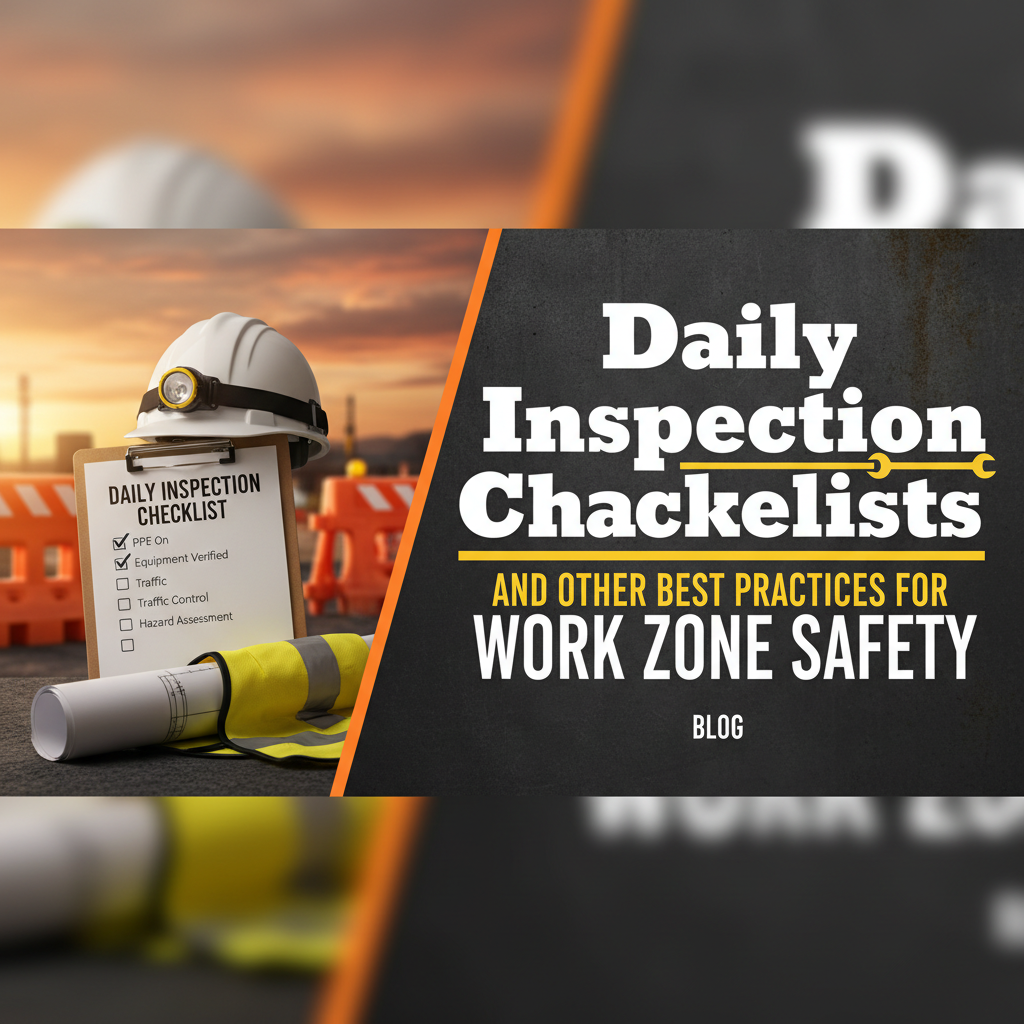
Work zones are among the most dynamic and unpredictable places in the entire construction industry. Traffic volumes fluctuate by the minute, equipment is constantly on the move, and a single oversight can put workers and motorists in jeopardy. A written work zone safety program is never enough on its own; it has to be brought to life every day in the field. That is precisely what a daily inspection checklist does. In this article, we’ll dig into why these checklists matter, what they should cover, and which actions really keep work zone hazards minimal. Why Daily Safety Inspections Are Essential? When you’re working just inches from fast-moving traffic, there’s no room for shortcuts. Construction zones are exposed to the public and packed with heavy equipment—one wrong move can have serious consequences. Add to that the fact that work zones are constantly changing. Lanes shift, detours pop up, and what was safe yesterday might be a hazard today. A daily checklist is the only way to ensure you don’t miss a new risk. On top of safety concerns, there’s a legal side to all this. OSHA, the MUTCD, and state DOTs all mandate regular inspections, and after any incident, investigators will want to see your paperwork. If you don’t have proper documentation, you’re already on the back foot. Finally, your company’s reputation and legal standing are on the line. After a crash, lawyers will want to know if you stuck to your own safety plan and kept records. Having a signed checklist isn’t just good practice—it’s your best protection in court and for your business’s name. Anatomy of an Effective Daily Work-Zone Checklist Below is a sample framework. Adapt it to local regulations, project-specific traffic control plans, and your company’s safety culture. 1. Traffic Control Devices Cones, drums, barricades, and delineators are upright and properly spaced, and reflective sheeting is intact. Warning signs are present in the correct order and at required distances. Dynamic message boards display current, accurate information and are readable in the sun and rain. Temporary pavement markings are visible day and night; no confusing ghost lines remain. 2. Barrier Systems Concrete or water-filled barriers are joined correctly, with no gaps wider than design tolerance. Impact attenuators are reset after any hit, and pins/bolts are in place. End treatments face traffic with proper flare rates and do not protrude into live lanes. 3. Worker Protection All personnel wear Class 2 or 3 high-visibility apparel as dictated by the speed zone. Hard hats, eye protection, gloves, and steel-toe boots are in good condition. Workers on foot are separated from equipment paths by cones, fence, or spotters. 4. Equipment and Vehicle Staging Backup alarms, strobes, and mirrors are operational. Dump trucks and pavers park inside the buffer zone, never in a live lane during breaks. The fueling area is bermed or drip-pan protected to prevent spills onto the pavement. 5. Illumination (for night work) Light towers are positioned to avoid blinding drivers; fixtures exceed 5 lux at the the work surface. Generator cords are routed outside walkways and protected from traffic. 6. Housekeeping and Debris Loose asphalt chunks, rebar, or formwork cleared from travel lanes. Trash cans are available for food waste to deter wildlife from entering the roadway. 7. Emergency Readiness First-aid kits stocked, eyewash bottles unexpired. Fire extinguishers charged, tagged, and within 100 ft of hot-work areas. Site map with GPS coordinates posted for EMS responders. 8. Documentation & Sign-off Inspector prints and signs name, adds date/time. Non-conformances logged with photos and the responsible party. Corrective actions are tracked to closure within the same shift whenever feasible. Beyond Checklists: Eight Work-Zone Safety Best Practices Pre-shift “tailgate” meetings Five-minute huddles to review the day’s phase plan, traffic pattern changes, and individual responsibilities. Workers contribute local knowledge— “That blind curve at Station 112 is slick after rain.” Real-time communication Two-way radios on a dedicated channel minimize confusion. Spotters call out truck movements, and supervisors broadcast sudden lane closures. Require radio checks at the top of every hour. Dynamic traffic monitoring Portable radar, queue-warning trailers, or Bluetooth sensors feed data to a central dashboard. When speeds drop or backups grow, flaggers or variable message signs can react instantly. Positive protection and clever taper design Where feasible, replace cones with barriers. Design tapers long enough for prevailing speeds (L = WS² / 60 per MUTCD) and avoids double merges that lead to last-second lane changes. Night-shift differential Fatigue impairs judgement. Provide shorter rotations, mandatory stretch breaks, and hot beverages. Arrange overlapping shifts so incoming crews get a daylight walk-through before darkness. Joint contractor-agency audits Invite the state DOT or prime contractor to walk the site weekly. External eyes spot hazards that insiders miss and build trust with the client. Near-miss reporting culture Reward, never punish, the reporting of close calls— “The skid steer almost clipped the buffer drum.” Trend these incidents to proactively adjust controls. Leveraging Technology—Without Losing the Human Touch Various mobile apps let inspectors complete checklists on a tablet, attach photos, and push corrective actions to the foreman’s phone. RFID tags on cones and barriers can be scanned to verify placement. Drones provide aerial confirmation of tapers and queue lengths in minutes. Remember, however, that tech supplements but never replace experienced boots on the ground who understand context a sensor cannot see. FAQs: Work Zone Safety Are there are additional safety measures that can be taken? Yes, print checklists on tear-resistant, waterproof paper. Rain-smeared forms are useless in court. Is it a good idea to rotate inspection duty? Yes, rotate the inspection duty among competent persons to keep the process fresh and to build bench strength. Conclusion: Work Zone Safety A well-crafted daily inspection checklist is the backbone of the work zone safety, but it is most powerful when paired with robust communication, positive protection, data-driven adjustments, and a learning culture. Build the habit, document relentlessly, and empower every crew member to speak up. That is how projects finish on time, under budget, and—most importantly—without tragedy. Stay safe out
The Foreman’s Guide to Eliminating Work Zone Rear-End Collisions

Here’s a number that should stop every foreman, contractor, and DOT engineer cold: according to the Federal Highway Administration (FHWA), rear-end crashes are the single most frequent type of collision in work zones. They aren’t just common; they are the dominant threat to your crew and the traveling public. For 25 years, I’ve seen the aftermath. The twisted metal, the project delays, the gut-wrenching phone calls. But I’ve also seen how a smart, layered safety plan can virtually eliminate the risk of work zone rear-end collisions. It’s not about luck; it’s about strategy. Why Rear-End Crashes Dominate Work Zones A work zone is a disruption. It forces drivers to do something they don’t want to do: slow down and pay attention. The core problem is speed variance—the dangerous difference between a car traveling at 65 mph and your stationary operation. When you combine that with today’s epidemic of distracted driving and visibility gaps at night or in bad weather, you have a recipe for disaster. The National Safety Council puts the average cost of a non-fatal injury crash at over $78,000, and that’s before you factor in project downtime, insurance hikes, and potential litigation. Preventing these incidents isn’t just a safety imperative; it’s a financial one. The 5-Layer Defense Against Work-Zone Rear-End Collisions You wouldn’t send a worker into a trench without shoring, so why send them onto a highway without a complete defense system? A single sign or a few cones isn’t enough. You need layers, each one designed to capture a driver’s attention and modify their behavior. Layer 1: Advance Warning Signage & Message Boards Your first line of defense starts long before the first cone. Static signs are the bare minimum. To truly grab attention, you need high-intensity, LED-powered changeable message signs (CMS). These boards allow you to post real-time, dynamic messages like “LEFT LANE CLOSED 1 MILE” or “TRAFFIC SLOWING AHEAD.” Per MUTCD guidelines, this warning should begin at least a half-mile out on high-speed roads, giving even the most distracted driver a chance to process the information and prepare to slow down. Layer 2: Proper Taper Length & Cone Pattern The taper is where you guide traffic out of the closed lane. A taper that’s too short or poorly defined invites chaos. The standard formula is a 15:1 ratio for every 1 mph of posted speed, but I always err on the side of a longer, more gradual transition. It gives drivers more time and space to merge smoothly. High-visibility cones with reflective collars are non-negotiable, especially for night work. This is a fundamental component of rear-end crash prevention. Layer 3: TMA Crash Trucks as Rolling Guardrails This is your crew’s last line of defense, and it’s the most important. A Truck-Mounted Attenuator (TMA) is a mobile crash cushion. It’s a rolling guardrail designed to absorb the kinetic energy of a multi-ton vehicle traveling at highway speeds. Proper TMA crash truck safety dictates placing it upstream of your crew to create a physical barrier. If a driver fails to respond to all other warnings, the TMA sacrifices itself to save your workers’ lives. The energy-absorbing cartridges are designed to be replaced after an impact, a small price to pay for a life saved. Layer 4: Dynamic Speed Feedback & Smart-Work-Zone Tech The best way to manage speed is to make drivers aware of it. Radar speed feedback signs that flash “YOUR SPEED” followed by “SLOW DOWN” are incredibly effective. They break the hypnosis of highway driving. For more complex projects, smart-work-zone systems link message boards, sensors, and even traffic apps like Waze. These systems can detect slowing traffic and automatically update upstream signs, providing real-time warnings that prevent the deadly chain-reaction pileups common in rear-end work-zone collisions. Layer 5: Night- and Low-Light Visibility Kit At night, visibility is everything. Your safety plan must be amplified after sundown. This means using brilliant, full-size Type C [Arrow Boards] that are impossible to ignore, even from a mile away. It means ensuring all your equipment and barricades use high-intensity prismatic (HIP) reflective sheeting. And for the work area itself, portable balloon lights provide 360-degree, glare-free illumination, making your crew and operation visible without blinding oncoming drivers. This is non-negotiable for work zone speed management in low-light conditions. Defense Layer Summary Defense Layer Key Gear Primary Crash-Reduction Effect 1. Advance Warning Changeable Message Signs (CMS) Grabs driver attention early; provides clear instructions. 2. Taper & Channelizing High-Viz Cones, Proper Taper Length Guides traffic smoothly; reduces late-merge conflicts. 3. Physical Protection TMA Crash Trucks Absorbs impact energy; physically shields workers from errant vehicles. 4. Speed Management Radar Speed Feedback Trailers Makes drivers aware of their speed and encourages voluntary slowdowns. 5. High Visibility Type C Arrow Boards, Balloon Lights Overcomes darkness and weather; ensures maximum conspicuity. Mini Case Study: Slashing Rear-End Incidents on the Parkway A paving contractor tackling a series of overnight milling and paving jobs on the Garden State Parkway was plagued by near-misses and two minor rear-end impacts in the first month. Their static sign setup wasn’t enough. After partnering with S.P.A. Safety Systems, they deployed a comprehensive package: two [Attenuator Trucks] for shadow and barrier protection, a radar speed feedback trailer at the start of the warning area, and a smart-work-zone system that linked traffic sensors to their message boards. The result? They cut rear-end incidents by over 60% for the remainder of the project and finished ahead of schedule. 10-Step Traffic-Control Plan (TCP) Checklist Before any cones hit the pavement, run your plan through this checklist: Have you reviewed the MUTCD guidelines for your specific roadway type? Are warning signs placed at the correct distances for the posted speed limit? Is your taper length sufficient for the traffic speed and volume? Is a TMA truck specified as the primary shadow vehicle? Have you incorporated dynamic elements, such as a CMS or a speed feedback trailer? Does the plan account for night work with enhanced lighting and reflectivity? Is there a clear plan for ingress/egress