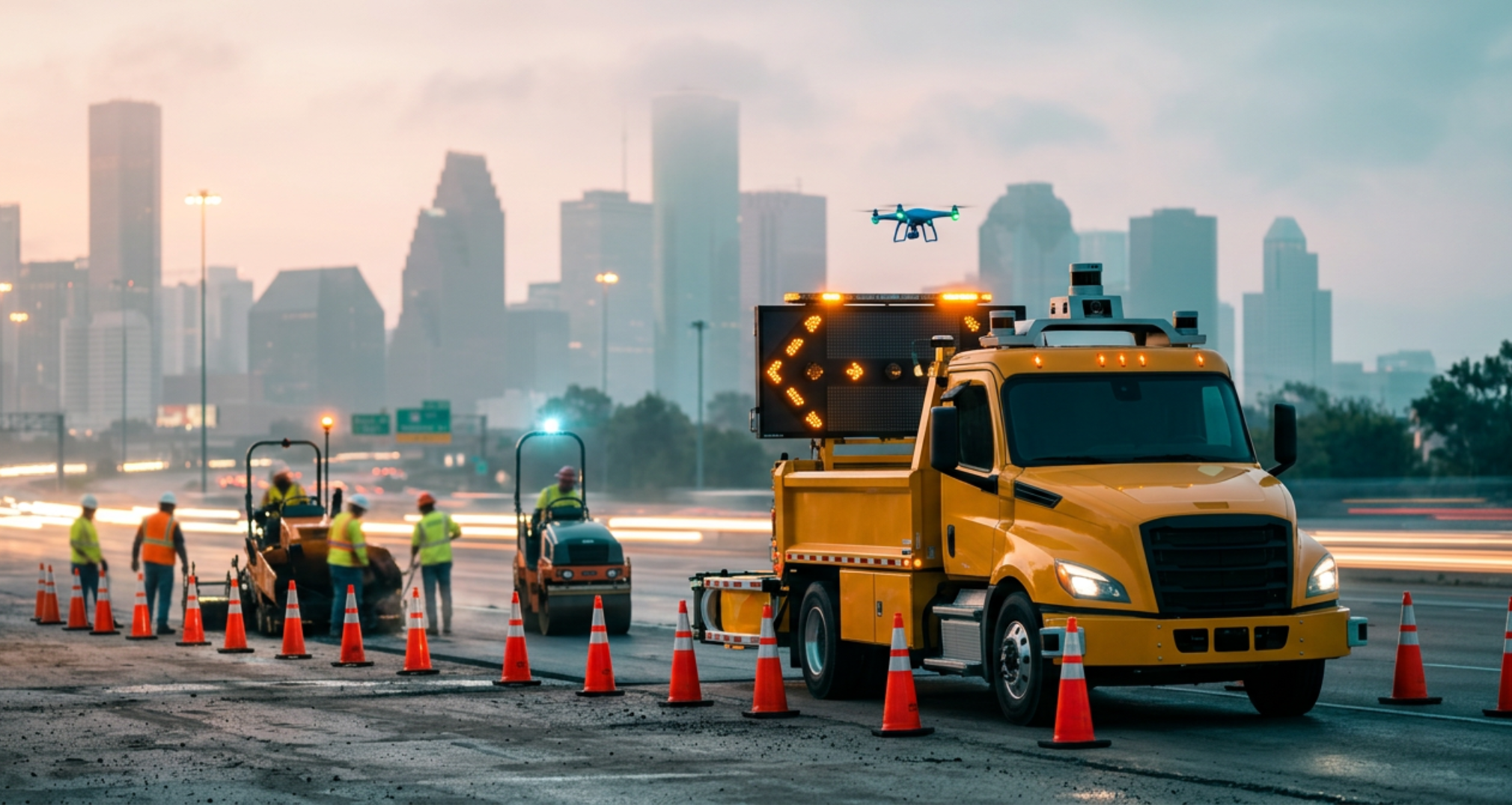
The person whose job is to get hit has always been the scariest seat in any work zone. That’s the TMA driver. They sit in the shadow truck behind the crew and wait. If a distracted driver comes flying into the lane, that truck takes the hit, and so does the person in the cab. That’s finally starting to change. Driverless crash trucks are now working in live traffic. Virginia passed a law for them this year, and your LinkedIn feed is probably full of videos of trucks with nobody behind the wheel. So let’s talk about what an autonomous truck-mounted attenuator is, where they’re running, what they cost, and what this means for highway crews in New Jersey and across the Northeast.
No hype. Just the stuff you need to know.
Why Everyone Is Suddenly Talking About Driverless Crash Trucks
This isn’t a tech-bro trend. It’s coming from a real safety crisis on American roads.
The Numbers Are Rough
Here’s what the latest federal and National Safety Council data shows:
- 850 people were killed in work zone crashes in 2024
- 42,094 people were injured in those crashes the same year
- FHWA says at least two people die in work zones every day
- More than half of fatal work zone crashes in 2024 happened at night
- Rear-end crashes made up 22% of fatal work zone crashes in 2024, up from 21% in 2023
And this one stings the most:
Between 2010 and 2024, fatal work zone crashes jumped 46%. Overall fatal crashes in the US grew only 20% in that same stretch.
So work zones are getting more dangerous faster than the rest of the road. And rear-end crashes are exactly the kind of crash a TMA is built to absorb.
Why 2026 Feels Different
The tech has existed for a while. What’s new is that the rules are catching up.
- Virginia added a new section to its state code in 2026 that allows a pilot program for autonomous truck-mounted attenuators in mobile work zones.
- Colorado, Minnesota, Wisconsin, and Oklahoma helped Penn State researchers build a national ATMA deployment toolkit.
- Federal researchers have published cost-benefit guides so DOTs can decide where driverless TMAs make sense.
Put simply, this has moved past cool demo videos. It’s now a question of when, not if.
Quick Refresher: What a TMA Actually Does
Before we get into the driverless stuff, let’s get everyone on the same page.
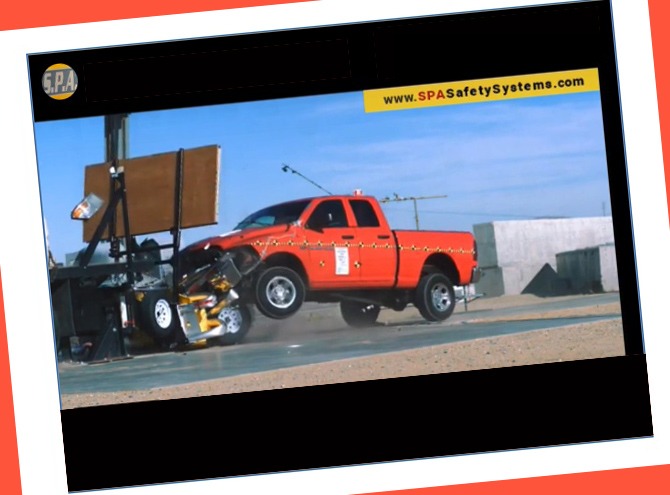
A truck-mounted attenuator is a crash cushion mounted on the back of a heavy truck. It sits behind slow-moving or stationary crews and works like a giant shock absorber.
What a Standard TMA Truck Carries
- An attenuator cartridge at the rear that crushes on impact
- A hydraulic system that raises and lowers the cushion
- Warning lights, strobes, and usually an arrow board
- A trained driver in the cab
Where You’ll See TMAs Working
- Line striping and pavement marking
- Pothole patching and crack sealing
- Sweeping and debris cleanup
- Placing and picking up cones
- Bridge and guardrail work
- Utility work along the shoulder
TMAs don’t replace cones and barrels. They add a layer of protection that cones can’t. A cone won’t stop a pickup going 60 mph. A properly maintained TMA can.
The only weak spot in the setup has always been the person sitting in the truck.
So What Is an Autonomous Truck Mounted Attenuator?
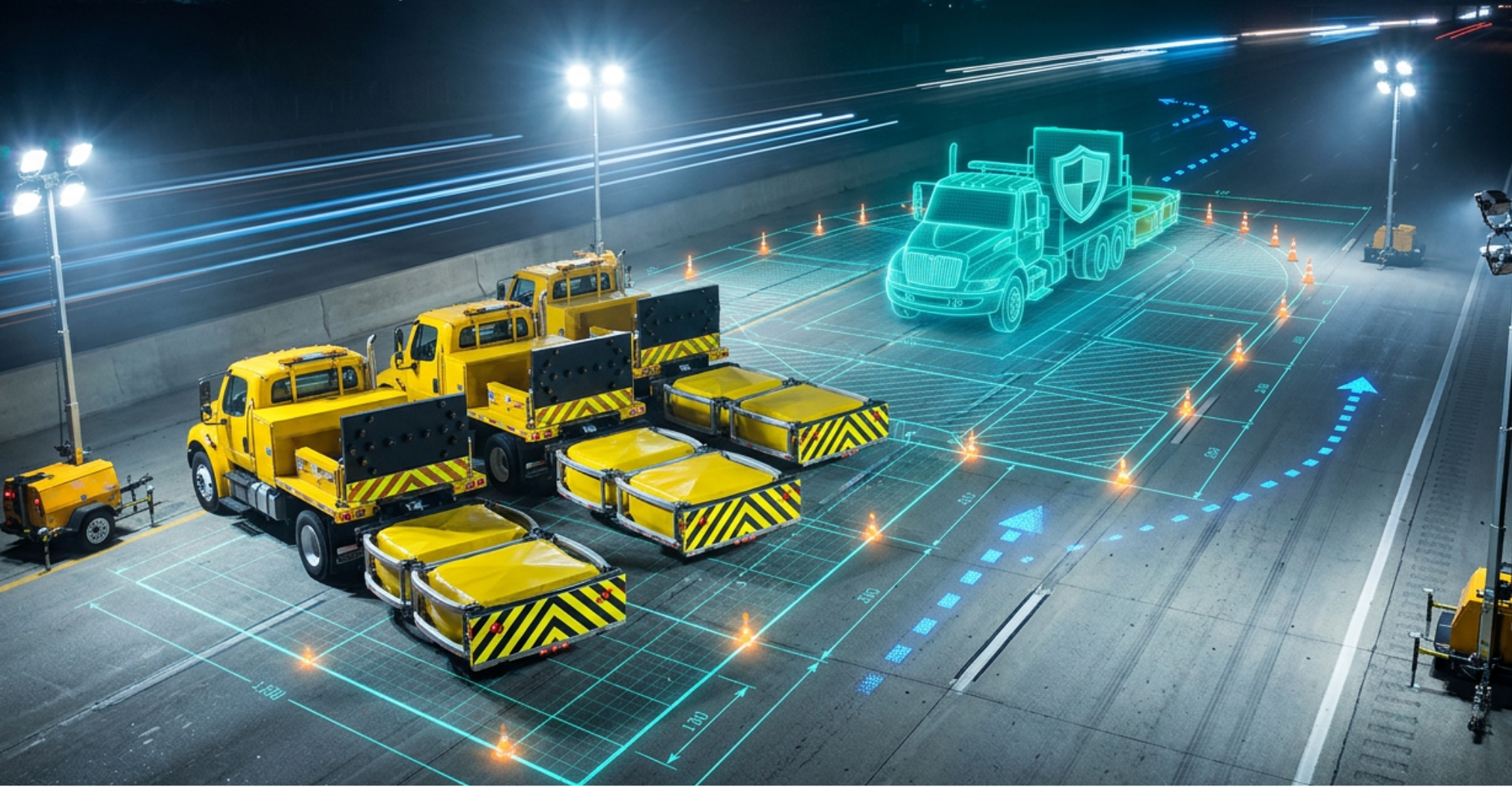
An autonomous truck mounted attenuator (ATMA) is a TMA truck that drives itself, without anyone in the cab, inside an active work zone.
The industry also calls it an Autonomous Impact Protection Vehicle (AIPV). Different name, same idea.
The Leader-Follower Setup
Most ATMA systems don’t work like a Tesla on autopilot. They use what’s called a leader-follower system.
Here’s how it works:
- A human-driven leader truck goes first. This is usually the work truck doing the striping, patching, or sweeping.
- The leader truck sends its position, speed, and direction to the follower truck over an encrypted wireless link.
- The driverless follower truck, which carries the attenuator, copies the leader’s path and stays a set distance behind.
- If something goes wrong, the follower stops.
Kratos, one of the main companies building these systems, calls the data packets “eCrumbs.” It’s basically a trail of digital breadcrumbs the follower truck keeps picking up.
The Tech Under the Hood
A typical ATMA retrofit kit includes:
- High-accuracy navigation. Kratos says its system is accurate to within about 6 inches.
- Vehicle-to-vehicle communication that’s encrypted so nobody can hack in
- Obstacle detection on the front and sides
- Backup systems in case one component fails
- Remote stop controls so the leader or a monitor can stop the truck instantly
No GPS? No Problem (Mostly)
GPS drops out under bridges, overpasses, and especially in tunnels. Early ATMAs struggled with that.
The Virginia Tech Transportation Institute (VTTI) tackled this in its Phase 2 work. The system now uses machine vision (basically cameras and software) when GPS drops out.
In testing, VTTI’s system:
- Ran at speeds up to 35 mph in live road pilots
- Stayed in automated mode for more than 3 hours straight
- Ran a mobile right-lane closure on US 460 and passed under three overpasses
- Worked in GPS-denied spots like the I-564 tunnel area in Virginia
That last one is a big deal for the Northeast, where tunnels, bridges, and tight urban corridors are everywhere.
Where Driverless TMAs Are Already Running
This is the part most people miss. Driverless TMAs aren’t some 2035 prediction. They’ve been quietly working for years.
Early Adopters
| State or Region | What’s Happening |
| Colorado | Tested the first self-driving construction vehicle on US roads, a driverless impact protection truck following a human-driven leader. |
| North Dakota | Started deploying in 2020 for line painting, sweeping, patching, crack sealing, and weed spraying |
| Florida | Ran a pilot and published detailed cost numbers |
| Virginia | Passed a 2026 law allowing an ATMA pilot program on state-maintained highways |
| Minnesota, Wisconsin, Oklahoma | Helped shape the national ATMA deployment toolkit |
| Other states | Kratos reports leader-follower deployments in California, Missouri, Ohio, Indiana, Tennessee, and more. |
The UK has also used these systems on real highway projects.
Virginia’s 2026 Law, Explained Simply
Virginia’s new code section is a useful look at how other states may write their rules. Here’s what it says:
- The state DOT may create a pilot program for ATMAs in mobile work zones
- ATMAs can run in autonomous mode only inside active mobile work zones
- They must use a leader-follower setup
- A remote operator has to monitor them the whole time and be able to see the surroundings, steer, or stop the truck.
- No human driver is required in the cab during autonomous mode
- Outside the work zone, including driving to and from the job, a licensed human driver has to be behind the wheel
- The law is set to expire December 31, 2031, unless it’s extended
That last part about getting to and from the job matters a lot. We’ll come back to it.
What About New Jersey, Pennsylvania, and New York?
The Tri-State area is definitely watching. Penn State researchers co-wrote the national ATMA deployment toolkit, and Northeast DOTs deal with some of the busiest, tightest work zones in the country.
For now, though, most contracts around here still call for a standard TMA with a trained driver. That’s the reality on the ground today.
What Does a Driverless TMA Cost?
Okay, let’s talk money. This is where a lot of the excitement cools off.
The Real Numbers So Far
Here’s what public research shows:
| Cost Item | Florida DOT Pilot Estimate |
| ATMA technology | $250,000 |
| Deployment | $40,000 |
| Yearly maintenance | $5,000 |
| Total over a 5-year life cycle | About $295,000 |
A separate federal planning toolkit estimated the system integration kit at around $298,000 per unit.
And keep in mind, those numbers mostly cover the autonomous tech itself. You still need:
- The truck
- The attenuator
- A leader vehicle set up to work with the system
- Training for operators and crews
- Ongoing vendor support and parts
Why DOTs Still Think It’s Worth It
The same federal toolkit puts the cost of one fatal crash at more than $14 million. Even one serious injury runs into hundreds of thousands of dollars.
So for a state DOT running dozens of mobile operations a year, the math can work out.
For a private contractor running five or ten trucks? That’s a much tougher sell right now.
Real Talk: What Driverless TMAs Can’t Do Yet
We love new tech. But we also fix trucks for a living, so here’s the honest version.
1. They Still Need a Human to Get to the Job
Under rules like Virginia’s, ATMAs only go driverless inside the active work zone. Getting from the yard to the job site still means a licensed driver in the seat.
So you’re not cutting a driver from the payroll. You’re moving that person out of the danger zone during the riskiest part of the shift.
2. If the Connection Drops, the Truck Stops
That’s the right way to fail safely. But in heavy traffic, a crash truck that suddenly stops in place can create its own headache. Crews need clear procedures for when that happens.
3. The National Rulebook Hasn’t Caught Up
Federal researchers point out that the MUTCD (the national rulebook for traffic control) offers very little guidance on ATMA operations. Most state work zone manuals were written for TMAs with drivers.
That means a lot of gray areas on:
- Following distances
- Lane-change procedures
- Who is responsible if something goes wrong
- How to set up the work zone
4. Weather Is Still a Wild Card
Snow, heavy rain, glare, and salt spray can all mess with cameras and sensors. Anyone who’s worked a Northeast winter knows how fast salt crust covers everything.
5. Training Isn’t Optional
The national toolkit says it plainly: ATMA is not a one-time deployment. You need refresher training, vendor troubleshooting support, and a parts plan.
6. The Attenuator Still Has to Work
This is the part people forget. A driverless truck with a worn-out cartridge, leaky hydraulics, or dead strobes is still a bad TMA.
The autonomous kit drives the truck. It doesn’t make the crash cushion any better.
What This Means for Your Crew Day to Day
If you run or work on a highway crew, here’s how things will likely change as ATMAs spread.
Roles Will Shift, Not Disappear
The old setup:
- One driver in the work truck
- One driver in the shadow truck, absorbing the risk
The new setup might look like:
- Lead driver: runs the work truck and keeps an eye on the follower
- Remote operator: watches the ATMA’s cameras and can stop or adjust it
- Transit driver: drives the ATMA to and from the job site
People don’t go away. They move out of the impact zone.
New Skills Will Matter
Crews will need to get comfortable with:
- Tablet-based control screens
- Emergency stop procedures
- Communication checks before every shift
- Reading system alerts and fault codes
Basically, your TMA driver might be partly a fleet tech in a few years. Wild, honestly.
Safety Culture Gets a Reset
When no one is in the shadow truck, some crews might feel safer than they really are. That’s a risk.
The best crews will treat an ATMA like any other piece of safety gear. Check it, trust it, but never assume it’s perfect.
Should You Wait for Driverless or Get a TMA Now?
This is the question we hear most from contractors. Here’s our straight answer.
Don’t wait.
Why Waiting Makes No Sense
- Your contracts need TMAs today. DOT and utility jobs across the Northeast require them right now.
- ATMA rollouts are mostly DOT pilots. Private contractors won’t see them as standard equipment for a while.
- Most ATMA kits are retrofits. They get installed on TMA trucks, so a solid, well-maintained truck still matters.
- The work zone death numbers aren’t waiting either. Every shift without proper protection is a gamble.
Buy, Rent, or Both?
Here’s a simple way to think about it:
Renting makes sense if:
- You have a short-term or seasonal contract
- You want to test before you commit to buying
- You’d like to see how ATMA tech matures before making a big purchase
Buying makes sense if:
- You run TMAs on most jobs, year-round
- You want full control over maintenance and scheduling
- You’re thinking about future upgrades and want a dependable base truck
A mix works if:
- You own a core fleet and rent extra trucks during busy months
- You need special builds for certain jobs
Make Sure Your TMA Is Up to Code
New TMAs bought for federal-aid projects must meet MASH crash-testing standards (the current federal crash-test criteria). If you’re running older equipment, make sure it’s still accepted under your state’s approved products list.
That’s true whether your TMA has a driver or not.
How SPA Safety Systems Helps
We’re S.P.A. Safety Systems, based in Flanders, New Jersey. We work with TMA trucks every day: renting them, selling them, fixing them, and building custom setups.
What We Offer
- TMA attenuator crash trucks for rent and for sale
- Cone trucks, bucket trucks, scissor lift trucks, hi-rail trucks, and rack body trucks
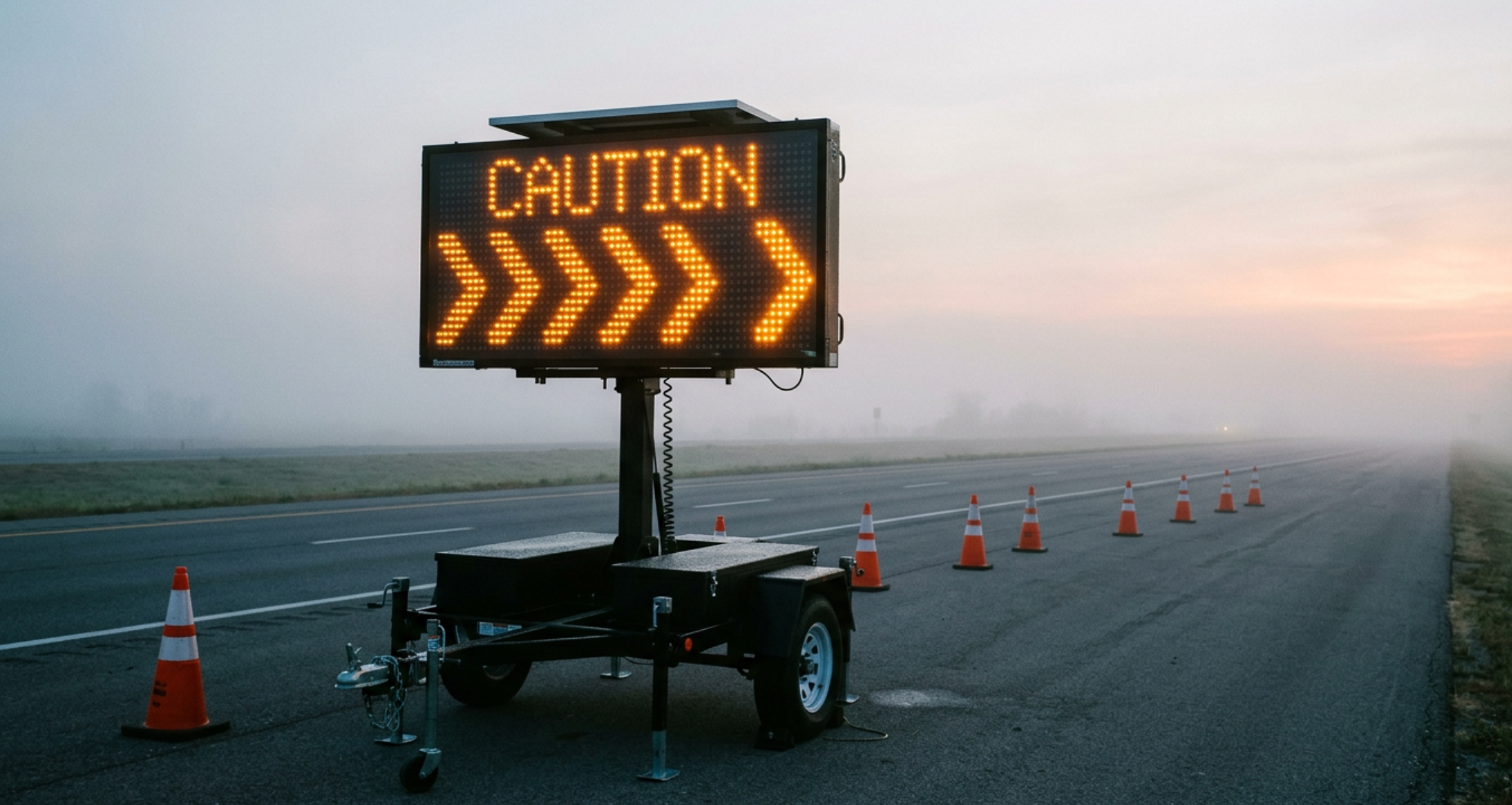
- Message boards and arrow boards for full work zone setups
- Repairs, maintenance, and inspections in our 19,200-square-foot facility
- Custom fabrication built around how your crew actually works
- Road service for the trucks we provide
Why It Matters Right Now
Driverless or not, every autonomous truck-mounted attenuator starts as a regular TMA truck. The better the base truck, the better everything on top of it works.
That’s what we focus on—strong trucks, dependable attenuators, and quick service when something breaks.
Want to see a TMA in action? Watch our TMA video demonstration on the homepage.
FAQs: Autonomous Truck Mounted Attenuator
1. What is an autonomous truck mounted attenuator?
It’s a crash truck that drives itself inside an active work zone. It follows a human-driven lead truck using GPS, cameras, and a secure wireless link. Since nobody sits in the cab, no worker is in the truck when a vehicle hits it.
2. Are driverless TMA trucks legal in the US?
In some states, yes, usually under pilot programs. Virginia passed a 2026 law allowing ATMAs in mobile work zones, as long as a remote operator monitors them and a human drives them to and from the job. Colorado, North Dakota, Florida, and others have run deployments too.
3. How much does an autonomous TMA cost?
Florida DOT’s pilot put the autonomous tech at about $250,000, plus $40,000 to deploy and $5,000 a year to maintain. That doesn’t include the truck or the attenuator. For most contractors, renting or buying a standard TMA is still the practical choice for now.
The Bottom Line
Driverless crash trucks are real, they’re working, and they’ll change how highway crews stay safe.
But the change is happening gradually. For now, most work zones in New Jersey and the Northeast still need a solid, well-maintained TMA with a trained driver.
So protect your crew today. Watch for what’s coming. And make sure your trucks are ready for both.