Highway construction is shifting faster than anyone predicted. Automated cone trucks went from concept to reality in just a few years. Right now, companies are running self-driving systems that deploy traffic control without putting workers in live traffic. It works, it’s getting better, and every traffic control contractor is asking the same thing: what happens when machines replace cone crews?
This isn’t theoretical if you run highway work. The equipment’s already out there. DOTs are updating specs to allow it. Competitors could be pilot-testing it now. In two years, traffic control deployment will look nothing like it does today. You need to know what’s actually happening, ignore the sales pitch, and figure out what it means for your operation. Falling behind now means catching up later might be impossible.
What Automated Cone Trucks Actually Do
Before diving into whether robots are stealing jobs, it helps to understand what these systems actually are and how they function in real-world conditions.
The Basic Technology
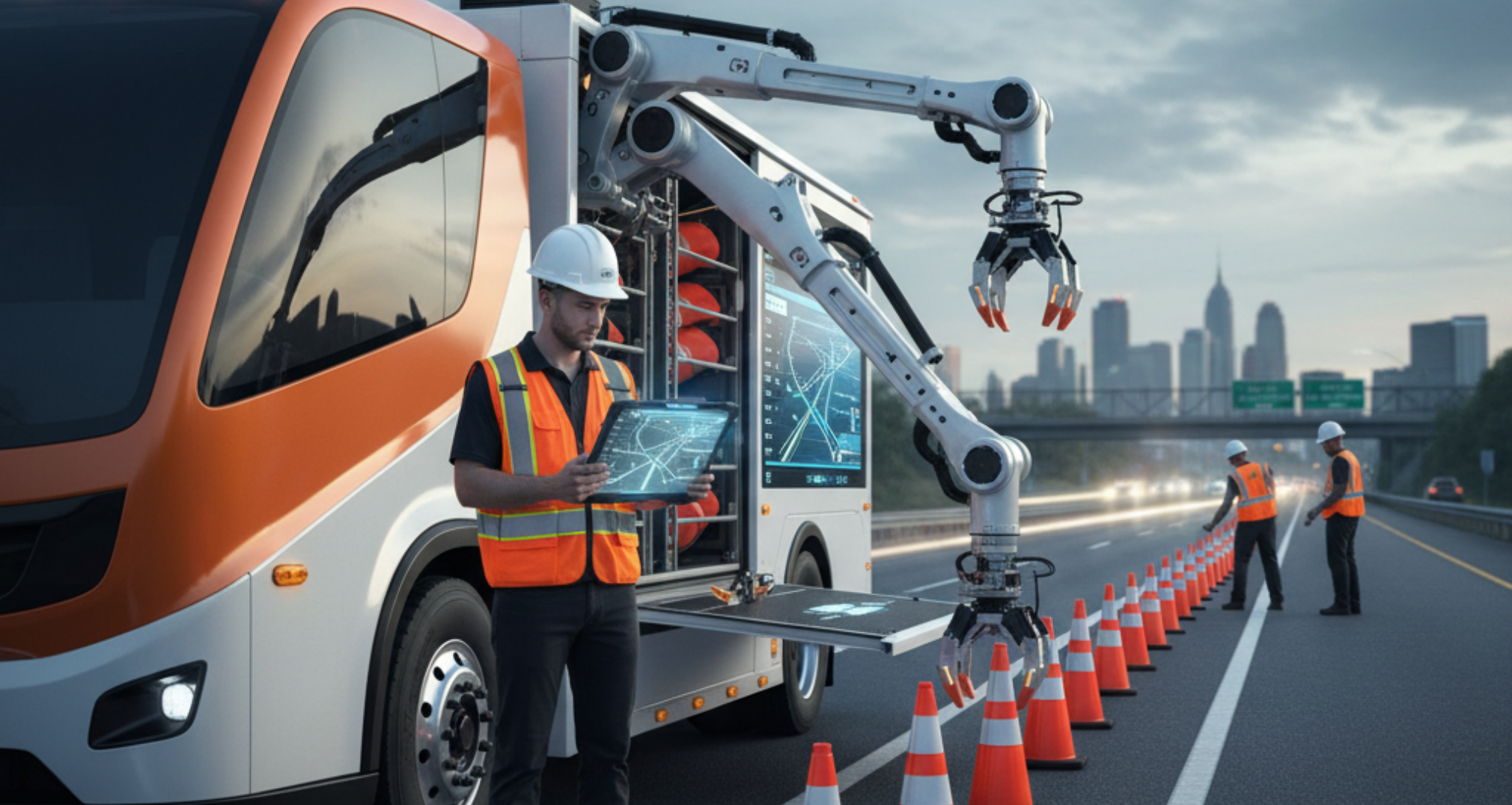
Automated cone placement systems mount on standard highway trucks, often on the same chassis as traditional manual cone trucks. The system includes a magazine that holds anywhere from 50 to 200 traffic cones, a robotic arm or deployment mechanism, GPS guidance, and control systems that manage the placement sequence.
The truck drives down the road at speeds between 5 and 15 miles per hour, depending on the system and conditions. As it moves, the automated mechanism picks cones from the magazine and places them at precise intervals programmed into the control system. GPS coordinates ensure the cones get dropped exactly where the work zone plan specifies. Some systems can also pick up cones on the return pass, loading them back into the magazine without anyone leaving the truck.
The driver stays in the cab watching the system and controlling speed and position. Current setups still require a human operator for safety, judgment calls, and situations the automation can’t handle. These aren’t full self-driving vehicles.
What They Can Handle Right Now
Current automated systems shine on simple highway stretches with decent pavement and visible lane markings. Long straight runs where you’re putting in a basic taper or closing a shoulder? Machines do it well. They drop cones faster than manual crews, nail the spacing every time, and keep workers out of traffic.
The systems handle both daytime and nighttime operations. Some contractors report that automated placement at night is actually easier in some ways because there’s less traffic to navigate around and visibility isn’t as critical when the machine is doing the placement. The consistency of automated systems means every cone goes exactly where it’s supposed to go, which matters when you’re creating a work zone that thousands of vehicles will drive through.
GPS lets these trucks run complicated layouts you program beforehand. Map out your plan in the office, load it to the truck, and the system executes it exactly. Manual crews can’t hit that level of precision, especially at night or in heavy traffic when everyone’s stressed.
Where the Technology Still Struggles
Automated systems hit real limits once you leave ideal conditions. Urban street work with constant turns, intersections, and obstacles throws them off. The sensors and guidance built for highway work get lost in the mess of city streets.
Rough pavement, potholes, and uneven surfaces cause placement issues. The mechanisms rely on relatively smooth conditions to deploy cones upright and in a stable position. When the truck hits a pothole at the exact moment a cone is being placed, that cone might tip over or land several feet from where it’s supposed to be. Manual crews automatically adjust for these conditions, but machines keep following their programming.
The Labor Cost Reality Check
The main selling point for automated cone trucks is cutting labor costs. But when you crunch the numbers with real-world assumptions, the math gets messier than vendors let on.
What You Actually Save in Labor
A standard cone crew is three to four people: one driver and two or three setting and pulling cones. Depending where you are, that’s $25 to $45 per hour fully loaded with wages, benefits, workers’ comp, and taxes.
Four people at $35 an hour total $140. A four-hour job costs $560 in labor for cone work alone. Five jobs a week, 45 weeks a year, and you’re burning about $126,000 annually on cone operations.
An automated truck still requires a driver and typically one helper to handle problems and assist when the automation can’t complete a task. Your labor cost drops to about $70 per hour for two people, down from $140 for four. That’s a savings of $70 per hour, or $280 per day if you’re running four-hour jobs.
Annually, this works out to roughly $63,000 in labor savings. That sounds significant until you remember that you spent an extra $200,000 or more buying the automated equipment and you’re paying an extra $15,000 per year in maintenance. Your breakeven point is somewhere around four to five years, assuming everything goes perfectly and you have enough work to keep the equipment busy.
The Hidden Labor Costs That Don’t Go Away
You still need cone crews with automation. Urban jobs, tricky intersections, tight spaces, and obstacles all need manual placement. You’re not ditching your crew. You’re just using them less on highways while still needing them everywhere else.
That means carrying both: automated gear for straightforward highway work and manual crews for complicated stuff. You’ve piled on costs without eliminating what you wanted to cut. Some contractors get stuck after spending heavily on automation while carrying nearly identical labor costs because they can’t actually eliminate positions.
Training costs are also higher with automated systems. Not only do operators need initial training on the equipment, but they also need ongoing education as software updates and capabilities expand. Your labor pool becomes more specialized, which can create scheduling problems when your trained automated equipment operator is sick or on vacation and you can’t easily substitute another worker.
Workers Comp and Insurance Implications
One legitimate advantage of automated cone placement is reducing workers’ comp exposure. Placing cones in active traffic lanes is dangerous work. Workers get hit by inattentive drivers with depressing regularity. Every time you can keep a human worker out of the travel lanes, you’re reducing the risk of a life-changing injury or fatality.
Your workers’ comp premiums are based in part on the work your employees do. If you can demonstrate that you’ve reduced the most hazardous activities through automation, some carriers will adjust your rates downward. The savings might be several thousand dollars annually, which helps the business case for automation.
How Smart Contractors Are Adapting
Instead of treating automation as either a miracle or a threat, smart contractors are taking measured steps to benefit from the tech while managing the risks and costs.
Hybrid Approaches That Actually Work
Contractors deploy automated systems where they actually help, and stick with manual gear for the rest.
A common hybrid approach is one automated truck for long highway tapers and basic shoulder closures, backed by traditional manual trucks from manufacturers like SPA Safety Systems for city work, tricky setups, and jobs where adaptability matters more than speed.
This allows you to market automation as a differentiator when bidding on certain projects, without abandoning the proven methods that work in most traffic control situations. You’re building experience with the new technology without betting your entire operation on first-generation equipment that might have problems.
Investing in Versatile Equipment Instead
Some contractors are taking a different approach entirely, choosing to invest in better traditional equipment rather than jumping into automation. A well-equipped manual cone truck with good ergonomics, efficient cone-loading systems, and proper safety features might cost $120,000 but provides capabilities you can use on every job.
SPA Safety Systems manufactures cone trucks designed specifically for efficiency and worker safety. Their trucks include features that speed up manual placement and retrieval while reducing the physical strain on workers. The result is productivity that approaches that of automated systems in many applications, at a fraction of the cost and with much more flexibility.
Focusing on the Services Automation Can’t Replace
The smartest contractors are thinking beyond cone placement to the broader range of services required by highway projects. Automated systems might eventually handle straightforward cone layouts. Still, they’re nowhere near managing complex work zones, providing flagging services, coordinating traffic control with multiple contractors, or handling the hundreds of other tasks that traffic control projects entail.
The 2028 Reality: What Will Actually Happen
Predictions about technology adoption are notoriously unreliable, but we can make educated guesses about where automated cone placement will actually stand by 2028 based on current trajectories and industry realities.
Cost Curves Will Improve but Slowly
Equipment prices for automated systems will likely fall from today’s $300,000+ to $200,000-$250,000 by 2028 as manufacturers refine designs and scale up production. Still way more than manual gear, but the gap shrinks some.
More importantly, the capability and reliability of these systems will improve. Second- and third-generation equipment will handle more diverse conditions, require less maintenance, and break down less frequently. The total cost of ownership will become more attractive even if purchase prices don’t drop dramatically.
For contractors who are on the fence about automation now, waiting until 2026 or 2027 to invest is probably a good idea. You’ll get better technology at somewhat lower prices, and the regulatory environment will be more settled. The risk of buying first-generation equipment that becomes obsolete quickly will be lower.
Labor Markets Will Adapt, Not Collapse
The panic about automation killing cone crew jobs by 2028 is probably overblown. Sure, some positions will disappear. Big contractors running five manual crews might drop to three manual plus two automated trucks. That cuts labor demand.
However, the highway construction industry already faces chronic labor shortages. Contractors struggle to find enough qualified workers for the positions they need to fill. Automation that reduces the number of people required for dangerous highway work might actually be welcomed by workers who can move to better positions.
What You Should Do Right Now
Regardless of how automation plays out over the next few years, contractors can take specific actions now to position themselves successfully.
Evaluate Your Actual Automation Need
Start with an honest assessment of how much of your cone placement work would actually benefit from automation. If 80 percent of your traffic control jobs are urban street work, complex intersections, and situations requiring constant adjustments, automation probably doesn’t make sense for you no matter how good the technology gets.
Invest in Quality Manual Equipment Now
Even if automation eventually dominates highway cone placement, that transition will take years. In the meantime, your business still needs reliable manual cone trucks.
SPA manufactures cone trucks and its complete line of highway safety equipment, including TMA attenuator trucks, scissor lift trucks, hi-rail trucks, and bucket trucks. Their custom fabrication capabilities enable them to build trucks tailored to your operation’s unique needs. Equipment purchased from SPA will serve your business productively whether automation takes over or fizzles out.
Build Relationships with Equipment Suppliers
Manufacturers and dealers serving the highway construction industry will be your source of information on automation developments, equipment options, and what’s actually working in the field. Building strong relationships with companies like SPA Safety Systems gives you access to expertise that helps you make better decisions.
SPA’s parts and service department works on equipment from all manufacturers, giving them visibility into what’s happening across the industry. They’re located in Flanders, New Jersey, and operate a 19,200-square-foot facility that handles everything from routine maintenance to custom fabrication. When you need honest advice about whether automation makes sense for your situation, talking to people who see the whole industry is better than relying on vendors selling specific automation products.
FAQs: Automated Cone Trucks
Should I wait to buy any cone trucks until automated systems become cheaper and more proven, or should I invest in manual equipment now, even though it might be obsolete in a few years?
Buy the manual equipment you need now. Your business can’t pause while waiting for automation to mature and prices to drop. Quality manual cone trucks from manufacturers like SPA Safety Systems will perform reliably for at least 10 years, probably more. Even if automation becomes standard on highways by 2030, you’ll still need manual gear for urban work, complex setups, and countless situations where automation doesn’t fit. Manual equipment stays versatile. It won’t become obsolete; it’ll just be used for different project types.
The uncertainty around automation makes waiting risky. What if adoption crawls slower than expected? What if costs stay high? What if your market never goes automated? You’d waste years instead of building your business with gear that works today.
Contact SPA Safety Systems at 973-347-1101 to discuss manual cone trucks and their full range of highway safety equipment. Their team can help you pick gear that fits your current needs and holds value as the industry changes.
If I invest $300,000 in an automated cone truck today, will I regret it in two years when better systems come out for half the price?
That’s a real risk with any first-generation tech. Today’s automated cone systems will get beat by better equipment in a few years. Buy now, and you’re paying top dollar for gear that’ll look outdated fast. Whether that matters depends on your situation.
Large contractor running multiple highway jobs and can’t find enough cone crew workers? The automated truck might pay for itself in three to four years, even with newer tech on the horizon. You’re buying current capability to fix today’s problems, not betting on long-term technology.
Small to medium contractor who only needs cone placement for part of your work? Dropping $300,000 on automation now is too early. Wait another two to three years for second-generation systems that’ll be more reliable, more capable, and probably cheaper. Use that capital on proven manual equipment that works across all your projects instead.
What actually happens to experienced cone crew workers when contractors switch to automated systems? Should I talk to my team about this now, or wait?
The truth is some cone crew jobs will disappear as automation spreads. A crew that needs four people now might only need two with automated equipment. That’s half the labor. But the real impact depends on context.
Good highway workers are already hard to find. Contractors can’t fill positions. Automation might ease staffing problems rather than cause layoffs.
Workers who learn automated systems will likely move into higher-paying roles. Operating a $300,000 automated truck requires more skill than manual cone placement, and that typically means better pay.
Manual cone placement isn’t disappearing. Urban projects, complex zones, and jobs needing flexibility still require human crews even if highways automate.
Should you tell your crew now? Be honest. They’re already hearing about automation and wondering what it means. A straightforward conversation about how tech will change your business over the next five years builds trust. You’ll need skilled workers regardless of equipment. The best job security comes from versatility. Workers who handle manual and automated gear, understand planning, and solve field problems will always have work.
Getting the Right Equipment for Your Business Today
While everyone debates the automated future, your business needs equipment that works right now for the actual projects you’re bidding and winning.
SPA Safety Systems has been building highway safety trucks for decades. Their tagline, “We Set the Standards of TMA Trucks on the Road Today,” reflects their leadership role in the industry. When you’re making equipment decisions that will affect your business for years, that kind of established track record matters more than any single new technology.
The company offers both sales and rentals, which gives contractors flexibility in how they acquire equipment. If you’re not ready to commit capital to a purchase, renting from SPA’s fleet gives you access to quality equipment without the long-term obligation. This is particularly valuable when you’re testing new types of trucks or taking on a project outside your normal scope.
Located at 278 Old Ledgewood Road in Flanders, New Jersey, SPA operates Monday through Friday from 7:30 AM to 4:30 PM. Reach them at 973-347-1101 or by email at austin@westchestermachinery.com. Whether you’re interested in traditional cone trucks, TMA attenuator systems, scissor lift trucks, or any other highway safety equipment, talking to their sales team gives you access to decades of industry experience and straightforward advice about what actually works.
Final Thoughts
Don’t let fear of future automation paralyze your decision-making about the equipment your business needs today. Make smart investments in proven technology from established manufacturers. Stay informed about developments. Adapt when it makes business sense. That approach has worked for successful contractors through every technology transition the industry has faced, and it will work through this one too.