If you’re running highway construction projects in 2026, you’ve probably noticed OSHA isn’t playing around anymore. The fines are getting steeper, the inspections are getting more frequent, and the tolerance for outdated safety equipment is basically zero. But here’s what most contractors don’t realize until it’s too late – the real cost of highway work zone fatalities goes way beyond the initial OSHA penalty. We’re talking about project shutdowns, skyrocketing insurance premiums, wrongful-death lawsuits that can bankrupt a mid-size company, and a reputational hit that makes bidding on future contracts nearly impossible. OSHA work zone safety compliance is essential to ensure worker safety and to carry out actions with confidence.
Let me paint you a picture.
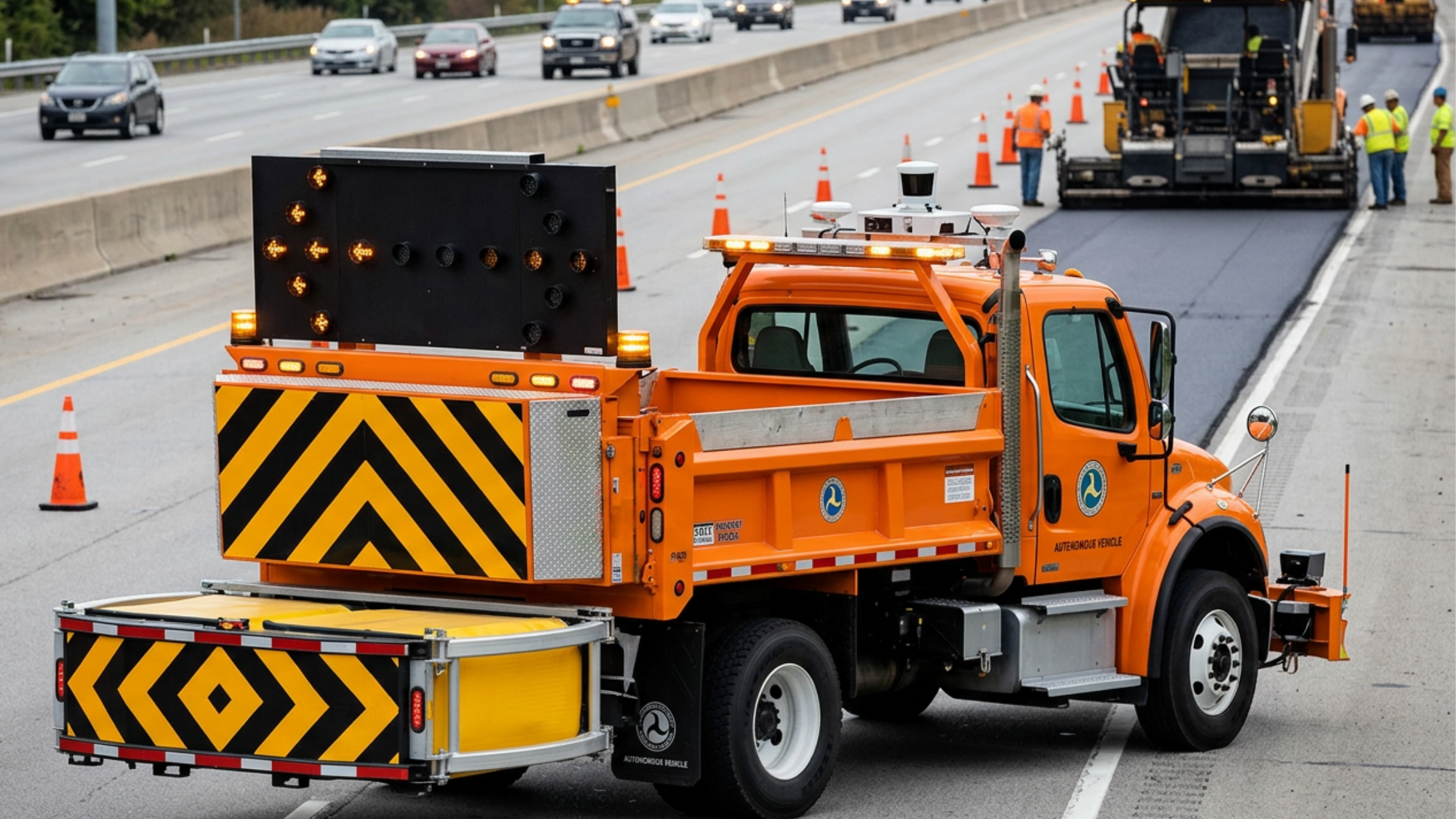
Last year, a contractor in Pennsylvania was slapped with a $436,000 OSHA fine after a work zone incident that could’ve been prevented with the proper placement of a TMA attenuator truck. The fine was just the beginning. Their insurance premiums tripled, they lost their pre-qualification status with the state DOT for 18 months, and three major clients terminated their contracts early. The total financial damage?
North of $2.8 million. All because they were running old equipment that didn’t meet current OSHA work zone safety compliance standards.
Why OSHA Is Coming Down Hard on Work Zone Safety in 2026
Highway work zone deaths keep going up, and the feds aren’t messing around anymore. The Bureau of Labor Statistics numbers tell a brutal story: 857 workers killed in roadway work zone incidents over the last two years.
Every single one of those deaths left behind a devastated family. Everyone shut down a job site. The economic damage runs into hundreds of millions of dollars. OSHA saw those numbers and decided the kid gloves were coming off.
They’ve completely overhauled how they inspect highway construction sites. Work zone traffic control and equipment standards are getting hammered now. Inspectors aren’t just walking through with clipboards anymore. They’re showing up with engineers. They’re out there with tape measures, checking stopping distances. They’re going through the traffic control plans line by line. Stuff that would’ve gotten you a warning in 2022?
Now it’s a citation and a hefty fine. Regional OSHA offices got marching orders from the top: make highway work zones a priority. And they actually got the budget to do it.
So what lit the fire under them? Politics played a big role. Federal infrastructure money is pouring into highway projects all over the country—billions of dollars.
More projects mean more workers out there in traffic. More exposure to danger. More deaths. Congress wasn’t subtle about it either – show us you’re fixing the work zone safety problem, or we’ll cut your funding. OSHA got the message loud and clear.
Here’s the part most people miss, though.
Insurance companies are getting absolutely destroyed by wrongful death lawsuits. When a worker dies in a work zone, their family lawyers up and goes after everyone involved. The settlements are massive – often several million dollars per case. Insurance carriers started doing the math and realized they’re bleeding money on these claims.
So they went to OSHA and basically said, “You need to enforce the rules harder because we can’t keep paying out like this.” When insurance money and federal oversight start working together, contractors are the ones who get caught in the middle.
The Real Costs Nobody Warns You About
Let’s break down what actually happens when OSHA catches you operating in a work zone where OSHA work zone safety compliance has not been met.
The initial citation and fine are just the tip of the iceberg.
Direct OSHA Penalties: Current willful violation fines max out at $156,259 per violation. Serious violations run $15,625 each. But here’s the kicker – they stack. If your TMA attenuator truck doesn’t meet MASH certification requirements, that’s one violation.
Project Shutdown Costs: OSHA can issue stop-work orders for serious hazards. Your entire project stops immediately. Crews sit idle but still get paid. Equipment rental charges keep piling up.
Your client starts assessing liquidated damages for every day you’re behind schedule. A three-day shutdown on a $5 million highway project can cost you $150,000-$300,000 in direct losses, and that’s before you factor in the domino effect on your other scheduled projects.
Lost Bonding Capacity: Surety companies hate OSHA violations. Your bonding capacity – the total dollar amount of projects you can bond simultaneously – gets slashed.
If you had $15 million in bonding capacity, you might drop to $8 million after a serious citation. That means you literally cannot bid on larger projects because you can’t get bonded. You’re stuck taking smaller jobs with thinner margins while your competitors eat your lunch on the profitable work.
Pre-Qualification Nightmares: State DOTs and major private clients have gotten brutal about safety records. Most now require disclosure of OSHA citations within the past three years as part of pre-qualification. Some automatically disqualify contractors with willful violations. Others assign point systems that make your bids less competitive.
New Jersey DOT, for example, can disqualify you from bidding on state contracts for up to three years after serious safety violations. In a state where 40% of highway work is state-funded, that’s a death sentence for many contractors.
What OSHA Actually Checks When They Show Up
Understanding what inspectors look for helps you know where your vulnerabilities are. OSHA doesn’t inspect randomly – they follow specific protocols, and highway work zones get the white-glove treatment.
Equipment Certification and Maintenance:
Your crash attenuator trucks better have current MASH certification documentation. Inspectors will ask to see it. They’ll also want maintenance records proving your equipment is in proper working condition.
That TMA truck with the hydraulic leak you’ve been meaning to fix? That’s a citation. The attenuator that hasn’t been crash-tested or recertified after its last impact? That’s another citation. Keep detailed maintenance logs for every piece of highway safety equipment you own or rent.
Traffic Control Plan Compliance:
OSHA requires that your actual setup exactly match your approved traffic control plan. If your plan calls for a TMA truck positioned 150 feet ahead of the work zone, but your crew places it at 100 feet because it’s easier, that’s a violation.
Inspectors walk the site with your TCP in hand, measuring distances, counting devices and checking positioning. They’re also looking at whether your plan meets Manual on Uniform Traffic Control Devices (MUTCD) standards, which OSHA incorporates by reference.
Worker Protection Zones:
They’re checking whether workers are actually protected from live traffic. Are impact attenuators positioned correctly? Is there adequate positive protection between workers and vehicle traffic? Are warning signs placed at proper intervals?
I’ve seen citations issued because warning signs were 450 feet ahead instead of the required 500 feet. OSHA is precise now.
Equipment Visibility and Lighting:
All your highway safety equipment needs proper lighting and high-visibility markings.
Arrow boards must be functioning and positioned correctly. Warning lights must be operational. If you’ve got a cone truck with burnt-out warning lights, that’s a citation. Reflective markings need to meet current standards and be in good condition – faded reflective tape isn’t compliant.
Temporary Traffic Control Device Standards:
Your traffic barrels, cones, signs, and other devices must meet current MUTCD specifications. Inspectors check height requirements, reflectivity standards, stability, and condition. Cracked signs, faded cones, or devices that don’t meet wind-resistance specifications all generate citations.
Why Your Current Equipment Probably Isn’t Good Enough
Here’s an uncomfortable truth – equipment that was compliant five years ago might not meet current standards. Safety regulations evolve, testing requirements change, and what passed muster in 2021 could get you cited in 2026.
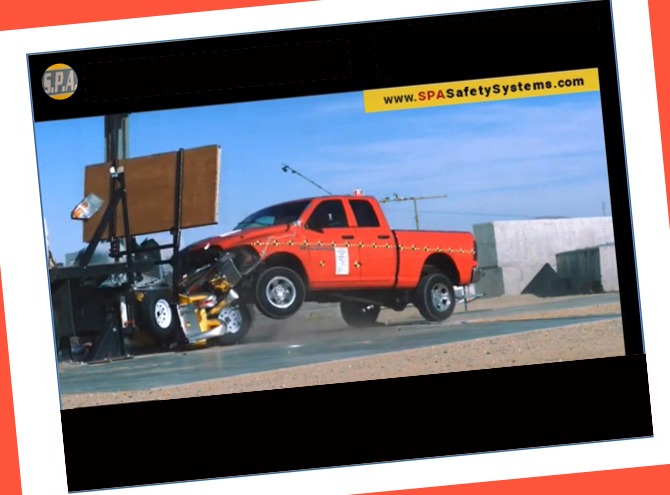
MASH (Manual for Assessing Safety Hardware) testing standards have gotten more rigorous. Older TMA systems tested under NCHRP 350 standards are being phased out.
If your attenuator trucks were certified under old testing protocols, OSHA and DOT are increasingly requiring upgrades or replacements. The testing scenarios are more severe now, crash speeds are higher, and performance requirements are stricter.
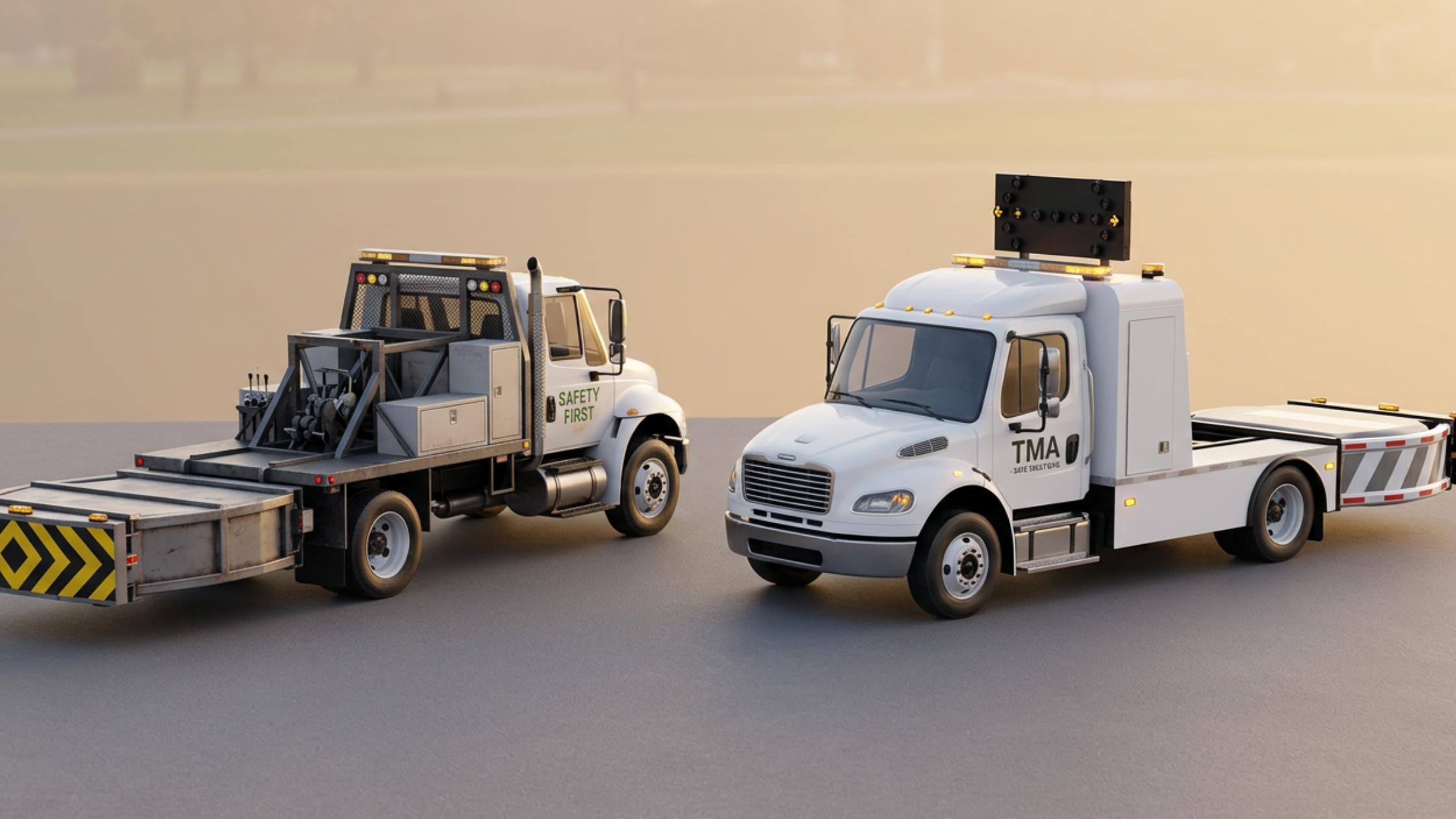
Impact attenuator technology has advanced significantly. Newer systems provide better energy absorption, faster deployment and retraction, and improved protection at various impact angles and speeds.
Visibility and lighting requirements have escalated. LED technology is now the standard, and older halogen or incandescent warning lights no longer cut it. Message boards need full-matrix capability with higher resolution. Static signs have been replaced with dynamic messaging in many applications. Equipment without modern visibility features puts you at risk both for citations and actual incidents.
The Business Case for Upgrading Now vs. Later
Let’s talk dollars and sense. Upgrading your highway safety equipment fleet feels expensive until you run the actual numbers against the cost of not upgrading.
Scenario One – You Upgrade Proactively:
Let’s say you operate three highway crews and decide to upgrade your equipment to current OSHA work zone safety compliance standards.
You invest in three modern TMA attenuator trucks, updated arrow and message boards, new cone deployment systems, and proper maintenance-tracking software. Depending on whether you buy or finance, you’re looking at a total investment of $400,000 to $600,000. Spread that over five years with financing, and you’re paying $90,000-$140,000 annually. Yes, that hits the bottom line.
Scenario Two – You Don’t Upgrade:
You keep running your existing equipment and hope you don’t get caught. For a while, you’re saving that $90,000-$140,000 per year. Then OSHA shows up at a job site. They find your equipment doesn’t meet current MASH standards, your traffic control setup violates MUTCD requirements, and your maintenance documentation is inadequate—boom – $180,000 in citations.
Your insurance company finds out, and your premiums jump $150,000 annually for the next three years. That’s $450,000. The state DOT disqualifies you from bidding on state projects for 18 months, costing you approximately $2 million in lost revenue opportunities.
The total five-year cost of not upgrading? North of $2.5 million in direct and opportunity costs.
The math isn’t even close. Upgrading is the cheaper option by a mile, even before you factor in the reduced risk of actual incidents that could cost lives and destroy your company.
The Financing Advantage:
Most contractors don’t realize that equipment financing is stupidly cheap right now compared to the risk you’re taking by not upgrading. Interest rates on construction equipment loans are reasonable, and the monthly payments are a fraction of the cost of a serious OSHA citation.
Banks and equipment finance companies are actually incentivizing safety equipment upgrades because they’ve done the same risk calculation you should be doing – lending you $500,000 to buy compliant equipment is way less risky than having you operate with old equipment and potentially getting hammered with violations that threaten your ability to repay any loans.
What Compliant Equipment Actually Looks Like in 2026
Let’s get specific about what your fleet needs to meet current OSHA work zone safety compliance requirements.
TMA Attenuator Trucks:
You need MASH-certified systems, period. The attenuator must be tested and certified in accordance with current TMA-a testing protocols. Documentation should include the test report number, certification date, and manufacturer specifications.
The attenuator needs proper maintenance in accordance with the manufacturer’s requirements, with records to prove it. The truck itself needs proper warning lights (LEDs are standard now), high-visibility markings that meet MUTCD specs, and warning signs mounted correctly. Your attenuator trucks should have been inspected within the past 30 days, with documentation available on site.
Arrow Boards and Message Boards:
Full-matrix LED technology is now the baseline. Your boards need to be legible from required distances under all weather conditions, which older technology often can’t achieve.
They need proper mounting at correct heights, usually on trailers with adequate stabilization. Remote programming capability is increasingly expected so boards can be updated without workers entering live traffic lanes.
Cone and Barrel Deployment Systems:
Cone trucks with automated or semi-automated deployment systems are becoming standard because they reduce worker exposure to traffic. Manual cone placement repeatedly puts workers in harm’s way, which OSHA doesn’t love. Modern cone deployment systems let operators place traffic control devices without entering live lanes.
Positive Protection Barriers:
Depending on your work zone configuration, you may need temporary concrete barriers, water-filled barriers, or other positive protection systems to separate workers from live traffic. These need to meet crash-testing requirements and be positioned in accordance with engineering specifications.
You can’t just drop some Jersey barriers and call it good – positioning, anchoring, and transition treatments all matter.
Lighting and Visibility Equipment:
Work zone lighting has to provide adequate illumination without creating glare that blinds motorists. High-visibility apparel for workers needs to meet ANSI/ISEA standards, which have become more specific about what constitutes compliance. Your equipment needs comprehensive visibility markings – retroreflective tape, warning lights and high-visibility paint schemes.
The Parts and Maintenance Problem Nobody Talks About
Here’s something that catches contractors off guard: owning compliant equipment is just step one. Keeping it compliant through proper maintenance is where many companies fall, and it’s where OSHA loves to issue citations.
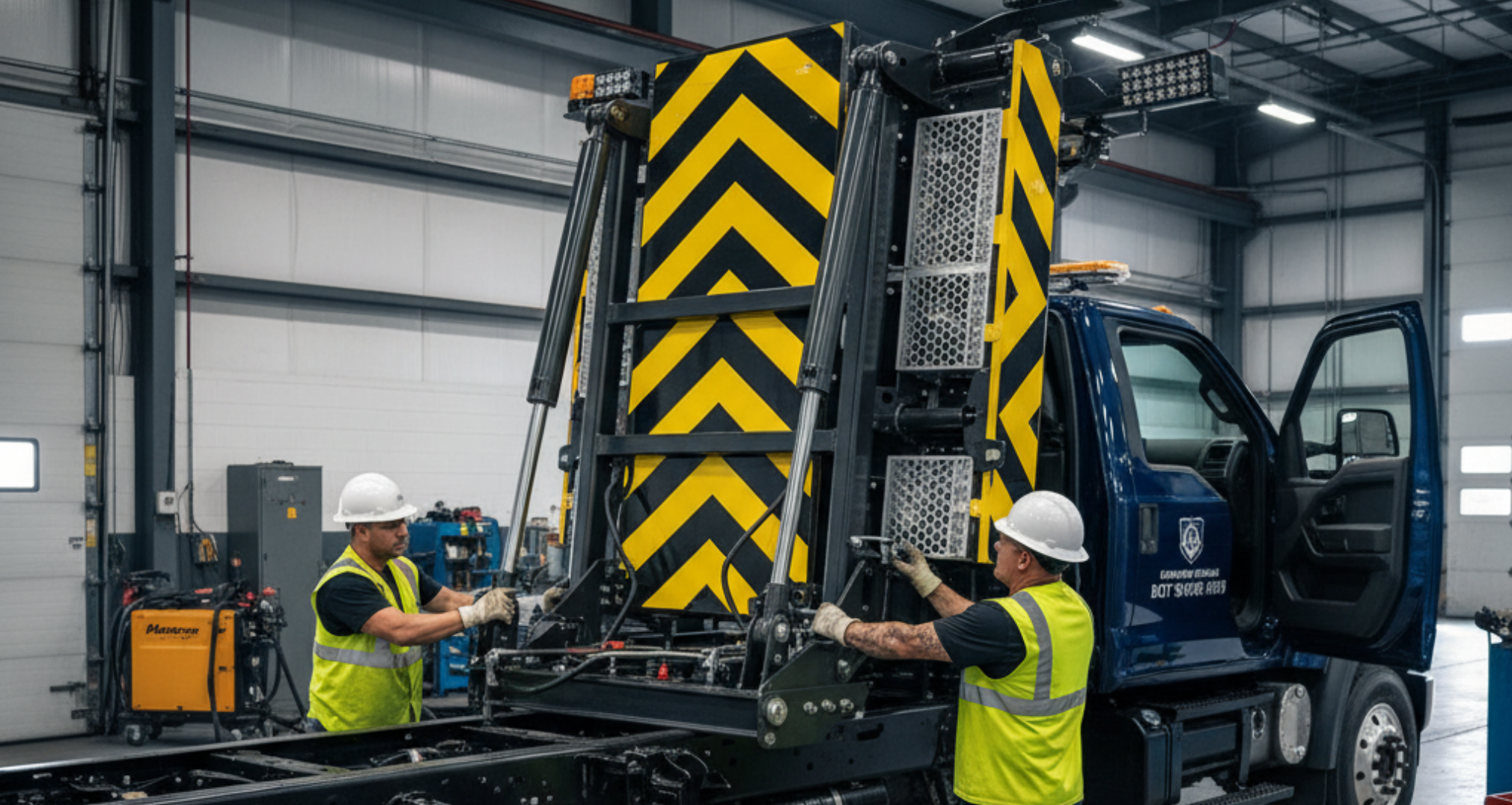
Highway safety equipment takes a beating. Attenuator systems are affected and require repairs or replacement. Warning lights burn out or get damaged. Hydraulic systems develop leaks.
The documentation burden is real. OSHA expects maintenance logs that show regular inspections, repairs performed, parts replaced, and who performed the work. “Our guys check it before each job” doesn’t cut it without written records.
Parts availability becomes critical. When your TMA attenuator gets clipped and needs repairs, you can’t afford to wait three weeks for parts while the truck sits idle. You need either backup equipment or access to rapid parts and repair services.
Some contractors maintain relationships with providers who stock parts and can turn around repairs quickly. Others keep backup equipment so they’re never stuck, unable to work due to equipment downtime.
What Should You Do Right Now?
If you’ve read this far, you’re probably feeling some urgency. Good. That urgency might save you from a catastrophically expensive OSHA citation or worse, a preventable fatality.
Step One – Audit Your Current Equipment:
Get real about what you’re actually running. Pull out the documentation for every piece of highway safety equipment you own or rent.
Check certification dates, MASH testing standards, maintenance records, everything. Make a list of what’s current and compliant versus what’s borderline or definitely non-compliant. Be honest – lying to yourself now makes the OSHA inspector’s job easier later.
Step Two – Calculate Your Actual Risk:
How many highway work zone days do you run annually? How many active projects are in OSHA’s crosshairs? What’s your current safety record? What’s your insurance situation?
Companies with clean records and good insurance can potentially phase in upgrades. Companies that are already on OSHA’s radar or have received recent citations need to move faster. If you’ve had an incident in the past 24 months, you should assume OSHA will inspect your next highway project and act accordingly.
Step Three – Price Out Solutions:
Contact equipment providers and get actual quotes for what you need. Compare purchase prices, financing terms, and rental rates.
For most contractors, a hybrid approach works – buy the equipment you use constantly, rent specialized items for occasional needs. Get quotes from providers like SPA Safety Systems at 973-347-1101 who understand compliance requirements and can help you spec the right equipment rather than just selling you whatever they have in stock.
Step Four – Make the Investment Decision:
This is a business decision, but it’s one where doing nothing is choosing the most expensive option. Even if you need to finance equipment or adjust project bids to cover rental costs, do it.
The alternative is gambling your entire business on not getting caught with non-compliant equipment. Those are terrible odds.
Step Five – Implement Maintenance Systems:
Buying compliant equipment is worthless if you don’t maintain it properly. Set up inspection schedules, create maintenance logs, assign responsibility for keeping records, and actually follow through.
This doesn’t require fancy software – a three-ring binder with checklists and a disciplined approach works fine. What doesn’t work is assuming equipment takes care of itself.
Why This Is Actually an Opportunity
I know this whole article sounds like doom and gloom, but there’s an upside angle here that smart contractors are already exploiting.
While your competitors are dragging their feet on upgrades and hoping they don’t get caught, you can use compliance as a competitive advantage.
Clients increasingly care about contractor safety records. They’re tired of projects getting shut down due to OSHA violations. They’re worried about liability exposure from working with contractors who cut corners.
When you can demonstrate that you’re running current, compliant equipment with solid maintenance programs and good safety records, you become the low-risk option. That’s worth money. Smart contractors are using their equipment investments as selling points in bids and negotiations.
Bonding companies love contractors who invest in safety. Better safety records mean better bonding terms and higher capacity. That means you can bid on larger, more profitable projects.
Some of the fastest-growing highway contractors in the country are growing precisely because their safety investments allow them to access work that their competitors can’t bond.
Worker recruitment and retention get easier when you’re known for taking safety seriously.
The New Jersey Advantage
Since SPA Safety Systems is based in Flanders, New Jersey, it’s worth noting that the New Jersey market is particularly strict on work zone safety.
New Jersey DOT is ahead of many states on safety requirements, which means contractors working in NJ are basically getting a preview of where the rest of the country is heading.
The flip side is that companies operating in New Jersey that get their equipment and practices up to par are automatically positioned well for work in other states. If you can meet New Jersey’s requirements, you can work anywhere. That geographic flexibility has real value.
FAQs: OSHA Work Zone Safety Compliance
How much does it typically cost to upgrade a highway construction company’s safety equipment fleet to current OSHA compliance standards?
For a mid-size contractor running 2-3 highway crews, you’re typically looking at $400,000-$600,000 for a complete fleet upgrade, including modern TMA attenuator trucks, updated arrow boards, message boards, cone deployment systems, and necessary accessories. However, this doesn’t have to be a one-time cash payment.
Equipment financing spreads costs over 3-5 years at reasonable interest rates, resulting in roughly $90,000-$140,000 in annual payments. Alternatively, rental programs let you access compliant equipment without a capital outlay, though long-term costs may be higher if you use it frequently.
What’s the difference between older NCHRP 350 certified equipment and newer MASH certified equipment?
NCHRP 350 was the previous crash-testing standard, which the Manual has replaced with the Assessing Safety Hardware (MASH) standard. The key differences are that MASH uses more realistic test conditions, including higher impact speeds, a wider range of vehicle types that better represent current traffic, and more severe impact angles.
Equipment certified under NCHRP 350 was tested at lower speeds and under less demanding conditions. While some NCHRP 350 equipment may still technically function, OSHA and state DOTs are increasingly requiring MASH certification because it represents current safety performance standards.
Can I just rent highway safety equipment instead of buying it, and will that keep me compliant with OSHA requirements?
Renting can absolutely keep you compliant, but you need to be strategic about it. The advantage of renting from reputable providers like SPA Safety Systems is that they maintain the equipment, handle certification documentation, and ensure everything meets current standards – basically outsourcing your compliance burden to people who specialize in it.
This works particularly well if you’re running highway work zones occasionally (say, under 100 days annually) or if you need specialized equipment for specific projects. However, you need to verify that rental equipment actually meets current OSHA work zone safety compliance standards – don’t assume all rental companies keep their fleets up to date.
Final Thoughts: Don’t Wait for the Citation
Look, I get it. Equipment upgrades are expensive, change is annoying, and there’s always a voice in your head saying, “We’ve been doing it this way for years without problems.” But that voice is lying to you. The compliance landscape has fundamentally changed.
OSHA isn’t giving warnings anymore – they’re issuing citations. Insurance companies aren’t cutting slack – they’re raising rates. Clients aren’t overlooking safety issues – they’re disqualifying contractors who have them.
The contractors who survive and thrive over the next five years will be the ones who recognize that highway work zone safety equipment isn’t an expense, it’s an investment that protects everything else they’ve built.
Your reputation, your bonding capacity, your insurance costs, your ability to bid on profitable work, your workers’ lives – all of it depends on getting this right.
Make the investment now, do it right, and sleep better knowing your business isn’t one inspection away from disaster.</p>
Contact SPA Safety Systems at
973-347-1101 or reach out to Austin at austin@westchestermachinery.com to discuss your specific equipment needs and compliance requirements related to OSHA work zone safety. They understand what it takes to keep highway work zones compliant and workers safe because that’s literally all they do. Whether you need to buy, rent, get equipment repaired, or have questions about what compliance actually requires, they can help you figure it out.