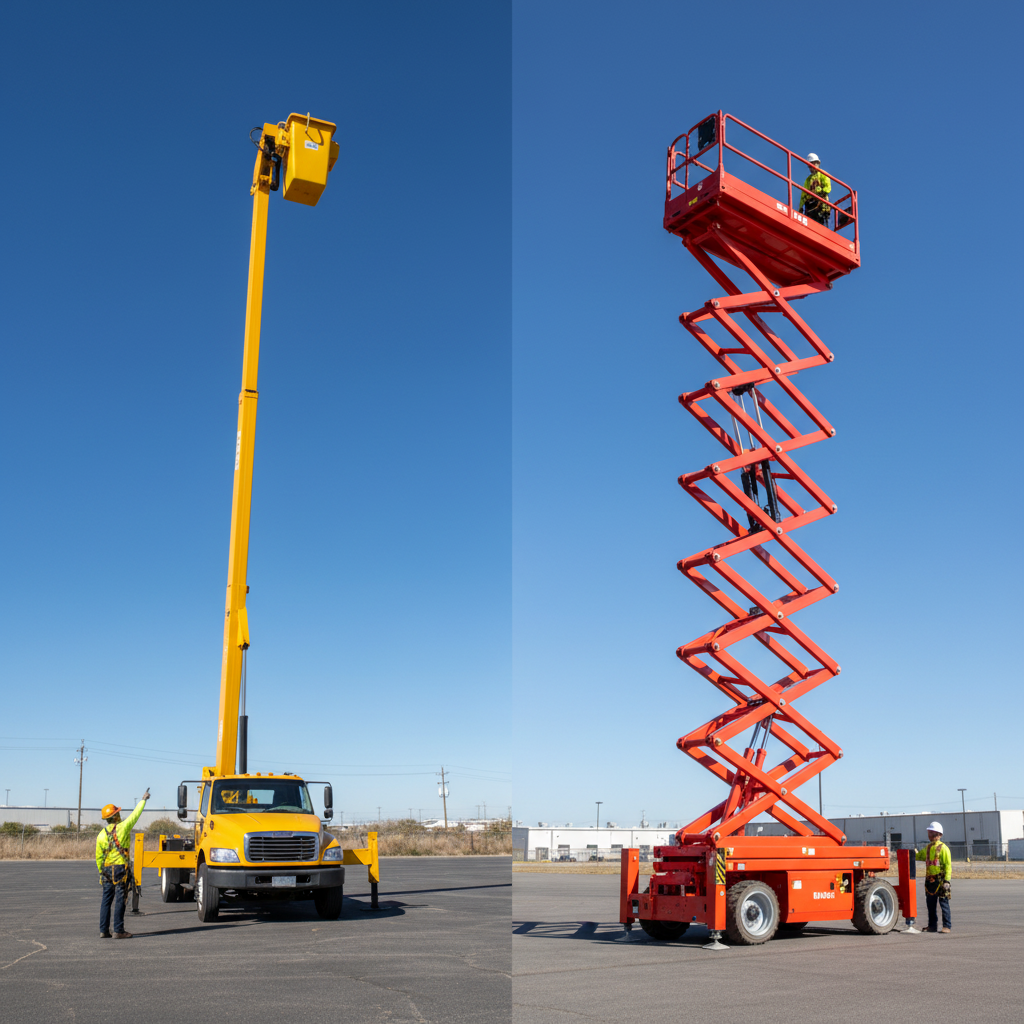
Getting your crew off the ground usually comes down to two main options: the scissor lift or the bucket truck. On paper, they seem to do the same thing—they lift people and tools into the air. But ask anyone who has actually run a job site, and they’ll tell you these machines are completely different animals.
One gives you a wide, stable deck for heavy materials; the other gives you the reach to get over obstacles and out to the street. If you grab the wrong set of keys, you aren’t just looking at wasted rental fees. You’re dealing with stalled timelines, frustrated workers, and safety hazards you didn’t plan for.
Here is a blog post that provides a practical breakdown to help you decide which machine is best suited to the job.
Anatomy of Each Machine
Scissor Lifts
- Vertical-only motion: stacked, crisscrossing arms extend straight up.
• Flat work deck: typically, 29–60 in. wide and 4–16 ft long, with slide-out extensions.
• Power source: electric for indoor use; diesel, dual-fuel, or hybrid for outdoors.
• Steering: self-propelled on slab or rough-terrain tires.
Bucket Trucks
- Telescoping or articulating boom mounted to a truck chassis.
• Single fiberglass or metal bucket sized for one or two workers.
• Hydraulic outriggers for stability.
• Road-legal—drive it to the next site without a trailer.
Height, Reach, and Workspace
Platform Height
Scissor lifts typically max out at around 60 ft, though most rentable units are in the 19–40 ft range.
Bucket trucks soar from 35 ft to well over 100 ft.
Horizontal Reach
Scissor Lifts: These machines are strictly vertical. If you can’t park directly underneath the work area, you can’t reach it.
Bucket Trucks: Designed for flexibility, rent a bucket truck because the boom can swing, extend, and bend, you can reach over obstacles like fences or parked cars—a necessity for utility work or painting difficult building exteriors.
Workspace Size
Scissor Lifts: Think of the deck as a floating workbench. There is ample room to stack pipes, fixtures, or tools, and two or three technicians can work side by side without bumping elbows.
Bucket Trucks: It’s tight quarters. The bucket is designed for “point access,” meaning it fits one worker and a few essential tools. It isn’t a place to store materials.
Site Conditions and Mobility
Ground Bearing
Electric slab scissor lifts demand smooth, level concrete and deliver tight turning radii—ideal for warehouses, data centers, and malls.
Rough-terrain scissors ride on foam-filled tires, have four-wheel drive, and use auto-level jacks, but still require firm soil. Deep mud or soft sand bogs them down.
Bucket rental truck can be set up almost anywhere a truck can park. If the soil under an outrigger is questionable, operators place cribbing blocks and continue rolling.
Transport Logistics
Scissors loaded onto a trailer or tilt-bed require tie-downs and add another item to the DOT inspection list.
Bucket trucks drive themselves from job to job; for dispersed utility or tree-care routes, this is priceless.
Set-Up Time
Scissor: deploy pothole guards, raise railings, do a quick walk-around—two minutes tops.
Bucket truck: park, level the chassis, drop outriggers, run a dielectric test if near energized lines—five to ten minutes.
Regulatory and Licensing Nuances
- Bucket rental truck operators often need a Class B CDL for vehicles over 26,000 lb GVWR; some states add a utility-line or arborist endorsement.
- Scissor truck lifts ordinarily require only a site-specific “competent operator” card validated by the employer or rental house.
- Road-going bucket fleets incur FMCSA logs, IFTA fuel reporting, and DOT numbers—a paper trail absent from scissor lift ownership.
Decision Matrix (Quick Reference)
|
Primary Concern |
Choose a Scissor Lift When… |
Choose a Bucket Truck When… |
|
Vertical Height |
≤ 60 ft |
> 60 ft |
|
Horizontal Reach |
0 ft needed |
Up‐and‐over obstacles |
|
Workspace |
Multiple workers/material |
Single worker/light tools |
|
Terrain |
Smooth slab or graded pad |
Varied roadside or off-grid |
|
Daily Moves |
One site all day |
Multiple stops, spread miles apart |
|
Budget |
Lower purchase/rental |
Budget accommodates CDL chassis |
| Electrical Proximity | Indoor or de-energized |
Live utility lines need insulation |
Real-World Scenarios
- Warehouse Racking Upgrade
– A 26 ft electric scissor glides through standard 8 ft aisles, lifts two installers plus a pallet of uprights. Bucket truck? Overkill and can’t get through the dock door. - Downtown Streetlight Retrofit
– Bucket rental truck parks curbside reaches over parked cars, and changes LED fixtures every 200 ft without unloading a trailer. A scissor lift would crawl through traffic lanes and demand police escorts. - Solar Farm O&M
– Rough-terrain scissor lifts carry wash systems and tool crates down endless rows of panels. The panels sit only 15 ft high, so reach is irrelevant; deck space is priceless.
Conclusion
There is no universal winner here. The scissor lift is a reliable workhorse for vertical jobs on stable ground, while the bucket truck is the specialist you need for reach and mobility. Making the right call means looking beyond the daily rental rate. You must match the machine to the site’s actual constraints—the terrain, obstacles, and crew size. Spend a few minutes planning the logistics before you sign the paperwork. It is much easier to fix a mistake on the ground than to realize you’re stuck with the wrong equipment sixty feet in the air.
Need more information? Head towards S.P.A. Safety Systems and get your questions answered!