
Illuminating Night Work Zones with LED Arrow Boards

Driving through a work zone after dark without the LED arrow boards guiding you feels different from cruising the same road in broad daylight. When the city noise thins out and traffic lightens, the roadway can feel almost peaceful—like the danger has passed. But that calm is misleading. At night, visibility collapses, depth perception plays tricks, and your buffer for mistakes shrinks to almost nothing. One small slip—an unintentional lane drift, a moment of hesitation on the brakes—can turn an orderly construction area into a fast-moving emergency. That’s why nighttime work-zone safety lives or dies on one thing: drivers getting clear warnings early enough to act. Contractors can’t lean on the old-school, passive setups that used to be considered “good enough.” The modern standard demands more, and for good reason. LED arrow boards and Portable Changeable Message Signs (PCMS) have become essentials, not extras, because they communicate in the language drivers respond to fastest in the dark—bright, high-contrast, active light. It isn’t just preference; it’s biology. In low-light conditions, a driver’s eyes and brain lock onto movement and illumination far sooner than they register reflective cones or static metal signs. Flashing directional arrows and dynamic messages cut through the visual noise, trigger quicker recognition, and buy those critical extra seconds that prevent confusion, sudden swerves, and rear-end collisions. In a nighttime work zone, those seconds are the difference between a smooth merge and a chain reaction. In this blog, we will discuss the benefits of illuminating night work zones with LED arrow boards and message boards. The Four Horsemen of Night-Time Risk The night doesn’t just darken the road; it fundamentally alters the physics and biology of driving. Let’s see why advanced signalling isn’t just a luxury but a necessity. The Erosion of Visibility The most immediate threat is the degradation of the driver’s perceptual bandwidth. Darkness operates like a filter, stripping away critical data points. Peripheral vision narrows significantly, color washes out into grayscale, and the depth perception usually provided by shadows and horizon lines vanishes. Barriers that look solid and imposing at noon can dissolve into vague, gray shapes at midnight, blending dangerously with the pavement until a driver is nearly on top of them. The weather makes this infinitely worse. Rain on a dark highway turns the asphalt into a black mirror, scattering light and obliterating lane markers. The Biological Battle Against Fatigue Beyond the visual, there is the inescapable reality of human physiology. Fatigue is the silent, pervasive threat of the night shift. Our circadian rhythms are hardwired to demand rest between 11:00 p.m. and 5:00 a.m.—the exact window when overnight construction is most active. Drivers navigating these zones aren’t just bored; they are fighting a physiological war against sleep. Many are battling heavy eyelids and experiencing “microsleeps,” causing reaction times to plummet. The data is precise: drowsy driving is a leading culprit in severe nocturnal crashes, meaning the person behind the wheel may not even be fully conscious until impact is imminent. The Trap of the Open Road Ironically, the lack of traffic creates its own hazard: speed. The empty road offers a seductive, false sense of security. Without the “visual friction” of bumper-to-bumper traffic to slow them down, motorists unconsciously creep above the speed limit. This creates a deadly physics problem. A car moving at 80 mph needs a massive distance to stop, yet the driver’s visibility is limited to the short reach of their headlights. They are effectively overdriving their eyes—traveling faster than they can see. When a lane closure appears out of the gloom, the gap between their speed and their sight distance leaves zero room for error. Sensory Overload in the Work Zone Finally, we must consider the crew’s vulnerability. Inside the barrels, workers are facing a sensory storm. Precision work—whether it’s milling pavement or rigging steel—requires absolute tunnel vision. However, the work zone itself is an auditory and visual chaotic mess, filled with the screaming of diesel engines, the beep of backup alarms, and the harsh glare of balloon lights. In this environment, a worker’s senses are overwhelmed. They are unlikely to hear or see a speeding vehicle breaching the safety taper until the moment it is too late to move. The Technological Pivot: The Science of LED Arrow Boards The transition to Light Emitting Diode (LED) technology has revolutionized this sector. Modern LED arrow boards are not just brighter; they are more innovative and more efficient. Instantaneous Intensity Unlike incandescent bulbs, which require a split second to warm up to full brightness, LEDs are instant-on. This crisp, immediate activation creates a sharper visual signal that cuts through the visual clutter of a roadway. Energy Autonomy The leap in energy efficiency is transformative. Modern LED boards slash power consumption by up to 80% compared to legacy equipment, enabling them to operate autonomously for weeks on solar panels and onboard batteries alone. Optical Precision Modern LED’s use advanced optics to create directional, high-contrast beams. They are designed to pierce through headlight glare, fog, and rain. The light is explicitly focused where it is needed—at the driver’s eye level—rather than spilling uselessly into the night sky. Strategic Deployment: Best Practices for Safety Owning the right equipment is only half the battle; deploying it correctly is what saves lives. Traffic control managers must adhere to a rigorous set of best practices. 1. The Night-Time Audit Planning cannot happen solely on paper. Before a project begins, safety managers should conduct a nighttime drive-through audit at the posted speed limit. This reveals hazards that are invisible on a blueprint: a billboard that distracts from a warning sign, a curve that hides the taper, or vegetation that blocks a solar panel. 2. Pattern Selection One size does not fit all. Sequential chevrons are the gold standard for lane closures. However, for shoulder work where the lane remains open, a “caution mode” (flashing corners) should be used. Using a directional arrow when no lane change is required is dangerous and can cause motorists to drive into
The Superintendent’s Call: Trailer vs Stand Boards for Your Work Zone

I remember standing on a Route 46 overpass in the chilly 3 a.m. air, the hiss of air brakes the only sound. My foreman and I were in a heated debate. We had a tight lane closure window, and the choice was simple but critical: drag the big trailer arrow board into a tight spot, or could we get away with a couple of compact stand boards and beat the sun? That decision—trailer vs stand boards—is one every crew faces. Get it right, and you’re efficient and safe. Get it wrong, and you’re burning payroll, missing deadlines, and creating unnecessary risk. This isn’t just about hardware; it’s about mastering your setup. Why Board Selection Shapes Safety—and Payroll In traffic control, time is everything. A recent Federal Highway Administration (FHWA) study suggests that for every minute a lane closure is delayed during setup, the cost in lost productivity and potential congestion penalties can be substantial. When your crew is wrestling with a heavy trailer on a narrow shoulder or trying to find a flat spot for a hitch, you’re not just wasting time—you’re spending money. The right board for the job streamlines your setup, reduces your crew’s exposure to live traffic, and gets your work zone operational faster. The wrong board does the opposite, turning a simple task into a logistical headache. The central question of trailer vs stand boards is a financial and safety calculation before it’s an equipment one. Trailer vs Stand Boards: The Feature Face-Off Let’s break down the practical differences. I’ve set up hundreds of both, and each has its place. This isn’t about which is “better,” but which is smarter for your specific application. Feature Trailer-Mounted Board Stand-Mounted Board Setup Time 15–20 minutes (unhitching, leveling, locking) 1–2 minutes (unfold, place, secure) Footprint & Storage Large; requires dedicated yard space Compact; fits in a truck bed or job box Power Source Solar panels with a deep-cycle battery bank Swappable 12V or 24V lithium batteries Runtime 20–30 days on a full charge (solar dependent) 5–7 days per battery; requires swaps Wind-Load Rating High (rated for 80+ mph winds when deployed) Moderate (rated for 40-50 mph; needs sandbags) Towing Requirements Requires a pickup truck with a pintle or ball hitch None; easily carried by one or two people Ideal Speed Zone High-speed (55+ mph) interstates & highways Low-speed (≤45 mph) urban, local, rural roads Typical Rental Rate ~$150–$250 / day ~$75–$125 / day This message board comparison makes it clear: trailers are built for high-speed, long-duration projects where their visibility and stability are paramount. Stand boards offer unmatched speed and flexibility for short-term, low-speed, or space-constrained jobs. Cost & ROI Snapshot: Ownership vs. Hassle-Free Rental Buying a board seems like a good investment, but the total cost of ownership tells a different story. You have to factor in maintenance, battery replacements, storage, and insurance. For many contractors, renting is a smarter financial move. 3-Year Total Cost of Ownership (TCO) – Single Trailer Board Cost Category Purchased Board S.P.A. Rental Solution Upfront Cost $18,000 $0 Maintenance & Repairs $2,500 $0 (Included) Storage & Insurance $1,800 $0 (Included) Total 3-Year Cost $22,300 ~$15,000 (Based on 10 weeks/year rental) Advantage Asset on books 28% Lower Cost & Zero Headaches When you rent from S.P.A. Safety Systems, you get a fully charged, perfectly maintained board delivered to your site. No storage costs, no dead batteries, no surprise repair bills. You just get the right portable traffic boards for the job, every time. Safety & Compliance Factors You Can’t Ignore The Manual on Uniform Traffic Control Devices (MUTCD) is our bible. Section 6F.61 outlines the specific requirements for arrow and message boards, including legibility distance and placement. Furthermore, OSHA’s Part 1926 construction standards require us to protect our workers from the motoring public. Here’s the bottom line: High-Speed Roads (≥45 mph): The MUTCD generally requires a larger, trailer-mounted board for adequate visibility and to command driver respect. Low-Speed/Urban Roads (<45 mph): A properly placed stand board often meets or exceeds the legibility requirements and is far safer to deploy in tight quarters. At S.P.A., our entire fleet of Message Boards and Arrow Boards is MUTCD-compliant and built to exceed federal standards. We use ultra-bright LEDs for maximum visibility day or night and ensure every unit is structurally sound and ready for deployment. Case Study: Paterson Paving Cuts Setup Time by 40% A paving crew out of Paterson, NJ, was struggling with nightly milling operations on tight city streets. They were losing nearly 30 minutes per closure, fighting to position their trailer arrow board around parked cars and tight corners. After a consultation, we switched them to our lightweight stand boards. The crew could carry the boards into position by hand in minutes. The result? They cut their average lane-closure setup time by 40%, adding nearly 2 hours of productive paving time to each week’s shift. Decision Matrix: Which Board Fits Your Work Zone? Still on the fence? Use this simple matrix. Find your job conditions and see which board is the smarter call. Factor Trailer Board is the Best Choice Stand Board is the Best Choice Speed Limit > 50 mph ✔️ Shoulder Width < 4 ft ✔️ Crew Size < 3 people ✔️ Project > 2 weeks ✔️ The Verdict on Trailer vs Stand Boards This grid simplifies the choice. For high-speed, long-term jobs with ample space, the trailer is your workhorse. For everything else—urban streets, short-duration work, small crews—the stand board delivers superior speed and flexibility. FAQs: Trailer vs Stand Boards for Your Work Zone 1. How long do the stand board batteries really last on a night job? Our message boards use high-capacity lithium batteries that reliably last 5-7 full shifts. With our rental program, we provide fully charged spares, so you can hot-swap a battery in under 60 seconds with zero downtime. 2. Do my drivers need a special license to tow a message board trailer? No. Most message and arrow board trailers are under the weight threshold that
Why LED Message Boards Are a Game-Changer for Highway Safety
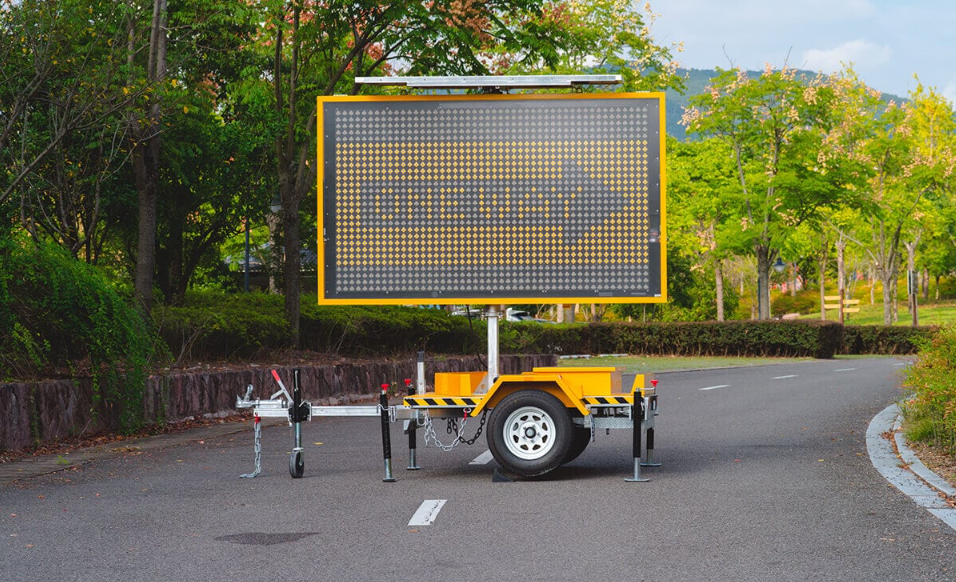
Introduction: From Confusion to Clarity in Seconds You’re driving late at night on a state highway. Suddenly, the lane splits for a detour you didn’t expect. Ahead, cones and barricades seem to point in every direction. But just before the confusion boils over, a bright LED message boards for highway safety comes into view: “DETOUR AHEAD – FOLLOW ARROWS” With instant clarity, you—and dozens of other drivers—safely and calmly adjust course. This is the difference that digital highway signage can make. For traffic engineers, DOT planners, and contractors, LED message boards are no longer a luxury—they’re a proven, practical solution for safer, smarter work zones. How LED Message Boards Work LED message boards (also called electronic message boards or variable message signs) are portable or mounted devices that use arrays of light-emitting diodes (LEDs) to display clear, changeable messages for drivers. Key Features High Visibility: Super-bright LEDs cut through glare, rain, fog, and darkness. Programmable Messaging: Operators can change messages in seconds—either locally or remotely. Energy Efficiency: Most boards run on solar power with battery backups, reducing fuel and maintenance costs. Custom Alerts: From speed warnings to detour instructions, messages can be tailored for any event or emergency, ensuring timely and relevant information. Role in Traffic Management: Smarter Work Zones, Safer Roads LED message boards are not just signs—they’re advanced traffic control devices at the heart of smart work zones. Immediate, Flexible Communication Real-Time Updates: Operators can change messages instantly in response to crashes, weather, or project needs. Dynamic Detours: When routes shift, drivers get up-to-date directions—minimizing confusion and bottlenecks. Emergency Alerts: Boards can display Amber Alerts, hazardous weather notices, or incident warnings in seconds. Enhanced Driver Response According to FHWA studies, drivers are 40% more likely to comply with digital signage than with static signs, especially in complex or unexpected situations. Reduced Risk of Accidents Advance Warning: Early notice of lane closures, speed reductions, or upcoming hazards gives drivers time to adjust safely. Clear Instructions: No more guessing—drivers see precisely what to do, reducing abrupt lane changes and last-second braking. Safety Impact: What the Numbers Say The Federal Highway Administration (FHWA) and state DOTs have published compelling data: Up to 25% reduction in work zone crashes when LED message boards are deployed as part of smart work zone strategies. Source: FHWA Work Zone Safety Fact Sheet Improved driver comprehension: Studies show digital signage improves message recall and compliance over static signs by up to 50%. Faster response times: Drivers react to LED boards more quickly, reducing the risk of rear-end and side-swipe collisions. “Our crash rates dropped by half after adding portable LED boards on our busiest resurfacing projects.” — NJ DOT Traffic Control Supervisor Cost-Efficiency and ROI: A Smart Investment for Contractors Some contractors hesitate at the initial price tag of quality LED message boards for highway safety. But a closer look reveals a strong business case: Lower Long-Term Costs Durability: Modern boards are designed for years of use, featuring weatherproof and vandal-resistant construction. Low Maintenance: LEDs outlast bulbs by a factor of 10 or more, and solar options reduce generator costs. Minimal Staffing: Remote programming cuts labor costs and response times. Fewer Project Delays Reduced Accidents = Fewer Work Stoppages: Every avoided crash saves time, paperwork, and potential litigation. Faster Setup and Teardown: Portable boards roll out in minutes, keeping projects on schedule. Insurance and Reputation Benefits Fewer claims and incidents can lead to lower insurance premiums. Demonstrated commitment to safety helps win DOT contracts and repeat business. Technical Advantages: What Sets LED Message Boards Apart Programmability: Messages can be scheduled, updated on the fly, or integrated with smart work zone networks. Legibility: High contrast and large fonts ensure readability at highway speeds, day or night. Connectivity: Many boards offer cellular or Wi-Fi controls for remote operation and real-time data logging. Compliance: Top models meet MUTCD and state DOT standards, which are essential for public projects. Conclusion: Clear Communication Saves Lives LED message boards aren’t just another piece of equipment—they’re a frontline safety tool that gives drivers the information they need to make smart, safe decisions. For traffic engineers and contractors, the benefits go beyond compliance: Fewer accidents, better project flow, and a stronger safety record. In an era of ever-changing work zones and increasing traffic volumes, clear and dynamic communication is essential. That’s why more DOTs and contractors are making LED message boards for highway safety a standard part of every project. FAQs: LED Message Boards for Highway Safety How do LED message boards improve work zone safety? By delivering real-time, highly visible messages, they help drivers make safer choices and reduce the risk of crashes. Are LED message boards required by DOT standards? For many projects, yes—state and federal guidelines often mandate use in smart work zones or major closures. Can the messages be changed remotely? Most modern boards allow remote updates via cellular or Wi-Fi connections, saving time and increasing flexibility. Do LED message boards work in bad weather? Yes—LEDs remain visible in rain, fog, and nighttime conditions, unlike many traditional signs. Are they cost-effective for small contractors? Yes—when factoring in reduced accidents, legal exposure, and repeat usability, the ROI is strong for both large and small firms. Ready to bring clarity and safety to your next highway project? Choose LED message boards—because every message counts. Contact us for more information.
