
Why Arrow Boards are Essential Temporary Traffic Solutions

In the world of road construction and emergency management, safety is not just a priority; it is the foundation upon which every project is built. At Spa Safety Systems, our mission is to provide the tools that protect lives. This article delves into one of the most effective pieces of equipment in our arsenal: the arrow board. A Night on the Highway: The Silent Guide Picture a late-night road crew working under the vast, dark sky. The only light for miles comes from their work lamps, casting long, dancing shadows. A line of cones and barrels marks the lane closure, but it’s the brilliant, pulsing glow of a large arrow board that truly commands the highway. A driver, tired from a long journey, sees the unmistakable flashing arrow from a mile away. It cuts through the darkness and the driver’s fatigue, delivering a clear, urgent message: “Merge now.” The driver complies, smoothly steering their vehicle away from the men and women working just feet from live traffic. This silent guardian, the arrow board, has done its job. It has prevented a potential tragedy and kept both the work crew and the motorist safe. This scenario plays out every day on countless roads, highlighting a crucial question: Why are arrow boards one of the most indispensable temporary traffic solutions? What Are Arrow Boards? An arrow board is a mobile sign that clearly warns drivers about upcoming changes in traffic patterns. It uses high-intensity lights to flash arrows, guiding drivers to merge left or right. These boards are vital for managing traffic during temporary road disruptions. At Spa Safety Systems, we offer a range of arrow boards designed for every situation: Trailer-Mounted: These are the workhorses of traffic control. Mounted on a wheeled trailer, they are easily transported and deployed for any project. Many of our models are solar-powered, offering an eco-friendly and cost-effective solution that operates for extended periods without external power. Truck-Mounted: Ideal for mobile operations, these units are fixed directly onto work vehicles. They are perfect for slow-moving tasks like line striping, pothole repair, or leading a maintenance convoy, as they provide a clear signal to following traffic. Portable/Skid-Mounted: These smaller, compact versions offer maximum flexibility and mobility. They can be placed on various supports for rapid deployment in tight spaces or for short-term emergency use. Designed for quick setup and maximum impact, these boards are a cornerstone of modern traffic management. Why Arrow Boards Are Essential for Temporary Traffic Solutions The power of an arrow board lies in its ability to cut through the noise and distractions of the road, capturing a driver’s attention. In an age of in-car technology and numerous potential distractions, a bright, flashing signal is impossible to ignore, even from a great distance or in poor weather conditions. Here’s why they are a fundamental part of any safety plan: >Improved Driver Awareness: Arrow boards encourage drivers to merge out of a closed lane well before they reach the work zone taper. This early reaction is critical on high-speed roads, as it prevents the sudden, dangerous maneuvers that often lead to collisions. Proven Accident Prevention: Clear, advanced warning is a key factor in reducing work zone crashes. By providing an unambiguous, universally understood instruction, arrow boards mitigate the confusion and hesitation that can lead to tragic accidents. They are a proactive tool for preventing rear-end collisions and protecting vulnerable roadside workers. Flexibility and Versatility: Arrow boards are incredibly adaptable. They can be deployed for planned construction projects, used for emergency lane closures after an accident, and even help direct traffic during significant public events, such as concerts or festivals. Their portability allows safety managers to position them for maximum effectiveness as traffic conditions change. >Regulatory Compliance: The use of arrow boards is a standard requirement for many types of road work, particularly on multi-lane, high-speed roadways. Utilizing compliant equipment, such as that from >Spa Safety Systems, ensures your project meets national and local safety standards, protecting you from liability while, more importantly, protecting lives. Real-World Stories from the Road The actual value of arrow boards is seen in their daily application across countless scenarios. Road Construction Projects: On a major interstate resurfacing project, trailer-mounted arrow boards are the first line of defense. Placed on the shoulder well in advance of a lane closure, they give drivers ample time and distance to merge safely, preventing traffic backups and protecting the paving crew. >Emergency Detours: When a sudden accident or natural event, such as a flood, closes a road, emergency services must reroute traffic immediately. Truck-mounted arrow boards are often the first on the scene, providing instant directional control to guide confused drivers away from the hazard and onto a safe detour. Significant Events: A city hosting a marathon needs to close dozens of streets. To guide the influx of traffic, portable arrow boards are placed at key intersections. They work in conjunction with other signage to ensure that visitors and residents can navigate the temporary routes without frustration, keeping both runners and drivers safe. Night Work Zones: Visibility is life after dark. For a crew performing utility work on a city street, the dimmed, high-intensity LEDs of an arrow board cut through the urban glare to alert drivers. Operators can dim modern boards to prevent blinding drivers while keeping them highly conspicuous—a critical feature for safe nighttime operations. Technology Advancements in Arrow Boards Today’s arrow boards are more advanced than ever, incorporating technology that enhances their effectiveness and efficiency. LED Technology: The move to LEDs has revolutionized arrow boards. They are brighter, use less power, and have a much longer lifespan, ensuring reliability and superior visibility. Solar-Powered Boards: Many of the arrow boards we provide are entirely self-sufficient. They harness the sun’s energy to charge an onboard battery bank, eliminating fuel costs, reducing emissions, and lowering your project’s operational budget. Intelligent Connectivity: The latest innovation is the “smart” arrow board. These connected devices can be monitored and controlled remotely. A project manager can use a
The Silent Bodyguard on the Shoulder: How TMA Trucks Reduce Roadside Risks
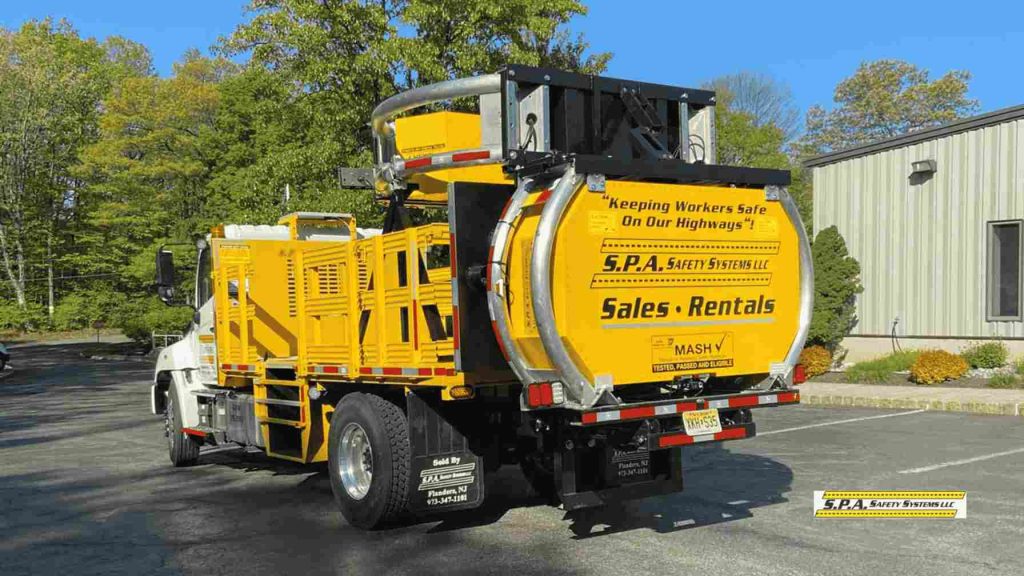
Highways are among the busiest—and most hazardous—work environments in the world. Every day, road crews face speeding traffic, distracted drivers, and unpredictable conditions that put both workers and motorists at risk. That’s where TMA trucks reduce roadside risks, acting as a silent bodyguard on the shoulder. These specialized vehicles, equipped with crash cushions and warning systems, not only protect construction zones—they also save lives. By absorbing impact and signaling drivers to slow down, TMA trucks have become an essential part of modern traffic management and highway safety. 1. Hook & Human Story It’s 2:13 a.m. on a Tuesday. A five-person maintenance crew crouches over fresh asphalt on I-75, their cones forming a fragile orange ribbon between them and the dark river of traffic. In the distance, a single pair of headlights drifts, weaving—then crossing the solid white line at 68 mph. The flagger can only shout. Steel meets aluminum with a thunder-crack. The intruding pickup erupts in sparks and accordion folds, but the workers feel only a gust of air. Between them and catastrophe sat a truck-mounted attenuator (TMA)—an unblinking guardian that accepted the impact, crumpled by design, and transformed what could have been five funerals into a tow-away fender-bender. Stories like this play out more often than most travelers realize. This article peels back the curtain on how TMA trucks mitigate roadside risks, why every modern traffic control plan requires them, and what the numbers—both human and financial—reveal. 2. What Are TMA Trucks? A TMA truck is two machines married into one purpose: 1. The host vehicle Medium or heavy-duty chassis (16,000 – 20,000 lb). Flashing arrow or message board, high-intensity strobes, brake upgrades. 2. The truck-mounted attenuator A collapsible cartridge of aluminum honeycomb, steel struts, or proprietary energy-absorbing cells bolted to the rear. Hydraulics raise or lower the cushion for travel or deployment. Think of it as a crash-tested shield on wheels—one that’s been smashed in controlled labs dozens of times so crews won’t be during the one uncontrolled moment that truly matters. The Federal Highway Administration classes TMAs as “impact protection vehicles,” and most units now meet MASH TL-3 criteria—meaning they safely arrest a 5,000 lb pickup striking at 62 mph.¹ 3. The Science of Impact Protection Physics is merciless: Impact energy rises with the square of speed. A 4,000 lb car at 60 mph carries ~480,000 ft-lb of kinetic energy—about the punch of 200 sticks of dynamite. Rigid obstacles return that energy to occupants in milliseconds; bodies can tolerate roughly 20–25 G before fatal trauma. TMAs stretch the stopping distance to lower that “G-whip.” How it works: Progressive Crush – Honeycomb cells collapse sequentially, much like crumpling one soda can at a time instead of the whole six-pack at once. Momentum Transfer – The heavy host truck absorbs residual force and rolls forward slightly, further bleeding energy. Occupant Survival Zone – Deceleration inside the striking vehicle is slowed to <20 G and <40 ft/s delta-V—thresholds shown by NHTSA to keep seat-belted drivers alive with survivable injuries.² MASH tests film high-speed dummy motion; neck and chest loads plummet by 70–80 % when a TMA replaces a rigid trailer, proving the life-versus-death delta. 4. Why Roadside Risks Are Rising Traffic Volume Up – U.S. vehicle-miles traveled hit a record of 3.26 trillion in 2023.³ Distracted Driving Epidemic – 31 % of drivers admit to texting behind the wheel in the past month.⁴ Higher Operating Speeds – Posted limits have inched from 55 to 70+ mph on many corridors. The result: work-zone fatal crashes jumped 56 % from 2010 to 2022, outpacing overall roadway deaths.⁵ Behind every hard hat is someone’s spouse or child; every shift begins with the unspoken hope that all cones get picked up by the same hands that set them out. Highways, like restless beasts, strike without warning—TMAs stand as the trainer’s shield. 5. How TMA Trucks Reduce Risks Impact Absorption – The core mission. A 2020 Texas A&M study tracked 62 real-world TMA impacts, resulting in zero worker injuries and two minor injuries to motorists.⁶ Mobile Warning Beacon – High-mounted arrow boards and 360° strobes catch drivers’ eyes sooner than cones do, buying precious reaction time. Dynamic Buffer Zone – During moving operations (striping, sweeping), the TMA shadow vehicle maintains a 50–100 ft gap, expanding the safety envelope around slow equipment. Night-Work Illumination – LED scene lights on modern units turn blacktop into daylight, reducing slips, trips, and fall hazards for the crew. Psychological Brake – Motorists naturally lift off the gas when they see a large truck blocking a lane, softening approach speeds even when no crash occurs. Case in Point: Florida DOT After mandating one TMA per crew on limited-access highways in 2018, the FDOT recorded a 73% reduction in serious work-zone intrusions in the first two years. Insurance payouts to contractors fell by $8.6 million—a fiscal echo of lives not lost. 6. Beyond Safety: Economic and Legal Benefits Liability Shield – A single fatal work-zone crash can exceed $11.4 million in litigation and societal costs (USDOT VSL, 2024). Preventing even one pays for an entire state’s fleet of TMAs. Insurance Premium Leverage – Underwriters often grant 10–30 % discounts when certified attenuators are standard operating equipment. Regulatory Compliance – MUTCD Part 6 and OSHA 29 CFR 1926 reference impact protection vehicles for most lane closures >45 mph; non-use can trigger citations or project shutdowns. Schedule Resilience – Crews avoid days-long investigations and equipment loss after a serious crash, protecting critical-path timelines and contract incentives. 7. Real-World Examples & Success Stories of TMA Trucks Missouri, June 2023 – A drowsy box truck hit a stationary TMA at 64 mph. The driver walked away; the paving crew, 90 feet downstream, continued working. Damage: $32k. Savings: six uninjured workers. Queensland, AUS, 2021 – An autonomous “follower” TMA, shadowing a paint rig, took the hit from a sedan; because no one was in the cab, zero injuries occurred. Technology is now being exported to U.S. pilots. New Jersey Turnpike, 2019 – Winter pothole patrol
The Guardian on the Shoulder: How Attenuator Trucks Keep Highway Workers Alive

Midnight on I-95. Sodium-vapor lights cast long shadows across fresh asphalt while a dozen laborers re-stripe the lane. Cars whip by at 70 mph, drivers half-hypnotized by road glare and playlists. At the edge of the closure sits a single vehicle—flashers pulsing, arrow board aglow, a hulking pad of honey-combed metal folded up behind the tailgate. To the crew, that truck is more than iron and hydraulics. It is a silent guardian. If a distracted driver drifts into the work zone, the attenuator truck will meet the impact first—crumpling in sacrifice so the people in hi-vis vests don’t have to. That is the heartbeat of every highway project: keep the people who build the road alive long enough to finish it. This article examines the role of attenuator trucks (also referred to as crash trucks, truck-mounted attenuators, or TMAs) enable this capability, the reasons regulators require them, the actual cost of these devices, and what the future holds for this shield on wheels. 1. What Exactly Is an Attenuator Truck? At its simplest, an attenuator truck is two things: A host vehicle—usually a 16,000–20,000 lb medium- or heavy-duty truck equipped with lights, arrow or message boards, and brakes upgraded for the extra mass. A truck-mounted attenuator (TMA)—a collapsible cartridge of aluminum, steel struts, and energy-absorbing cartridges (often aluminum honeycomb or proprietary foam) attached to the rear. When a car or truck slams into the apparatus, the cartridges crush in a carefully engineered sequence, converting kinetic energy into controlled deformation and keeping deceleration forces below the injury threshold for the errant driver and the work crew ahead of the truck. Industry shorthand you’ll hear on site: “TMA truck” – the complete package. “Impact protection vehicle” – generic DOT term. “Shadow vehicle” – when the truck follows a moving work operation like line-striping. 2. How Do Truck-Mounted Attenuators Work? Imagine a soda can that you can squeeze slowly. It collapses, absorbing force, but the rim stays intact. TMAs scale that idea to highway speeds—only the ripple zones are aluminium honeycomb, steel angles, or proprietary composite cartridges. Key engineering elements: Frangible cartridges – Crush in segments to smooth out G-forces. Backup frame – Rigid cage that stops the impact vehicle after energy absorption. Anti-rotation lugs – Keep the attenuator aligned to prevent it from jackknifing. Hydraulic deployment – Operators can raise or lower the unit from the comfort of the cab. Most modern TMAs are tested under the Manual for Assessing Safety Hardware (MASH) standards at 62 mph (100 km/h) with 2,420 lb and 5,000 lb test vehicles. Passing means the occupant impact velocity stays under 40 ft/s and ridedown accelerations under 20 G—numbers proven to keep people alive.¹ 3. The Safety Imperative: Why TMAs Have Become Non-Negotiable Highway work zones are among the deadliest job sites in America. According to the Federal Highway Administration, 857 people were killed and roughly 44,000 were injured in work-zone crashes in 2022 alone.² Roughly four out of five of those killed are motorists, but the psychological weight on crews is immense: one strike, one friend gone. Early 2000s pilot programs in Texas, Virginia, and Queensland compared similar construction zones with and without TMAs. Injury severity in rear-end intrusions dropped 70–80 % when an attenuator truck was present.³ The math persuaded regulators: MUTCD & FHWA – Require impact protection vehicles for most mobile and short-duration lane closures. OSHA 29 CFR 1926.200–203 – Cites MUTCD for traffic control devices, making TMA usage an enforceable safety expectation. State DOT specs – Many (TX, CA, FL, NY, WA) mandate a certified TMA for any lane closure on roads posted 45 mph or higher. 4. Where Do Attenuator Trucks Fit in the Traffic Control Plan? Think of a work zone in layers, each buying time: Advance signing warns drivers that something is ahead. Taper channelizing devices (cones, drums) guide traffic away. The attenuator truck sits at the head (stationary) or shadow (mobile) position to catch mistakes. Work area where people and equipment operate. Typical deployment strategies: Stationary lane closure – TMA parked 50–100 ft upstream of workers, brakes set, attenuator down. Slow-moving operation (sweeping, striping) – Shadow vehicle maintains 50–100 ft gap behind the work vehicle, adjusting speed continuously. Rolling roadblocks – Multiple TMAs leapfrog to protect a convoy chip-seal or pavement repair. DOT specs dictate buffer length based on posted speed and job class. For example, Caltrans charts call for a 180-foot buffer at 55 mph, while the Florida DOT stretches to 305 feet at 70 mph. The higher the speed, the longer the buffer, and the heavier the host truck, to prevent push-through. 5. Do They Really Pay for Themselves? Cost–Benefit in Hard Numbers Up-front investment • New TMA body & truck: $120–180k • Retro-fit attenuator on existing chassis: $40–60k Crash cost avoided • Average fatal work-zone crash societal cost: $11.4 million (USDOT Value of Statistical Life, 2023). • Average injury crash cost: $200k–$500k (medical, litigation, downtime, equipment). A Texas A&M Transportation Institute study tracked 181 TMA-equipped lane closures over five years. They absorbed 62 impacts. Property damage averaged $18,700 per hit, zero worker injuries, and only two minor driver injuries. Estimated savings vs. comparable non-TMA crashes: $51 million.³ Fleet managers also report: 10–30 % lower liability premiums after TMA deployment. Faster project completion (fewer shutdowns after an incident). Higher bid competitiveness—DOTs increasingly score safety equipment in award criteria. Return on investment often pays off in a single avoided serious crash. 6. Case Study: The Night the TMA Took the Hit June 14, 2023, Springfield, Missouri, I-44 resurfacing. At 2:07 a.m., a drowsy box-truck driver slid past the cone taper at 62 mph. Dash cam shows only two seconds elapse before impact—but the crash truck was in place. 18-ft aluminum honeycomb cartridges collapsed from 36 in to 8 in. G-force on the intruding driver peaked at 17 G—a survivable hit; he walked away with bruises. The paving crew, 85 ft downstream, never felt the collision. Total downtime: 4.5 hours to swap in a spare TMA. Paver restarted before
