
Bucket Truck Rental: How to Pick the Right Truck for Utility and Storm Work
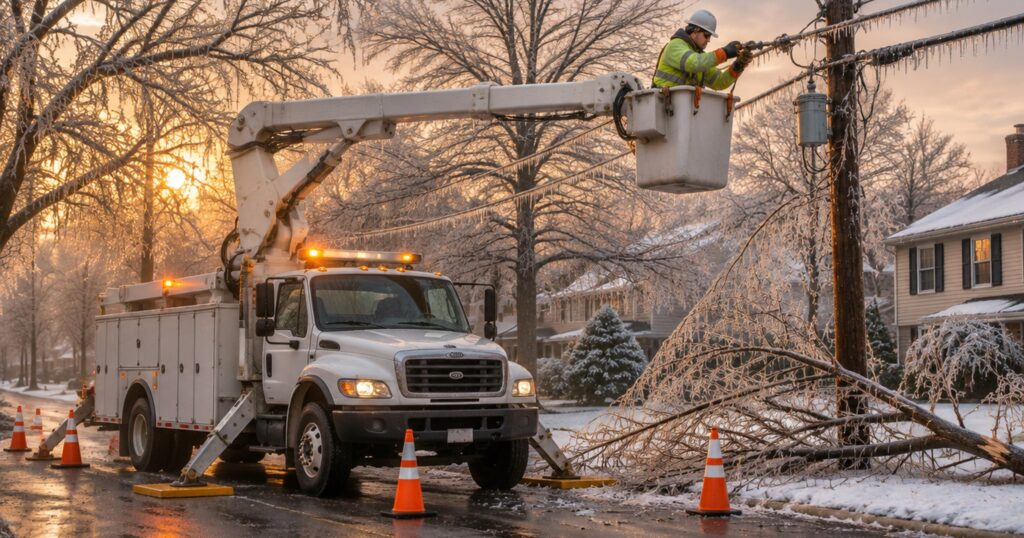
When an ice storm drops lines across three townships overnight, nobody has time to research equipment. The calls start at 5 a.m., and the crews who get back to work first are the ones who already know what truck they need and where to get it. That’s why the best time to plan a bucket truck rental is before the weather turns. This guide walks through how to match a truck to the job: working height, boom style, insulated versus non-insulated units, chassis size, and the OSHA rules your operators are expected to follow from the minute the outriggers go down. No sales pitch. Just the questions you should answer before you sign a rental agreement. Why Contractors Rent Bucket Trucks Instead of Buying A bucket truck is a big commitment. It needs a driver, an annual inspection, dielectric testing if it’s insulated, insurance, storage and a mechanic who knows hydraulics. For a lot of contractors and municipalities, the truck only earns its keep for part of the year. Renting makes sense when: The work is seasonal. Storm restoration, holiday lighting installs, tree trimming around lines and sign work all spike at certain times of year. You need a different height for one job. Your 40-foot truck handles 90% of the work, but one project needs 55 feet or more. Your own truck is down. A failed inspection or a hydraulic leak shouldn’t stop a crew for two weeks. You’re bidding something new. Renting lets you take on a contract before you know whether that type of work will keep coming. SPA Safety Systems offers bucket trucks from 36 to 70 feet on daily, weekly and monthly terms, so you can size the rental to the job instead of the other way around. Step 1: Figure Out the Height You Actually Need Height is the first question every rental desk asks, and it’s the one crews most often get wrong. Platform height vs. working height Spec sheets usually list two numbers: Platform height: how high the floor of the bucket goes. Working height: platform height plus an assumed reach for a person standing in the bucket. Some quotes use one and some use the other. Before you compare trucks, confirm which number you’re looking at. A “40-foot truck” can mean very different things depending on the sheet. Measure the job, then add margin Look at the highest point your crew has to reach, not the average. Then add margin for: Setup distance. You rarely park directly under the work. Ditches, parked cars, curbs and traffic all push the truck back. Terrain. Outriggers on a slope or soft shoulder can limit how far the boom extends. Clearance from lines. Your operator needs room to keep the required distance from energized conductors (more on that below). A good rule of thumb: if your measurement lands at the top end of a truck’s range, size up. Common height ranges and typical uses Height range Typical jobs 36 to 42 ft Street lights, traffic signals, signs, service drops, light tree work 45 to 55 ft Distribution line work, taller poles, commercial signage, parking lot lights 60 to 70 ft Transmission-adjacent work, tall structures, large tree removal, wide setbacks Step 2: Choose the Right Boom Style Bucket trucks come in two main boom designs, and each one handles obstacles differently. Straight (telescopic) boom A telescopic boom extends in a straight line. It’s simple, it reaches far, and it’s great when you have a clear path to the work. Best for: open roadsides, sign and light work, jobs where you can park close and go straight up. Articulated (knuckle) boom An articulated boom has a hinge that lets it bend up and over obstacles. That makes it the better choice in tight spaces or when you need to reach around tree limbs, fences or other lines. Best for: urban streets, backyard easements, tree work near lines, anywhere the straight path is blocked. Some trucks combine the two with an articulating lower section and a telescopic upper section. SPA Safety Systems carries both straight boom and articulated telescopic units, so ask about the site conditions and the rental team can point you to the right one. Step 3: Insulated or Non-Insulated? This is the question that matters most for safety, and it isn’t optional if your crew works near energized lines. OSHA defines an insulated aerial device as “an aerial device designed for work on energized lines and apparatus” (29 CFR 1910.67). Those units are built and tested so the boom provides a layer of electrical protection. A few things to know: Insulated units must be electrically tested. OSHA requires electrical tests in line with the ANSI A92.2 standard. When you rent, ask for the date of the most recent dielectric test. Nobody can modify the insulated section. OSHA states that “the insulated portion of an aerial lift shall not be altered in any manner that might reduce its insulating value.” That includes drilling, mounting accessories or making field repairs to the fiberglass. Insulation is a backup, not a license. Your crew still has to keep minimum approach distances and follow your company’s electrical safety program. If your work is nowhere near power lines (sign installation on a highway gantry, building maintenance, holiday lights on a commercial building), a non-insulated truck may be fine. If there’s any chance of contact with a conductor, rent insulated. Step 4: Check the Chassis and Who Can Drive It The truck under the boom matters as much as the boom. CDL requirements Under federal rules, a single vehicle with a gross vehicle weight rating (GVWR) of 26,001 lb or more generally requires a commercial driver’s license. Many 36 to 40 foot bucket trucks are mounted on Class 4 or 5 chassis such as the Ford F-550 or Ram 4500 and 5500, which typically fall below that line. Larger units often ride on heavier chassis that do require a CDL. Check the GVWR on the door sticker and match it to
Bucket Rental Truck vs. Scissor Truck: A Comparison
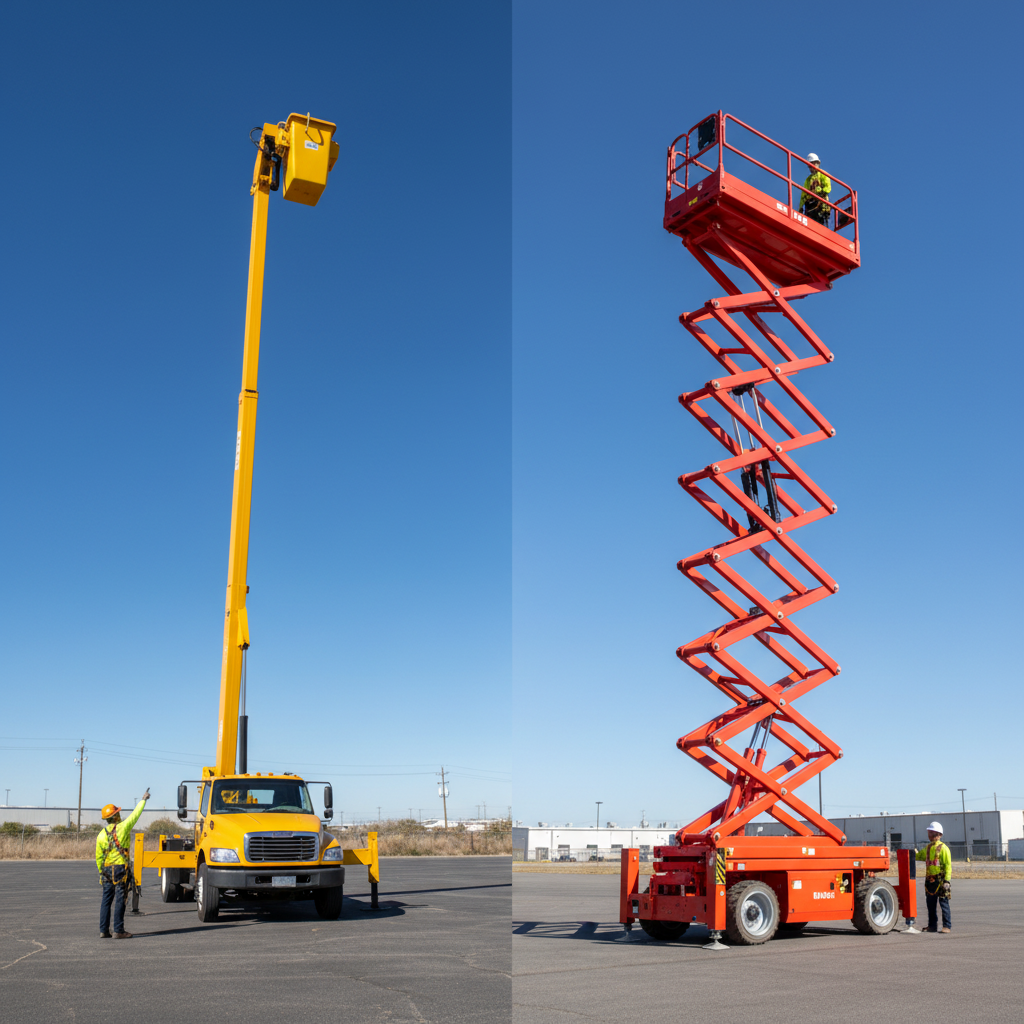
Getting your crew off the ground usually comes down to two main options: the scissor lift or the bucket truck. On paper, they seem to do the same thing—they lift people and tools into the air. But ask anyone who has actually run a job site, and they’ll tell you these machines are completely different animals. One gives you a wide, stable deck for heavy materials; the other gives you the reach to get over obstacles and out to the street. If you grab the wrong set of keys, you aren’t just looking at wasted rental fees. You’re dealing with stalled timelines, frustrated workers, and safety hazards you didn’t plan for. Here is a blog post that provides a practical breakdown to help you decide which machine is best suited to the job. Anatomy of Each Machine Scissor Lifts Vertical-only motion: stacked, crisscrossing arms extend straight up. • Flat work deck: typically, 29–60 in. wide and 4–16 ft long, with slide-out extensions. • Power source: electric for indoor use; diesel, dual-fuel, or hybrid for outdoors. • Steering: self-propelled on slab or rough-terrain tires. Bucket Trucks Telescoping or articulating boom mounted to a truck chassis. • Single fiberglass or metal bucket sized for one or two workers. • Hydraulic outriggers for stability. • Road-legal—drive it to the next site without a trailer. Height, Reach, and Workspace Platform Height Scissor lifts typically max out at around 60 ft, though most rentable units are in the 19–40 ft range. Bucket trucks soar from 35 ft to well over 100 ft. Horizontal Reach Scissor Lifts: These machines are strictly vertical. If you can’t park directly underneath the work area, you can’t reach it. Bucket Trucks: Designed for flexibility, rent a bucket truck because the boom can swing, extend, and bend, you can reach over obstacles like fences or parked cars—a necessity for utility work or painting difficult building exteriors. Workspace Size Scissor Lifts: Think of the deck as a floating workbench. There is ample room to stack pipes, fixtures, or tools, and two or three technicians can work side by side without bumping elbows. Bucket Trucks: It’s tight quarters. The bucket is designed for “point access,” meaning it fits one worker and a few essential tools. It isn’t a place to store materials. Site Conditions and Mobility Ground Bearing Electric slab scissor lifts demand smooth, level concrete and deliver tight turning radii—ideal for warehouses, data centers, and malls. Rough-terrain scissors ride on foam-filled tires, have four-wheel drive, and use auto-level jacks, but still require firm soil. Deep mud or soft sand bogs them down. Bucket rental truck can be set up almost anywhere a truck can park. If the soil under an outrigger is questionable, operators place cribbing blocks and continue rolling. Transport Logistics Scissors loaded onto a trailer or tilt-bed require tie-downs and add another item to the DOT inspection list. Bucket trucks drive themselves from job to job; for dispersed utility or tree-care routes, this is priceless. Set-Up Time Scissor: deploy pothole guards, raise railings, do a quick walk-around—two minutes tops. Bucket truck: park, level the chassis, drop outriggers, run a dielectric test if near energized lines—five to ten minutes. Regulatory and Licensing Nuances Bucket rental truck operators often need a Class B CDL for vehicles over 26,000 lb GVWR; some states add a utility-line or arborist endorsement. Scissor truck lifts ordinarily require only a site-specific “competent operator” card validated by the employer or rental house. Road-going bucket fleets incur FMCSA logs, IFTA fuel reporting, and DOT numbers—a paper trail absent from scissor lift ownership. Decision Matrix (Quick Reference) Primary Concern Choose a Scissor Lift When… Choose a Bucket Truck When… Vertical Height ≤ 60 ft > 60 ft Horizontal Reach 0 ft needed Up‐and‐over obstacles Workspace Multiple workers/material Single worker/light tools Terrain Smooth slab or graded pad Varied roadside or off-grid Daily Moves One site all day Multiple stops, spread miles apart Budget Lower purchase/rental Budget accommodates CDL chassis Electrical Proximity Indoor or de-energized Live utility lines need insulation Real-World Scenarios Warehouse Racking Upgrade – A 26 ft electric scissor glides through standard 8 ft aisles, lifts two installers plus a pallet of uprights. Bucket truck? Overkill and can’t get through the dock door. Downtown Streetlight Retrofit – Bucket rental truck parks curbside reaches over parked cars, and changes LED fixtures every 200 ft without unloading a trailer. A scissor lift would crawl through traffic lanes and demand police escorts. Solar Farm O&M – Rough-terrain scissor lifts carry wash systems and tool crates down endless rows of panels. The panels sit only 15 ft high, so reach is irrelevant; deck space is priceless. Conclusion There is no universal winner here. The scissor lift is a reliable workhorse for vertical jobs on stable ground, while the bucket truck is the specialist you need for reach and mobility. Making the right call means looking beyond the daily rental rate. You must match the machine to the site’s actual constraints—the terrain, obstacles, and crew size. Spend a few minutes planning the logistics before you sign the paperwork. It is much easier to fix a mistake on the ground than to realize you’re stuck with the wrong equipment sixty feet in the air. Need more information? Head towards S.P.A. Safety Systems and get your questions answered!
Scissor vs Bucket Trucks: The Definitive Guide for Your Next Job

The sun isn’t even fully up, but the traffic is already building. Your foreman is staring at the underside of an overpass, then back at the two trucks idling in the staging area. Choose the bucket truck, and you’ll be resetting the outriggers every 20 feet. Choose the scissors, and you might not have the reach. The clock is ticking. Choosing between Scissor vs Bucket Trucks will be discussed in this blog. Choosing the right elevated work platform is more than a logistical puzzle; it’s a decision that impacts your timeline, your budget, and your crew’s safety. As someone who has helped hundreds of contractors navigate this choice, I can tell you the answer is rarely just about maximum height. Let’s break down the real-world differences in the scissor vs bucket trucks debate. When Elevation Isn’t Your Only Challenge Getting your crew in the air is one thing. Doing it efficiently and safely is another. The best choice often comes down to the constraints of your job site. Platform vs. Basket: The most obvious difference is the work platform itself. A scissor lift truck offers a large, stable deck, perfect for two or three workers plus tools and materials. Think of it as a mobile scaffolding system. A bucket truck, or cherry picker, has a compact basket, ideal for one or two workers in tight spaces. Footprint & Site Impact: A bucket truck requires a wider area to deploy its outriggers, which provide stability for its articulating boom. This can be a deal-breaker in a tight urban corridor or a single-lane closure. A scissor truck, by contrast, typically has a smaller, self-contained footprint, lifting straight up from its chassis. Mobility at Height: This is a game-changer. Many scissor trucks are designed to be driven slowly while the platform is elevated. For linear tasks like bridge inspections, light replacement, or sign installation, this is a massive scissor lift truck advantage. A bucket truck must be fully lowered, its outriggers retracted, and the truck repositioned for each new work area, dramatically increasing setup time. Side-By-Side Feature Breakdown Let’s put the specs head-to-head. This isn’t about which is “better,” but which is better for your specific task. Feature Scissor Lift Truck Bucket Truck (Articulating Boom) Reach Height Good (Typically 20-50 ft) Excellent (40-150+ ft) Side Reach (Lateral) Minimal (Platform may have a small extension deck) Excellent (Can reach up and over obstacles) Platform Area Large (Often 50-100+ sq. ft.) Small (Compact basket for 1-2 people) Setup Time Very Fast (Position and lift) Moderate (Position, deploy outriggers, lift) Crew Capacity Higher (2-4 workers + materials) Lower (1-2 workers) Ground Conditions Prefers flat, stable surfaces More forgiving with outriggers on slight slopes This bucket truck comparison makes it clear: if your primary need is reaching over obstacles or achieving extreme heights, the bucket truck is your tool. If you need a large, stable work deck for tasks on a relatively flat plane, the scissor truck delivers unmatched efficiency. Cost & ROI Snapshot Your budget is a real-world constraint, and it’s about more than the rental or purchase price. Total Cost of Ownership (TCO) tells the real story. Here’s a simplified 3-year projection for a new, comparable mid-range unit. 3-Year Estimated Total Cost of Ownership Cost Factor Scissor Lift Truck Bucket Truck Purchase Price (Est.) $110,000 $150,000 Annual Maintenance $3,000 $5,500 Annual Fuel/Energy $4,000 $6,000 Annual Insurance $2,500 $3,500 3-Year TCO $129,500 $184,500 For many, renting is the smarter financial move. It eliminates maintenance headaches and gives you the flexibility to choose the right truck for each job. How to Calculate Your Rental Cost: (Daily/Weekly Rate x Duration) + Delivery/Pickup Fees + Insurance = Total Rental Cost A typical weekly rental might run $1,500 for a scissor truck and $2,200 for a bucket truck, but this varies. The crucial takeaway is that choosing a bucket truck when a scissor truck would do means you’re not just paying more for the rental—you’re losing money on labor due to slower repositioning times. Safety & Compliance Factors In the world of elevated work platform safety, compliance isn’t optional. Both truck types fall under OSHA’s standard for aerial lifts, which governs everything from electrical insulation to fall protection. Additionally, the equipment itself must meet stringent design and manufacturing standards. Here’s what this means for you: Daily Inspections: You are required to perform a pre-start inspection of the vehicle and the lift components every single day. Operator Training: Only trained and authorized personnel can operate the lift. Fall Protection: Workers on the platform must use appropriate personal fall arrest systems (harnesses and lanyards). At S.P.A. Safety Systems, we don’t just meet these standards; we exceed them. Our entire fleet undergoes a rigorous, multi-point inspection and maintenance protocol far beyond the manufacturer’s recommendations. When you rent from us, you’re not just getting a piece of equipment; you’re getting a guarantee of compliance and reliability. Real-World Case Study A New Jersey DOT maintenance crew was tasked with replacing 200 light fixtures on the underside of a two-mile-long overpass. Their initial plan involved a bucket truck, which would have required a full stop, outrigger deployment, and retraction for every four fixtures—a process they estimated would take five full night shifts. After a quick consultation, they switched to one of our driveable scissor trucks. By moving slowly down the closed lane with the platform elevated, they could service 30-40 fixtures per setup. They finished the entire project in just three shifts, saving thousands in labor and getting the road open two days ahead of schedule. Decision Matrix: Which Truck Fits Your Project? Use this quick grid to guide your thinking. Find the intersection of your primary needs to see which truck is likely the better fit. Ground: Flat & Stable Ground: Uneven/Sloped Height: Low (<40′) / Reach: Minimal Scissor Truck (Ideal Use Case) Bucket Truck (Outriggers provide stability) Height: High (>40′) / Reach: Significant Bucket Truck (Height & reach are key) Bucket Truck (Designed for this) This matrix simplifies the initial choice in the