
Truck Mounted Attenuator Guidelines For Work Zone Protection
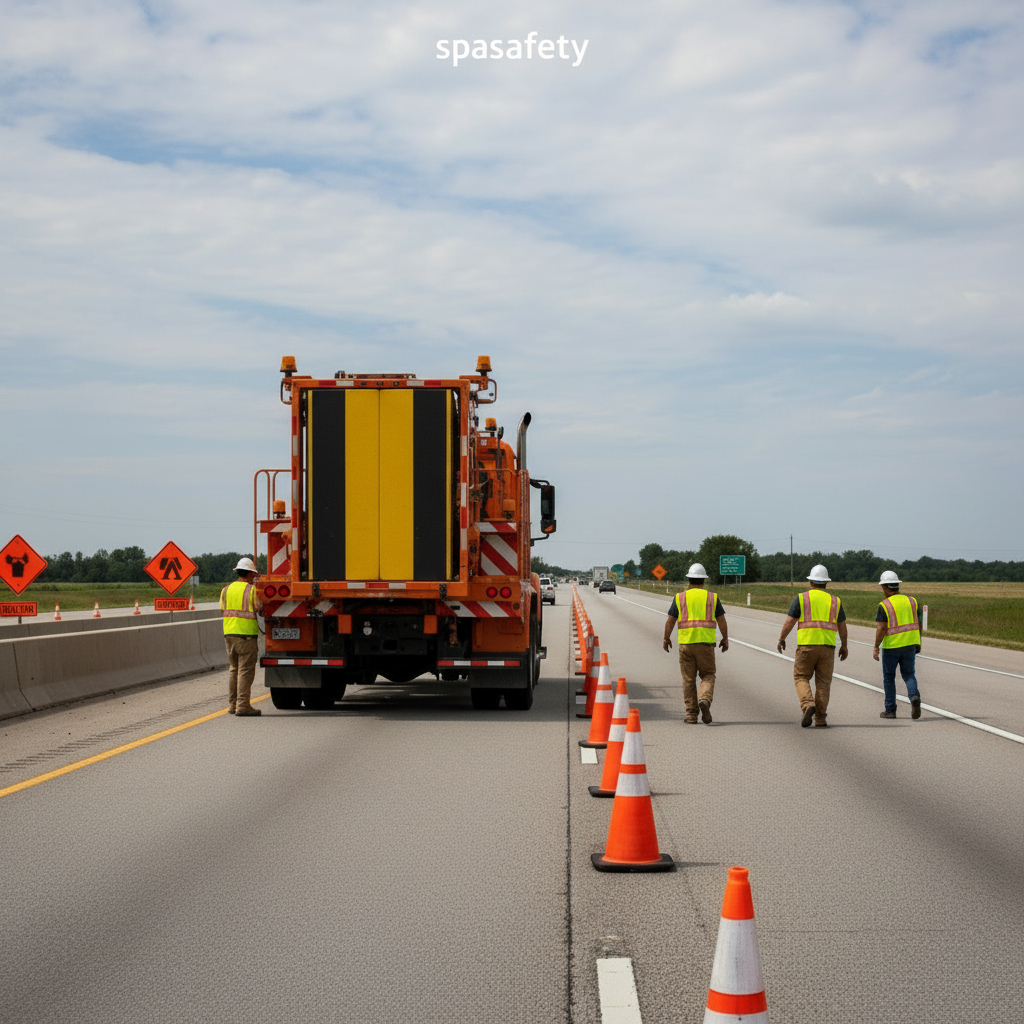
There is a specific kind of dread that comes with working on a highway. You’re pouring concrete or painting lines, your back turned to traffic, trusting a few plastic cones to keep you safe while 80,000-pound semis scream past at seventy miles an hour. What really separates a road crew from a distracted driver isn’t a cone or a sign—it’s the “shadow truck.” And hanging off the back of that truck is a piece of engineering that is designed to be destroyed: the Truck-Mounted Attenuator (TMA). It’s a mobile shield; a bodyguard made of steel and aluminium. Understanding how to use it, purchase it, and maintain it isn’t just about following regulations; it’s about ensuring everyone can clock out at the end of the shift. In this blog, we’ll discuss purchasing and maintaining it, which isn’t just about compliance. We will discuss attenuator crash trucks and how they enhance safety in work zones. How does the Shield work? At its core, a TMA is a sophisticated crash cushion. It bolts onto the back of a heavy vocational truck—usually a dump truck or a flatbed—and acts as a sacrificial lamb. When a car or rig slams into the back of a shadow truck, the TMA takes the hit. Inside the unit, cartridges made of aluminium honeycomb or steel tubes are designed to collapse in a very specific sequence. This buckling process does two things: it absorbs the impact’s energy, converting that kinetic energy into crumpled metal, and it prevents the shadow truck from being launched forward into the workers standing just a few feet away. The “MASH” Standard: Why It Matters? You will hear the term “MASH” used frequently. An important part of the truck mounted attenuator guidelines, it stands for the Manual for Assessing Safety Hardware. Specifically, you want equipment that meets MASH Test Level 3 (TL-3). This isn’t just paperwork. To pass this standard, a TMA has to survive a gauntlet. Engineers ram a 5,000-pound pickup truck into it at 62 mph. They do it straight on and at an angle. To pass, the TMA must keep the G-forces low enough for the driver of the crashing car to survive, and it must ensure the shadow truck doesn’t roll forward too far. If you are buying or renting a TMA, look for that MASH TL-3 rating. Anything less is a gamble you don’t want to take at highway speeds. One-Hit Wonders vs. The Resilient You have two main design choices: sacrificial or reusable. Sacrificial units are one-and-done. If they are struck, discard the cartridge and purchase a new one. Reusable units use hydraulic cylinders and spring steel. They can take a low-speed bump and reset. If you work in high-traffic city zones where “fender benders” are common, reusable might save you money. For high-speed interstate work, the focus is usually just on surviving the “big one.” Tactics on the Tarmac Having the gear is one thing; positioning it is another. The Rolling Blockade As per the truck mounted attenuator guidelines, for jobs such as striping or pothole patching, the shadow truck must move. It usually trails the crew by a specific distance. Too close, and a crash pushes the truck into the workers. Too far, and a confused driver might cut in between the truck and the crew. The “Quick” Job Trap The most dangerous words in road construction are, “It’ll only take a minute.” Crews often skip setting up the TMA for a quick debris removal or sign fix. That is when accidents happen. Whether the job takes ten minutes or ten hours, the shield needs to be up. Ramps and Exits Off-ramps are notorious for indecisive drivers. Placing a TMA here requires angling the truck so that, if it is struck, it doesn’t push into live traffic. It’s a game of geometry where the stakes are life and death. The Human Element We focus heavily on the steel and hydraulics, but the operator inside the shadow truck has one of the most grueling roles on the project. They aren’t just sitting behind the wheel; they are living in the rearview mirror—constantly gauging the speed of oncoming lights and bracing for a hit that could happen at any second. Daily Checks are Non-Negotiable Before the key turns, the operator must check the pins, hydraulics, and lights. A bent frame from a previous “love tap” might seem fine, but it could cause the unit to fail catastrophically during a real crash. Don’t Improvising Ballast You can’t just throw concrete blocks in the bed to meet the weight requirement. If they aren’t secured, those blocks become missiles in a crash. Use proper steel ballast plates bolted to the frame. The Future is Smart Technology is catching up. We are starting to see “Connected TMAs.” These units can detect a crash and automatically lock the truck’s brakes to prevent it from rolling forward. Some can even send an instant alert to the crew’s phones or headsets the moment an impact occurs, giving them a split-second head start to step aside. The Bottom Line A Truck-Mounted Attenuator is an expensive line item on a budget, which is why these truck mounted attenuator guidelines are worth considering. It requires maintenance, training, and a heavy truck to haul it. But when you strip away the regulations and the engineering specs, its purpose is simple. At 2:00 AM, in the pouring rain, when a driver falls asleep at the wheel and drifts into the work zone, that TMA is the only thing that prevents a tragedy. It turns a fatal headline into a repair bill. Treat the equipment with respect, and it will do the one thing that matters most: bring your crew home alive. Head towards S.P.A. Safety Systems for expert help and opinion.
The Guardian on the Shoulder: How Attenuator Trucks Keep Highway Workers Alive

Midnight on I-95. Sodium-vapor lights cast long shadows across fresh asphalt while a dozen laborers re-stripe the lane. Cars whip by at 70 mph, drivers half-hypnotized by road glare and playlists. At the edge of the closure sits a single vehicle—flashers pulsing, arrow board aglow, a hulking pad of honey-combed metal folded up behind the tailgate. To the crew, that truck is more than iron and hydraulics. It is a silent guardian. If a distracted driver drifts into the work zone, the attenuator truck will meet the impact first—crumpling in sacrifice so the people in hi-vis vests don’t have to. That is the heartbeat of every highway project: keep the people who build the road alive long enough to finish it. This article examines the role of attenuator trucks (also referred to as crash trucks, truck-mounted attenuators, or TMAs) enable this capability, the reasons regulators require them, the actual cost of these devices, and what the future holds for this shield on wheels. 1. What Exactly Is an Attenuator Truck? At its simplest, an attenuator truck is two things: A host vehicle—usually a 16,000–20,000 lb medium- or heavy-duty truck equipped with lights, arrow or message boards, and brakes upgraded for the extra mass. A truck-mounted attenuator (TMA)—a collapsible cartridge of aluminum, steel struts, and energy-absorbing cartridges (often aluminum honeycomb or proprietary foam) attached to the rear. When a car or truck slams into the apparatus, the cartridges crush in a carefully engineered sequence, converting kinetic energy into controlled deformation and keeping deceleration forces below the injury threshold for the errant driver and the work crew ahead of the truck. Industry shorthand you’ll hear on site: “TMA truck” – the complete package. “Impact protection vehicle” – generic DOT term. “Shadow vehicle” – when the truck follows a moving work operation like line-striping. 2. How Do Truck-Mounted Attenuators Work? Imagine a soda can that you can squeeze slowly. It collapses, absorbing force, but the rim stays intact. TMAs scale that idea to highway speeds—only the ripple zones are aluminium honeycomb, steel angles, or proprietary composite cartridges. Key engineering elements: Frangible cartridges – Crush in segments to smooth out G-forces. Backup frame – Rigid cage that stops the impact vehicle after energy absorption. Anti-rotation lugs – Keep the attenuator aligned to prevent it from jackknifing. Hydraulic deployment – Operators can raise or lower the unit from the comfort of the cab. Most modern TMAs are tested under the Manual for Assessing Safety Hardware (MASH) standards at 62 mph (100 km/h) with 2,420 lb and 5,000 lb test vehicles. Passing means the occupant impact velocity stays under 40 ft/s and ridedown accelerations under 20 G—numbers proven to keep people alive.¹ 3. The Safety Imperative: Why TMAs Have Become Non-Negotiable Highway work zones are among the deadliest job sites in America. According to the Federal Highway Administration, 857 people were killed and roughly 44,000 were injured in work-zone crashes in 2022 alone.² Roughly four out of five of those killed are motorists, but the psychological weight on crews is immense: one strike, one friend gone. Early 2000s pilot programs in Texas, Virginia, and Queensland compared similar construction zones with and without TMAs. Injury severity in rear-end intrusions dropped 70–80 % when an attenuator truck was present.³ The math persuaded regulators: MUTCD & FHWA – Require impact protection vehicles for most mobile and short-duration lane closures. OSHA 29 CFR 1926.200–203 – Cites MUTCD for traffic control devices, making TMA usage an enforceable safety expectation. State DOT specs – Many (TX, CA, FL, NY, WA) mandate a certified TMA for any lane closure on roads posted 45 mph or higher. 4. Where Do Attenuator Trucks Fit in the Traffic Control Plan? Think of a work zone in layers, each buying time: Advance signing warns drivers that something is ahead. Taper channelizing devices (cones, drums) guide traffic away. The attenuator truck sits at the head (stationary) or shadow (mobile) position to catch mistakes. Work area where people and equipment operate. Typical deployment strategies: Stationary lane closure – TMA parked 50–100 ft upstream of workers, brakes set, attenuator down. Slow-moving operation (sweeping, striping) – Shadow vehicle maintains 50–100 ft gap behind the work vehicle, adjusting speed continuously. Rolling roadblocks – Multiple TMAs leapfrog to protect a convoy chip-seal or pavement repair. DOT specs dictate buffer length based on posted speed and job class. For example, Caltrans charts call for a 180-foot buffer at 55 mph, while the Florida DOT stretches to 305 feet at 70 mph. The higher the speed, the longer the buffer, and the heavier the host truck, to prevent push-through. 5. Do They Really Pay for Themselves? Cost–Benefit in Hard Numbers Up-front investment • New TMA body & truck: $120–180k • Retro-fit attenuator on existing chassis: $40–60k Crash cost avoided • Average fatal work-zone crash societal cost: $11.4 million (USDOT Value of Statistical Life, 2023). • Average injury crash cost: $200k–$500k (medical, litigation, downtime, equipment). A Texas A&M Transportation Institute study tracked 181 TMA-equipped lane closures over five years. They absorbed 62 impacts. Property damage averaged $18,700 per hit, zero worker injuries, and only two minor driver injuries. Estimated savings vs. comparable non-TMA crashes: $51 million.³ Fleet managers also report: 10–30 % lower liability premiums after TMA deployment. Faster project completion (fewer shutdowns after an incident). Higher bid competitiveness—DOTs increasingly score safety equipment in award criteria. Return on investment often pays off in a single avoided serious crash. 6. Case Study: The Night the TMA Took the Hit June 14, 2023, Springfield, Missouri, I-44 resurfacing. At 2:07 a.m., a drowsy box-truck driver slid past the cone taper at 62 mph. Dash cam shows only two seconds elapse before impact—but the crash truck was in place. 18-ft aluminum honeycomb cartridges collapsed from 36 in to 8 in. G-force on the intruding driver peaked at 17 G—a survivable hit; he walked away with bruises. The paving crew, 85 ft downstream, never felt the collision. Total downtime: 4.5 hours to swap in a spare TMA. Paver restarted before